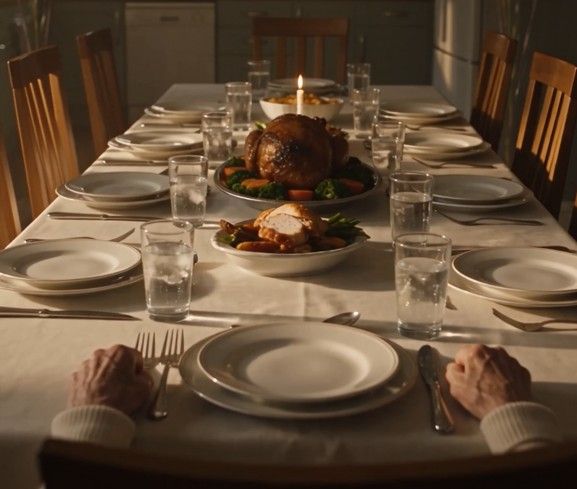
At five o’clock, I stopped pretending anyone was running late. Eleven glasses stood around my dining table, their ice melted. The roast I had reheated twice was drying at the edges, and the lemon cake sat untouched beneath seven unlit candles.
I was seventy years old. My name is Marion, and six weeks earlier I had called each of my three children—Daniel in Seattle, Marcus in Atlanta, Patrice in Phoenix—to tell them April eighteenth, a Saturday, was my birthday. I asked directly: “I want everyone here.” Every one of them promised.
Daniel said, “Absolutely, Mom.” Marcus told me, “Wouldn’t miss it.” Patrice said, “I’m actually really looking forward to this.” I believed them. For thirty-one years I had taught fourth grade. I pressed the embroidered tablecloth my mother gave me when Thomas and I married, set eleven places, bought the boys’ favorite cereal, and put fresh towels in the guest rooms.
Thomas had died fourteen months earlier from pancreatic cancer. Eleven weeks passed between diagnosis and death. The doctors called it fast, as though speed made losing someone gentler. He left tomato seedlings in the garage that he had meant to plant and a library book with his reading glasses folded on top, twenty pages from the end. All three children came for the funeral. They hugged me, cried, and stayed four days. Then they went home.
Daniel once called every Sunday, then every other Sunday, then once a month. Eight months after Thomas died, he told me he and his wife had found a house in a better neighborhood with better schools. “It’s a lot, Mom.” I understood the question he hadn’t asked and transferred him $20,000.
Three months later, Marcus said Sandra’s mother was sick and they needed flights, hotels, rental cars, and time off work. “I hate even bringing this up,” he said. I sent $15,000. Patrice never asked directly. She mentioned a transmission, a roof, private-school tuition, a surprise medical expense, then went quiet. Most times, I filled the silence with, “How much do you need?”
Over the past year, I had given them nearly $50,000 from savings Thomas and I had built over forty-three years of marriage. I was embarrassed—not because helping my children was wrong, but because somewhere inside me I knew the pattern. They called when they needed something.
That morning, I had expected proof that we were still a family, that I was more than a checkbook with a voicemail greeting. By four, I knew no one was coming. I sat at the head of the table and looked at Thomas’s empty chair. If one of my children needed $20,000 tonight, how long would it take them to reach me? I wondered how long it would take any of them to notice they had forgotten their mother’s seventieth birthday.
I opened my laptop and began reviewing every transfer from the past year. My hands started to shake when I found a payment I did not remember making, dated the very morning I had called them with the invitation.
The amount on the screen was $8,400. I leaned closer, then checked the date again. It had gone to an account I recognized as Daniel’s, but the description field was blank. I remembered the twenty thousand for the house and the smaller amounts that followed when he said the closing costs had grown. I did not remember this one.
My hand hovered over the trackpad. There were eleven place settings. The empty chair at the far end seemed to hold Thomas’s absence, while the line on the screen seemed to hold something worse: the possibility that I had forgotten what I had given.
I called Robert, our financial adviser, but it was after his office hours. I left a short message asking him to call me in the morning. Then I opened the account history and printed the page. I did not call Daniel. I did not want to ask a question before I understood it.
The next morning, I spoke to the bank’s fraud department. They confirmed the transfer had been initiated from my online account with my own credentials and sent to Daniel’s account. They could not tell me who had used my password or why the memo was blank. There was no indication that the bank had been breached. The transfer was not reversible through the bank’s ordinary process, but they placed additional security on my account and helped me change the password.
I felt a cold pressure in my chest. Had I sent the money and forgotten? I had been tired the morning of the invitation. I had made coffee, written down flight times, and called each child. Maybe I had moved the money in the same hour and failed to record it.
Robert came to the house after lunch. He brought the statement from the joint account Thomas and I had kept for decades, along with a notebook where I had been tracking family gifts. I had written down the $20,000 to Daniel, the $15,000 to Marcus, and the sums for Patrice. I had also written the date of the birthday calls. On that date, I had made no note of a payment.
“Your records are careful,” Robert said. “But a missing note isn’t proof that you didn’t authorize it.”
“I know.”
He compared the transfer with the account’s login history and asked whether any of my children knew my password. I had once shared it with Daniel because he helped set up online banking after Thomas died. I had changed it afterward, but I couldn’t remember exactly when. Robert helped me request the bank’s access logs and printed a list of authorized devices. The transfer came from a computer registered to Daniel’s home, but the bank could not identify who had been sitting at it.
That was enough to ask him directly, but not enough to accuse him. I called and said I needed to discuss a transfer. Daniel sounded distracted. He asked if it could wait until the weekend.
“It can’t,” I said. “I see $8,400 sent to your account on the morning I called about my birthday. Did you ask me for it?”
Silence. Then: “I thought we had talked about it.”
“When?”
“I don’t remember exactly.”
“Did I tell you to take it?”
He exhaled. “I needed to cover a contractor deposit. The house had repairs we weren’t expecting.”
“That doesn’t answer my question.”
“Mom, I was going to tell you.”
“Did you ask?”
Another pause. “I thought you’d say yes.”
The answer settled into me with a strange clarity. I was not confused about the birthday date. I had not secretly chosen to send him money and then forgotten. He had used the access he still had and decided my usual answer could stand in for permission.
