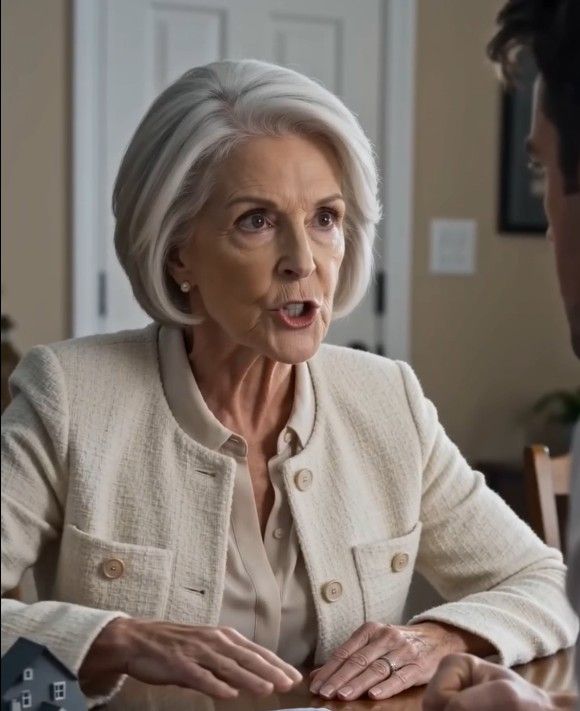
“I’m still alive,” I said.
He looked away. The elevator arrived, and for once I let the doors close without inviting him inside.
That evening Kendra’s mother called. I almost let it ring out, then thought of the furniture in storage. Her name was Helen; we had exchanged recipes and birthday greetings for years without ever having an honest conversation about money.
“We were told you wanted us to have somewhere permanent,” she said. “We thought we were accepting your offer.”
I explained my actual offer: help finding a rental and a contribution toward its deposit. I told her I had never approved the purchase, and that documents had been submitted without my permission. She did not argue. In the background I heard her husband ask her to put the phone on speaker.
His name was Frank. He spoke slowly, leaving spaces between the words. “We should have called you ourselves.”
I said that would have helped, but the promises weren’t theirs to invent. Frank asked whether my original rental offer still stood. I looked at the bank folder, now filled with records I wished I had never needed to keep.
“I need time before I decide,” I said.
They accepted that. After we hung up, I cried for the first time. Ruth sat beside me and handed over tissues without turning my grief into advice. I was grieving the son I thought I had raised and the mother I had become around him, always making room until there was almost no room left for myself.
On the fifth morning, I went back to the bank in person. The woman who helped me remembered my husband because he had once repaired a sticking drawer at her old branch. She asked whether I wanted someone with me while we reviewed the access records. I said I could manage, then admitted that managing was taking more effort than I expected.
She slid a glass of water across the desk. Together we checked addresses and beneficiaries without confusing either with permission to spend my money. Some choices could stay as they were; others needed formal changes. Every signature I made was mine, placed deliberately where I understood its purpose.
Walking home, I realized how much of the shock came from that small theft of authorship. Matthew had not emptied my savings. He had tried to empty the meaning of my answer. Restoring account safeguards mattered, but so did deciding what I would cook, whom I would see, and when I would pick up my own telephone.
For two weeks, I did very little beyond appointments, walks, and ordinary meals. Ellen reviewed my estate documents and removed Matthew from a contingent role I no longer trusted him to hold. We chose an independent professional where one was needed, and she made sure I understood the responsibilities and costs.
I did not give everything away in anger. My retirement budget still came first, including the care I might eventually require. The grandchildren’s planned gifts stayed modest and deliberate. The apprenticeship idea waited until I could look at it without imagining Matthew watching over my shoulder.
When I finally visited the training center, the director showed me a workbench scarred with drills and saws. A student named Luis was fitting a cabinet door that would not hang straight. He checked the hinges, frowned, and began again rather than forcing it shut.
My husband would have liked that. He used to say a crooked frame could make every door seem wrong.
I asked practical questions about completion rates, supervision, financial controls, and what a limited grant could actually buy. We agreed on nothing that day. Wanting to do good did not require surrendering judgment, a lesson I was learning rather late.
Meanwhile, the house sale moved on without us. The seller’s broker confirmed that my identity dispute had been recorded and that no purchase would proceed in my name. Matthew and Kendra had to address their own exposure through counsel. The architect sent a brief apology for his part in the uncomfortable visit and explained that he had believed I was a willing buyer.
I told him I understood. His plans were not the problem. The story attached to them was.
The police investigation took months. I supplied what was requested and refused Matthew’s repeated attempts to make me the messenger between him and the investigator. Eventually he and Kendra accepted responsibility through a supervised diversion agreement available in their circumstances, with conditions, costs, and a requirement to stay out of further trouble. It was a process, not a family pardon, and I did not control its terms.
By then, Helen and Frank had found a small rental near a bus route. I chose to contribute a fixed amount toward the deposit, paying the property manager directly after reviewing the lease. The gift came with no loan papers, no expectations of future access to my accounts, and no promise that I would rescue the next crisis.
Before the lease began, Helen invited me to see the place. I nearly refused, afraid that every conversation would end with another need. Instead, she showed me the kitchen window and the cupboard where Frank planned to keep his work clothes. There was no guest suite assigned to me, no suggestion that my help entitled anyone to decide my future.
Frank carried in a chair from storage. One leg rocked. He knelt to examine it, and Helen laughed softly, saying he could not sit anywhere until he had made it level. For the first time I saw them outside Matthew’s grand plan: two tired people trying to make a smaller life decent.
“We thought losing the house meant we’d failed at everything,” Helen said while Frank went for a tool. “Then the children kept talking about what we deserved, and we stopped asking what we could afford.”
I understood that shame. My husband and I had known lean winters when the shop heater stayed low and we mended our coats instead of buying new ones. But nobody could purchase dignity for another person with someone else’s retirement. We sat at their borrowed table and talked about the park, the bus, and where to buy good vegetables.
When I left, Frank thanked me once. He didn’t follow me to the car with a second request. The absence felt so unfamiliar that I noticed it all the way home.
Helen wrote to thank me. At the bottom she added, “We are learning the difference between help and a plan someone made for us.” I kept that note.
Matthew was furious when he learned of the rental. He said I had helped them after ruining his attempt to do the same thing. I did not answer for a day. Then I wrote that helping people required their knowledge and the giver’s consent. He could call when he understood both parts.
For several weeks, he didn’t call. I discovered that quiet could hurt and still be necessary. On Sundays I walked past the park’s duck pond, bought bread I actually liked, and stopped keeping entire afternoons empty in case he needed something.
The grandchildren visited with clear arrangements between their parents and me. I didn’t question them about home or tell them the adult details. We baked uneven biscuits and repaired the loose wheel on a toy truck. Their affection was not an apology I could extract from my son, and I was careful never to treat it as one.
