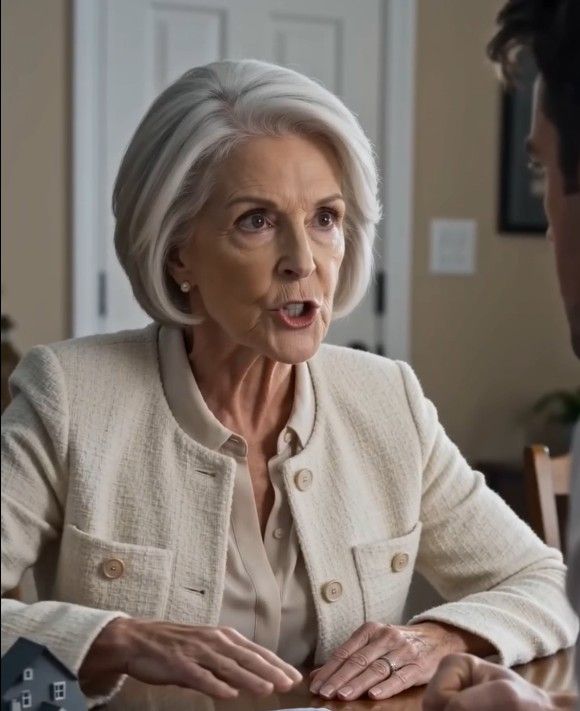
“Please preserve everything you received,” I said. “Including the original messages.”
She agreed to send the full correspondence available to her, then asked if I had a safe place to stay. I looked at my husband’s reading glasses, still tucked into the little dish on my dresser. The question made the room feel suddenly unfamiliar.
“This is my home,” I said. “They’ll be leaving.”
When I returned, Kendra was standing. Matthew had opened the bank folder again, as if the answer might have appeared inside it while I was gone. I asked them to put any keys to my apartment on the table.
“You’re making this sound criminal,” Kendra said.
“Someone used my name on financial documents. I am describing what happened.”
Matthew told her to stop talking. It was the first useful thing he had said that afternoon, but he said it too late. Her eyes filled, and she turned toward him with an expression I could not mistake for surprise.
I repeated the request for the keys. Matthew laid his beside the retirement cards. Kendra said hers was at home; I told her she could send it, but the lock would be changed regardless. Then I held the door open again.
“Mom, please. Let’s fix this inside the family.”
“Start by leaving when I ask.”
He went. I locked the door and sat down without clearing the table. The cardboard house remained beside the salt shaker, its little windows shining under the kitchen light. I turned it around so I would not have to see the room they had assigned me.
My neighbor Ruth answered on the second ring. We had shared walks and tomatoes, nothing as serious as this, but she came over carrying a thermos of soup and stayed while I called the bank where my real savings were held. I reported that someone close to me had accessed personal information and asked what precautions were appropriate.
The bank helped me change credentials, remove an old shared mailing address, and add stronger verification. No unauthorized withdrawal appeared. That good news loosened something behind my ribs, although it did not make the forged statement less frightening.
The next morning I met my attorney, Ellen, with printed emails and the cards in a sandwich bag because I couldn’t bear putting them back into my wallet yet. She listened without telling me that families were complicated. I had heard enough of that phrase whenever complicated meant tolerating something painful.
She explained that the offer and my identity needed to be addressed separately. A disputed document did not automatically become a binding agreement, but ignoring it would be foolish. With my permission, she notified the brokerage in writing that I denied signing or authorizing anything and requested preservation of the records.
She also helped me make an accurate report to the police and document the incident. There were no handcuffs that afternoon, no instant verdict. There was a reference number, a tired investigator who asked careful questions, and the relief of having said the truth somewhere it could not be shouted down.
Three days later, Matthew requested a meeting at Ellen’s office. I agreed on the condition that Kendra attend too. Until then he had sent seventeen messages, most beginning with apologies and ending with explanations of what I needed to do to keep things from getting worse.
At the meeting he looked smaller than he had in my kitchen. Kendra held a tissue twisted so tightly it resembled string. Ellen placed the questionable statement between us and asked how it had been produced.
Kendra said she had edited a sample document from an old financing inquiry. The account was not mine. She had inserted my name and an invented balance because the agent wanted evidence that the offer was credible.
“We weren’t going to take anything out of that bank,” she said. “It wasn’t even a real account for her.”
Ellen let the silence stand. Finally I asked why my signature appeared on the offer. Matthew stared at the carpet before admitting he had approved the electronic signing process using details he knew about me. He had expected to persuade me before anyone needed real funds.
There it was: no mysterious fortune, no secret account. Just my son’s certainty that my refusal was temporary, and his wife’s willingness to turn that certainty into a document.
“You planned to make it harder for me to say no,” I said.
He opened his mouth, closed it, and nodded.
I had imagined that discovering the truth might steady me. Instead, my hands began to shake under the table. I pressed them against my knees and remembered him at eight, bringing me a broken toy and trusting that if he put it in front of me, I would repair it.
“You have to correct what you told her parents,” I said. “They deserve to know whose decision this was.”
Kendra whispered that her father had already paid to move the furniture. She wanted me to hear the loss in that sentence. I heard it, but I heard the missing apology too.
“Then tell him before he spends anything else.”
Ellen ended the meeting with specific next steps: their lawyer could communicate with hers, the brokerage would receive their corrections through proper channels, and I would not sign a replacement offer or provide funds. Any investigation would proceed on evidence, not on bargains made at this table.
Outside, Matthew followed me to the elevator. He asked whether I meant to leave him nothing when I died. That question, after everything we had discussed, hurt more than his shouting.
