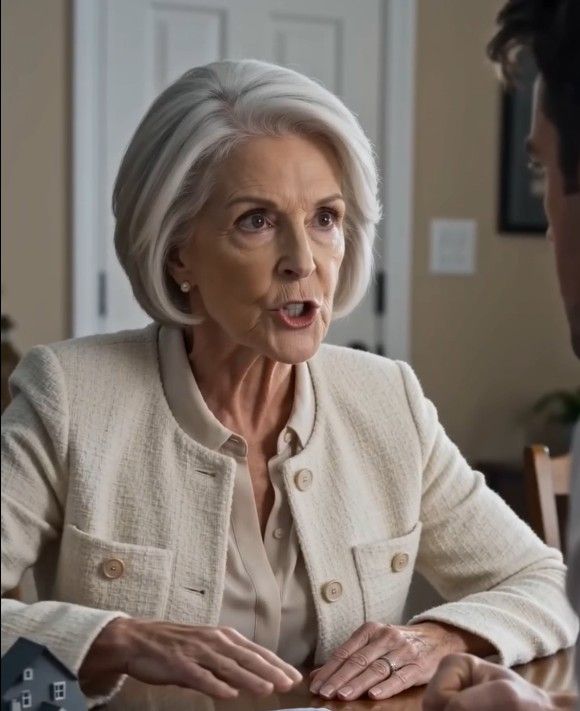
One afternoon the older child asked why the little cardboard house sat on my cupboard. I had brought it home from Ellen’s office after the paperwork was settled, unsure why I hadn’t thrown it away.
“It reminds me to ask questions before I agree to things,” I said.
She considered that, then asked whether we could paint its front door green. I said yes. We covered the table with newspaper, and for half an hour the house belonged to nobody’s scheme. It was cardboard, paint, and a child concentrating so hard her tongue touched her lip.
Matthew’s first different apology arrived in a letter. It contained no request for money, no description of Kendra’s distress, and no list of good intentions. He wrote that he had treated my years of work as an inheritance already available to him, and that when I said no, he had tried to arrange the world so my answer would become impossible.
I read that sentence three times. Then I put the letter away for a week before replying.
We met in the park. He said he and Kendra were working with a counselor and repaying expenses they had caused. I asked no questions about their sessions. I told him what contact could look like: planned visits, no access to financial records, no pressure about my estate, and an end to shouting the moment it began.
“Do you think you’ll trust me again?” he asked.
“I can watch what you do,” I said. “That’s what I have to start with.”
He nodded without asking me to make the answer kinder. We walked once around the pond. It wasn’t forgiveness completed in a circle, but it was the first time in months I had been beside him without bracing for a demand.
Kendra apologized separately. She named the cards, the statement, and the offer. When she began to explain how frightened she had been for her parents, she stopped herself and said fear did not make my name hers to use. I thanked her for saying it. Warmth did not return on command, but the conversation ended without anyone telling me what a good mother should do.
In early autumn, I approved a small first grant for the apprenticeship program, with a review before any renewal. Part paid for tools students could borrow when they couldn’t afford their own. I chose useful things: measuring tapes, safety glasses, solid hand tools, equipment that would last.
The director asked whether the cabinet holding them could carry my husband’s name. I said yes and brought a photograph from the old shop. In it he stood behind the counter, grinning at something outside the frame. I had forgotten how young he looked before illness narrowed our days.
On the morning the cabinet was installed, Frank came to help attach its doors. He had asked the director directly whether a retired carpenter might volunteer, and the director had checked his experience before agreeing. Neither man had told me he would be there.
He looked embarrassed when I entered. “I hope you don’t mind,” he said. “I wanted to be useful somewhere.”
I watched him test a hinge with the same patient motion my husband had used. Then he handed me a small wooden box, worn smooth around its clasp. Inside lay a brass ruler with our hardware shop’s name stamped along the edge.
Years earlier, before I knew him as Kendra’s father, Frank had been a young tradesman short of money for a set of tools. My husband had let him pay a little each payday. Frank had kept the ruler after the tools wore out, remembering the man who trusted him without making him feel small.
“I didn’t recognize the shop name until Helen showed me your photograph,” he said. “Your husband helped me start. I thought these children might need the same chance.”
I ran my thumb over the faint lettering. For so long I had thought the empty bank folder proved that something precious had vanished between generations. Here was another account of our lives, kept in worn brass and work done carefully.
I set the ruler inside the lending cabinet, where it could be used. That evening I went home to my small apartment, opened the window toward the park, and ate supper at a table that belonged entirely to me.
