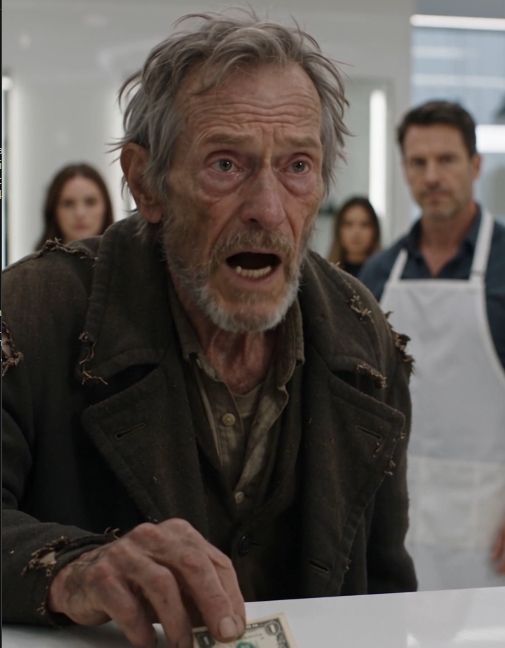
“When Lucia and I opened this place,” he said, “we didn’t just want to cut hair. We wanted to make people feel like they mattered. Every person who sat in that chair left looking better and feeling seen. That was the promise. Not luxury. Not status. Just — dignity. A moment where someone takes care of you.”
He looked at Marco.
“That’s what I want it to be again. Not what they turned it into. Not a place where money walks and human beings are pushed away. A place where anyone can walk through that door and be treated like they belong.”
Marco nodded slowly.
“There’s a shelter on Fifth Street,” he said. “Where I used to stay. A lot of the guys there — they haven’t had a proper haircut in months. Some of them have job interviews. Some of them just need to feel human again.”
Enzo’s eyes softened.
“Then we start there,” he said.
The next morning, Marco brought six men from the shelter to the salon. They came in hesitantly, eyes darting, shoulders hunched, the way people do when they’ve been turned away so many times that expecting kindness feels dangerous.
Enzo greeted each one by name. Marco had written the names on slips of paper and handed them over beforehand, and Enzo had memorized every one, because he understood — better than anyone alive — the power of being called by your name instead of being looked through.
He cut their hair one by one. He talked to them while he worked — not about their circumstances, but about their lives. What music they liked. Where they’d grown up. What they dreamed about when things were quiet. He listened the way he’d listened to every client for forty years, with his whole attention, with genuine curiosity, with the unspoken message: *You are worth my time. You are worth this chair. You are worth this mirror reflecting you back to yourself as someone whole.*
One of the men, a quiet guy named David, looked at himself in the mirror after Enzo finished and touched his own face like he was meeting a stranger.
“I forgot what I looked like,” he said.
Enzo put a hand on his shoulder.
“You’re still in there,” he said. “You were always still in there.”
David nodded. His jaw tightened. He didn’t cry, but his eyes were bright, and when he shook Enzo’s hand, he held on for a long time.
This became the salon’s new tradition. Every Saturday morning, before the regular clients arrived, Enzo and Marco opened the doors to anyone from the shelter, the transitional housing program down the block, or anyone else who needed a haircut and couldn’t afford one. They called it the Lucia Chair, named after Enzo’s wife. A small gold plaque was mounted beside the styling station nearest the window — the same station where Enzo had given his very first haircut in 1963.
The plaque read: *In memory of Lucia Bellini, who believed every person deserves to be seen. This chair is for anyone who needs one.*
Word spread. Other salons in the neighborhood began offering similar mornings. A local business donated shampoo and supplies. Catherine Huang, the lawyer, referred clients who needed professional appearances for court hearings. Priya started a small fundraiser that raised enough to repair the salon’s aging plumbing and replace two of the broken chairs.
And through it all, Enzo was there. Every day, arriving at seven in the morning, unlocking the door with hands that still trembled but no longer shook from fear — only from age, only from the honest work of living a long life. He would turn on the lights, look at the mirrors, touch the counter the way you touch the face of someone you love, and begin.
He never became wealthy again. He didn’t want to. The settlement from Ridgeline had been enough to cover his debts and secure the salon’s future, and he had put the rest into a small trust fund for the shelter’s residents, managed by Catherine, disbursed for job training, housing deposits, and medical needs.
What Enzo wanted — what he had always wanted, underneath everything that had been taken from him — was the work itself. The snip of scissors. The hum of conversation. The quiet intimacy of one human being caring for another in the most basic, physical way.
Marco became his partner in every sense. They were not family by blood, but they had built something that blood alone could never guarantee — a bond forged in mutual recognition, in the shared understanding of what it meant to be invisible and to be made visible again.
On quiet evenings, after the last client had left, they would sit in the salon together, not always talking, sometimes just breathing in the same space, letting the silence be what it was — not empty, but full. Full of everything they had survived. Full of everything they had built. Full of the presence of someone who would not leave.
One evening in late autumn, Enzo arrived at the salon and found Marco arranging fresh flowers in a jar on the counter — sunflowers, bright and stubborn, the kind that turned their faces toward the light no matter what.
“Where did those come from?” Enzo asked.
“Rosa,” Marco said. “She dropped them off this morning. Said you’d know what to do with them.”
Enzo held one of the sunflowers up to the light. The petals were thick and golden, and for a moment, the whole room seemed to glow.
“Lucia loved these,” he said quietly. “She planted them outside the salon, the first year we were open. Said they brought good luck.”
He placed the sunflower gently back in the jar and looked at the salon — his salon, the place that had been stolen from him and returned, the place that had been everything and nothing and everything again.
Then he looked at Marco.
And in that look, there was everything — grief and gratitude, loss and recovery, the unbearable weight of years and the impossibly light feeling of being home at last.
“Thank you,” Enzo said. “For seeing me.”
Marco shook his head. “Thank you for letting me.”
Enzo smiled — the same small, cracked, beautiful smile from the day he’d gotten the news — and turned the Open sign on the door. The bell above the frame chimed softly as the first client of the morning stepped inside, and the day began, the way all good days begin, with the simple, radical act of opening a door and letting the light in.
