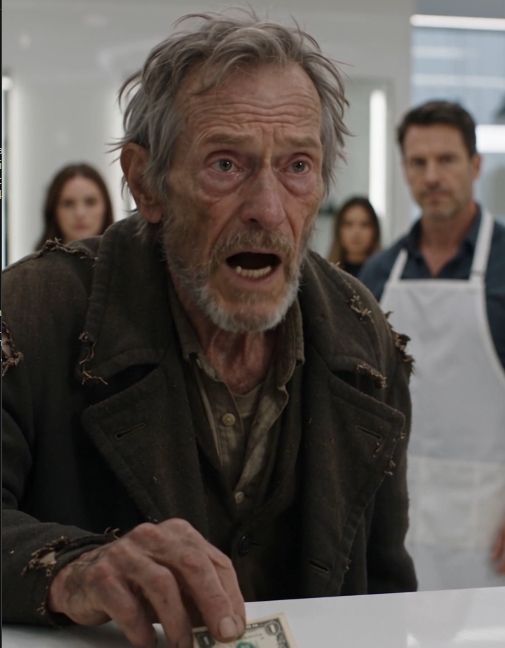
“You look like a man who survived,” Marco said, and began to prepare the scissors.
While Marco worked — slowly, carefully, with the reverence of someone who understood he was doing more than cutting hair — Priya made a phone call. She reached the number listed on the salon’s business license, which connected to a Ridgeway Holdings office. A bored administrative assistant answered.
Priya explained the situation. The assistant put her on hold for eleven minutes. When she returned, her voice had changed.
“We’ll need to send a representative,” she said.
“Send whoever you want,” Priya replied. “But you should know — the original owner is here, he has documentation, and there are witnesses.”
The silence on the other end of the line lasted long enough to say everything.
Within two hours, the salon had transformed. A lawyer arrived — not from Ridgeway, but from a legal aid nonprofit Priya had contacted. She was a small woman in her fifties named Catherine Huang, and she listened to Enzo’s story with the focused calm of someone who had heard many stories of injustice but still had the capacity to be moved by them.
She reviewed the envelope, the newspaper clipping, and the small folder of documents Enzo had kept in a storage unit for over a decade. Original incorporation papers. A deed with his signature. Photographs of the salon’s opening day, with Lucia beside him, both of them young and radiant and full of hope.
“This is substantial,” Catherine said. “More than substantial. If half of what these documents show is accurate, the transfer of ownership was fraudulent. We can file an emergency motion to freeze the salon’s assets and begin a formal investigation.”
Enzo sat in the styling chair throughout this conversation, Marco having finished the haircut. In the mirror, he barely recognized himself — not because the transformation was dramatic, but because for the first time in years, he saw a man instead of a shadow. Marco had trimmed the beard, shaped it with care, and the lines on Enzo’s face, once hidden beneath unkempt hair, now told a story of endurance rather than defeat.
“You don’t have to fight this alone anymore,” Marco said, standing behind him.
Enzo looked at Marco’s reflection. Their eyes met in the mirror.
“Why?” Enzo asked. “Why would you help me? You don’t know me.”
Marco set the scissors down.
“Because when I was seventeen, I aged out of foster care with nothing. No family. No money. No one waiting for me. I slept in a shelter for three months. And one day, a woman named Mrs. Rowan came into the shelter and asked if anyone wanted to learn to cut hair. She ran a mobile salon for homeless people. She gave me my first pair of scissors. She told me I had a gift. She changed my life with that single act of seeing me when no one else would.”
He paused.
“You walked in here today, and no one saw you. I know what that feels like. I won’t do that to another person. Not ever.”
Enzo’s hand trembled as he reached out and gripped Marco’s wrist. He didn’t say thank you. He didn’t need to. The pressure of his fingers said everything.
Over the following weeks, Catherine Huang filed the case. The legal proceedings moved with surprising speed once a local journalist named Derek Osei picked up the story. His article, *The Ghost of Bellini’s*, ran in the Sunday edition of the city paper and was shared over forty thousand times online.
The public reaction was immediate and fierce. Bellini’s Salon had been a beloved neighborhood institution for decades, and the revelation that its founder had been robbed, erased, and left to live in poverty while his legacy was profited from by faceless corporations struck a nerve. Customers called in to express outrage. Former clients shared memories of Enzo cutting their hair in the early years. A woman named Rosa, now eighty-one, called the paper and said she had been Enzo’s very first customer in 1963 and had never forgotten his kindness.
Ridgeway Holdings sent a representative — a polished man in a gray suit named Kenneth Pryce — to the salon for a meeting. He sat across from Enzo and Catherine in the reception area, his briefcase on his lap, his smile carefully calibrated.
“Mr. Bellini,” he began, “Ridgeway Holdings acquired this property through a legitimate transaction in 2017. We’ve invested significantly in—”
“Through a forged transaction,” Catherine interrupted. “Facilitated by a financial advisor who has since been convicted of fraud in two other cases. We have documentation linking the shell company that sold you the lease directly to that advisor’s network.”
Kenneth’s smile flickered.
“I’m not here to negotiate,” Enzo said quietly. “I’m here to tell you that I want my salon back. Not for money. Not for revenge. Because my wife’s name is woven into these walls, and I will not let strangers profit from her memory.”
Kenneth Pryce left the salon that day without his smile. Two weeks later, Ridgeway Holdings’ legal team, faced with the mounting evidence and the tidal wave of public pressure, agreed to a settlement. The terms were simple: full ownership of Bellini’s Salon would be restored to Enzo Bellini, effective immediately.
When Catherine called to tell him the news, Enzo was sitting in the salon — his salon again — in the styling chair by the window. Marco was sweeping the floor. Priya, Jules, and Bea were rearranging the product shelves, having collectively decided that they would stay and work for the new owner. Dana had resigned the day after the newspaper article ran, leaving a one-line note that said she needed to think about who she wanted to be.
Enzo held the phone to his ear and listened to Catherine’s words. When she finished, he was silent for a long time.
“Mr. Bellini?” Catherine said. “Did you hear me?”
“I heard you,” he whispered. “I heard you.”
He set the phone down. He looked around the salon — the clean mirrors, the white chairs, the soft light coming through the window. Lucia’s face flashed in his mind, the way it always did in moments of joy, as though she were standing just behind him, her hand on his shoulder, whispering, *See? I told you. The truth doesn’t expire.*
Marco stopped sweeping. He’d seen Enzo’s face change.
“What happened?” Marco asked.
Enzo looked at him. And for the first time since he’d walked through the door with a crumpled dollar bill, he smiled. It was small, cracked, imperfect — the smile of a man who had forgotten how and was relearning, muscle by muscle, breath by breath.
“It’s mine again,” he said.
Marco set the broom down and wrapped his arms around the old man. Enzo stiffened for a moment — he hadn’t been embraced in so long that his body had forgotten what it meant — and then something released inside him, and he held on, his face pressed against Marco’s shoulder, his breath coming in short, shuddering waves that were half laughter and half tears.
Priya saw it from across the room and turned away, pressing her hand to her mouth. Jules put her arm around Bea’s shoulders. No one spoke. The moment didn’t need words.
The following Saturday, they held a reopening. Not a grand gala with champagne and speeches, but something simpler and more honest. Enzo asked for chairs to be set up on the sidewalk outside, and for the doors to be wide open, and for anyone who wanted to come to come.
They came. Dozens of them. Old clients who remembered Enzo from the early days. New clients who had read the article. Families with children. A group of elderly men from the barbershop down the street who walked over to shake Enzo’s hand and tell him they were glad he was back.
Rosa came. She was eighty-one and walked with a cane, and when she saw Enzo standing in the doorway of his salon, she started crying before she reached him.
“You old fool,” she said, gripping his hands. “I looked for you. After they said you died, I looked for you. I knew it wasn’t true. I knew it.”
“I’m sorry,” Enzo said. “I’m sorry I disappeared.”
“Don’t you ever do that again,” she said, and the fierceness in her voice made him laugh — a real laugh, the kind that comes from a place so deep it surprises the person making it.
Marco watched from inside the salon, leaning against the doorframe, arms crossed, grinning. He had spent his whole life believing that home was something you had to build from scratch, something you earned through relentless effort and solitude. But watching Enzo shake hands on the sidewalk, watching old Rosa pinch his cheek, watching Priya hand out coffee to the line of people waiting to come inside, Marco understood something he hadn’t before.
Home was not a place. Home was being known. Home was the moment someone looked at you and said, *I see you. You belong here. Stay.*
That evening, after the last guest had gone and the chairs were folded and the floor was swept clean, Enzo and Marco sat together in the quiet salon. The streetlights outside cast warm amber rectangles across the hardwood floor. The mirrors reflected their two figures — one old, one young — sitting side by side in the gentle dark.
“Can I ask you something?” Marco said.
Enzo nodded.
“What are you going to do now? With the salon, I mean. What do you want it to be?”
Enzo was quiet for a long moment. He looked at the mirrors, at the chairs, at the name above the door that he could see in reverse through the glass.
