He had no ready answer.
I told him he could seek help for his own reasons, but my decision would not depend on watching him improve. I would not become the supervisor of his honesty.
He cried. I had known him long enough to recognize real tears. They hurt to witness, and they changed none of the facts.
I left with my friend.
In the following weeks, the solicitor sent the documents I had requested. Julian’s wife had acknowledged the relationship in writing. My husband’s letter and later message showed the attempt to make her husband remain quiet. There was no hidden partnership, no secret plot against me, and no glamorous stranger waiting to offer a new life.
The truth was smaller and uglier: my husband had wanted control of the story.
With legal advice, I sent him a statement through our attorneys. I had never approved the affairs. I had never authorized the use of my name. He was to correct the false claim in writing to the people who had received it.
He resisted for a week, saying a correction would make him look worse. His attorney eventually helped him see that repeating a false statement was not a sound way to protect himself. He signed the correction.
It did not undo the betrayal. It removed a lie that had tried to make me its witness.
Julian sent one brief note through his solicitor confirming receipt. He thanked me and said he would have no further personal contact unless records required it. I was glad. We had met at the intersection of two damaged marriages; that did not create an obligation to become each other’s cure.
I wished his wife clarity, although we never met. For a few days I had wanted to imagine her as the whole cause of my pain. The documents made that impossible. She had made choices. So had my husband. Only one of them had made vows to me.
The divorce took months. There were inventories, valuations, meetings that left my jaw aching, and forms written in language that made intimate loss sound like office maintenance.
I did not receive everything I wanted. Neither did he. We reached a settlement after careful review of our assets, and I found an apartment with good light and a door that closed firmly.
A counselor helped me name the shame I had mistaken for loyalty. I was ashamed that I had stayed after discovering the affairs. I was ashamed that I had worn a dress to injure him. I was ashamed that strangers had seen our lives crack open.
She asked whose opinion I heard when I called myself foolish.
I knew the answer before I said it.
One afternoon, I received an invitation to another formal dinner at the old house. It had been sent by an assistant who had not yet updated the mailing list. My name appeared beneath his as though nothing had changed.
I telephoned the office and asked for a correction. The assistant sounded embarrassed and began explaining how busy she had been. I told her she had made an ordinary mistake. I wanted the list changed, and that was all.
Afterward, I sat beside my window with the invitation on my lap. I had expected anger. Instead, I felt grief for the ease of being recognized as part of a pair. There would be rooms where people no longer knew what to call me, and I would have to learn not to answer their uncertainty with an apology.
At my next counseling appointment, I described that small exchange. We practiced saying my own name without attaching an explanation. It seemed ridiculous until I heard how often I added that I had been married to someone important.
I began introducing myself through the things I did. I helped at the arts center. I loved old films. I made excellent soup and poor coffee. Those facts were modest, but none depended on a man’s permission to remain true.
The invitation went into the recycling. I kept the blank envelope because it was good paper, and later I used it to write a shopping list. It was a small, satisfying change in purpose.
There were ordinary failures along the way. I bought too much food for one person. I missed a payment because I assumed he still handled that account. I cried in a shop when a familiar song began playing.
Each failure looked, at first, like evidence that I could not manage alone. Then I corrected the payment, froze half the soup, and walked out of the shop. Competence grew through those small repairs.
My friends learned that I did not need every dinner to become a review of the divorce. Sometimes we spoke about books or a broken lift or the terrible coffee near my building. Those evenings gave me parts of myself that had never belonged to the marriage.
One friend asked whether I would ever wear the crimson dress again.
“I don’t know,” I said.
“Then keep it until you do.”
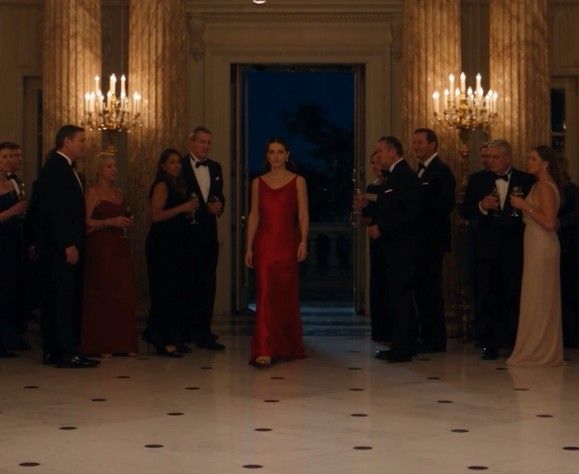
I hung it at the end of the wardrobe. For months, it held the memory of his face beside the marble column. I could look at it without feeling powerful or defeated. It was becoming an object again.
There was one final meeting before the papers were signed. My husband came without flowers. He looked older, although perhaps I had simply stopped protecting him with my gaze.
“I am sorry I made you responsible for keeping everyone comfortable,” he said.
It was the first apology that named something I recognized.
“Thank you,” I answered.
He asked whether that changed anything.
“It changes what I will remember about this conversation.”
He nodded. We signed where our attorneys indicated. Neither of us made a speech. In the corridor afterward, he offered his hand, uncertainly, and I shook it.
I did not forgive every act that day. I did stop waiting for him to provide the sentence that would let my life resume. It had already resumed, unevenly, while he was searching for words.
That winter, the community arts center advertised ballroom lessons. I walked past the notice twice before taking its photograph. Then I registered under my own name and paid with my own card.
The first evening, I wore flat shoes and an old blue dress. Our teacher explained how a partner’s frame supported movement without controlling it. When my shoulders tightened, she asked me to stop and breathe.
“Following is a choice,” she said. “You can always stop.”
