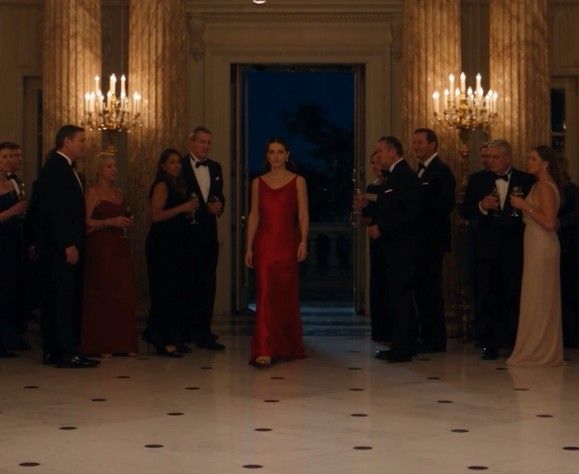
It was an oddly precise answer. I realized I had expected him to turn into a rescuer, because rescue would excuse how carelessly I had entered this room. Instead, he gave me a choice.
I asked for the small library beyond the reception hall. I knew its two doors, its telephone, and the housekeeper who worked within earshot. We walked there separately. I carried my own evening bag.
Inside, I switched on the reading lamp and remained standing. My husband reached for the decanter on the desk. I asked him to leave it alone.
Julian removed a folded letter from his jacket.
“I am married to one of the women,” he said.
The floor did not vanish beneath me. There was no dramatic gasp. What I felt was a dull recognition, as if someone had finally named the weight I had been carrying.
My husband stared at the paper.
“Your wife told you a story. That doesn’t make it true.”
“She told me because she wanted our marriage to survive,” Julian said. “That is between her and me. This is about what you said afterward.”
He placed the letter on the desk. It was addressed to him, dated two weeks earlier, and written on my husband’s business stationery. I read it where it lay.
It accused Julian of trying to extort money. It threatened to tell the charity trustees that he had fabricated an affair. Then it stated that I knew about the relationship and had agreed that it was harmless.
I read that sentence twice.
“You used my name.”
My husband moved closer. “I was trying to prevent a scandal.”
“You used my name to say I approved.”
He glanced at Julian, as though I were allowing a stranger to misunderstand something simple. There had been nights when that glance would have silenced me. I knew its grammar now.
“I thought you wanted discretion.”
“I wanted you to stop lying.”
Outside, someone laughed. Glass chimed against glass. The party continued with perfect confidence that its walls contained nothing worth interrupting dinner for.
Julian explained that he had replied through a solicitor. My husband had then invited him tonight, saying they could speak quietly and settle the matter. He had arrived expecting a conversation about the threatening letter.
“I saw you dancing,” he said. “I recognized you from photographs. I thought he might be using the party to suggest everything was fine between you.”
“So you stepped into my dance.”
“I made a poor decision. I was angry. I tried to tell you without making a scene.”
“You made me part of a scene without asking.”
“Yes.”
The simple admission startled me. My husband had not managed anything that plain in three months. Julian looked ashamed, but I did not reward him for saying the minimum. He had his own work to do.
My husband began to explain that the other women had meant nothing. I watched his mouth shape a familiar sentence and understood, with unusual clarity, that nothing was not an apology. Nothing was the name he gave other people’s pain when it inconvenienced him.
“Do you still have the messages?” I asked Julian.
“Yes. My solicitor has copies.”
“I don’t want to read intimate details. I want the claims about me and any threats made in my name.”
He nodded and gave me the solicitor’s contact information. I copied it onto the back of a place card from my bag, then photographed the letter with his permission.
My husband reached toward my phone.
I moved it behind my back.
“Don’t.”
His hand dropped. For a moment, all the habits of our marriage were visible between us: his assumption, my old reflex to soften the refusal, the silence in which he waited for me to do that work.
I let the silence stand.
Julian asked whether I wanted him to leave. I said yes. He thanked me for hearing him, apologized once more for the dance, and walked out through the reception hall. I watched the door close without feeling abandoned.
My husband sat down.
“You came here to humiliate me,” he said.
The accusation was useful because it was partly true. I had come wanting an audience for his jealousy. I could admit that without surrendering everything else.
