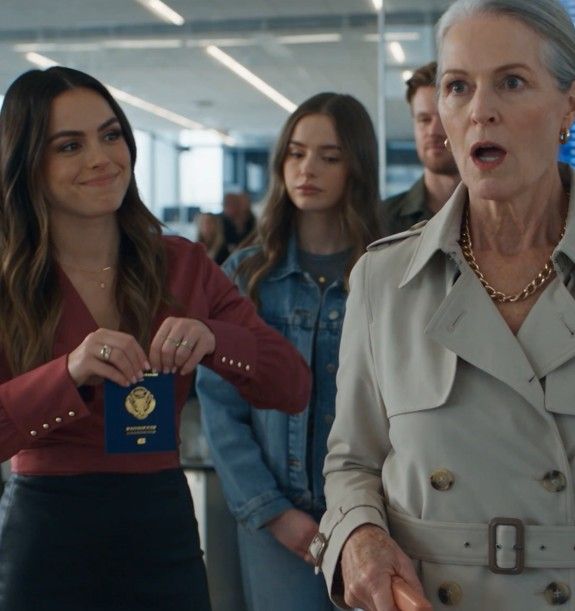
I also reviewed the financial help I was providing. Private-school tuition already committed for the term would be honored so the children didn’t suffer an abrupt change. Future terms would require their parents to plan. I ended automatic transfers for household expenses and declined another business loan Derek proposed as if the airport had never happened.
I wrote the boundaries plainly. No access to my accounts. No use of my name for reservations without consent. No expectation that emergencies created by avoidable choices would become mine to fund. Each sentence felt harsh until I imagined asking another person to obey its opposite.
Emily came to see me on Sunday. She brought no children and no requests. I was grateful for both. We sat at the table where the passport lay inside a clear sleeve.
“I was ashamed,” she said. “I knew it was wrong. I kept waiting for someone else to say so.”
“There were only a few of us there.”
“I know.”
I asked why she had learned to believe Vanessa’s displeasure was more dangerous than mine. Emily said my forgiveness seemed certain. Vanessa’s affection always felt conditional. She had chosen the person easiest to lose because she assumed I would never let myself be lost.
It was a painful answer, but it was honest enough to begin with. I told her my love wasn’t disappearing. My willingness to be treated that way was. Rebuilding trust would take behavior, not a tearful afternoon followed by another bill.
She agreed to family counseling with me. In the sessions, we talked about Richard’s death and the roles we had taken afterward. I had made myself useful whenever grief threatened to make me feel unnecessary. Emily had learned that asking was easier than noticing whether I needed anything.
Neither truth excused the airport. They explained why the pattern had lasted. Recognizing my own part helped me change it without accepting responsibility for Vanessa’s decision to destroy a document.
Vanessa’s first apology arrived by text and contained the word but three times. I didn’t answer until she sent another, shorter one acknowledging what she had done. I told her I appreciated the acknowledgment and still needed distance. Derek never apologized directly. That meant I would plan my relationship with him according to his actions rather than hope.
The passport report reached a conclusion after the authorities reviewed the available information. I received the formal notice and kept it with the records. I didn’t exaggerate its result when relatives asked. The damage, the statements, and the acknowledgment remained documented. My safety and future choices did not depend on a dramatic penalty.
For several months, I saw the grandchildren in modest ways. Library visits. Lunch at a diner. A Saturday at a nearby lake where we packed our own sandwiches. Their parents knew the arrangements, and I kept adult conflict out of the conversations.
They learned that affection could include ordinary outings without first-class seats. I learned it too. My younger grandchild was just as proud to spot a turtle as to discuss snorkeling. We stood together on a wooden dock, watching it slide from a log into green water.
In the autumn, Emily invited me to dinner she had cooked herself. She told Vanessa in advance that I would be treated respectfully or the invitation would end. Vanessa chose not to come. Dinner was quiet, with a slightly overcooked roast and laughter when the gravy wouldn’t pour.
Emily cleared my plate without asking me to pay for anything. It was such a small action that I almost missed what it meant. She had begun seeing me as a person at the table rather than the reason the table existed.
One afternoon, Derek came to the house to return a folder he had borrowed when applying for financing. I met him on the porch. He held the folder against his chest and looked past me toward the living room, as though familiar furniture might make our conversation familiar too.
“The business is having a rough stretch,” he said.
“I’m sorry to hear that.”
He waited. I waited with him. Eventually he asked whether I could cover a short-term payment. He called it a bridge, a word he had used often enough that I wondered where all the bridges were supposed to lead.
“No,” I said. “You need advice from someone who can review the business independently.”
“You used to believe in me.”
“I can hope you succeed without becoming your lender.”
He put the folder on the porch table. Inside were copies of documents I had already asked him to return. I checked them while he stood there. He seemed offended by that, but I didn’t leave the verification for later to protect his pride.
Before he left, he said Vanessa was upset that I didn’t trust her. I told him trust was built through conduct, not restored by declaring the injured person inconvenient. He looked at his watch. It was still the one I had helped purchase. I felt no urge to demand it back. Gifts already given were gifts. Future assistance was a choice.
That distinction became useful whenever guilt arrived. I didn’t have to rewrite seven years as a mistake. Some of the help had genuinely mattered. I could be glad the children had stayed in school, glad Emily’s wedding had been beautiful, and still decide that the pattern could not continue.
I began meeting a retired colleague for coffee each Wednesday. We talked about books and the absurdities of our old office. When she heard about Hawaii, she asked whether I wanted a companion or preferred to go alone. The question was so simple I needed a moment to answer it.
“I want to try alone,” I said.
“Then send me a picture of the water.”
She didn’t sound rejected. She sounded pleased for me. I carried that response home like a small lesson: people who cared about me could survive an answer that wasn’t centered on them.
I practiced with other things. I declined a committee I no longer enjoyed. I hired someone to repair a shelf instead of waiting for Derek to use the offer as another reason to ask for money. I cooked meals I liked, including the spicy soup nobody else wanted. My life became less impressive as a service and more recognizable as mine.
When my replacement passport arrived, I set it beside the old pieces. The new cover looked strangely stiff. I booked a shorter Maui trip for myself, using the credits that were actually available and choosing a small hotel near the beach instead of the villa.
This time, I shared my itinerary with a friend for safety, not with relatives waiting to add their needs. I left a note for the neighbor watering my plants and checked my own arrangements twice. The coral suitcase still rolled smoothly.
Before leaving, I opened Richard’s old travel folder to find the little luggage tag he used. Inside, beneath a map, I found an unused postcard from a trip we had once canceled because someone needed our help. On the back, he had written a message and never mailed it.
He said that someday he wanted to take me somewhere without bringing anybody’s problems in the suitcase. He joked that I would probably make a spreadsheet for the sunset. Beneath the joke was a simple sentence: he hoped I knew I deserved rest even when no one else needed me.
I sat with that sentence until I stopped crying. For seven years, I had carried his memory like an instruction to keep everyone comfortable. Here was the man himself asking me to set the load down.
I slipped the postcard into my planner beside the new reservation. At O’Hare, I showed my driver’s license for the domestic flight and checked the coral suitcase. Nobody tore anything. Nobody assigned me a task in place of a seat.
In Maui, I watched the sunset from the sand with my shoes beside me. I called the grandchildren afterward and told them about a little fish I had seen near the rocks. They told me about school. Emily asked whether I was happy.
“Yes,” I said, surprising myself with how easy the answer felt.
After the call, I put the phone away. The tide moved up the beach in soft lines. I didn’t photograph the last light or calculate what it had cost. I stayed until the sky grew dark, carrying nothing that required me to apologize for being there.
