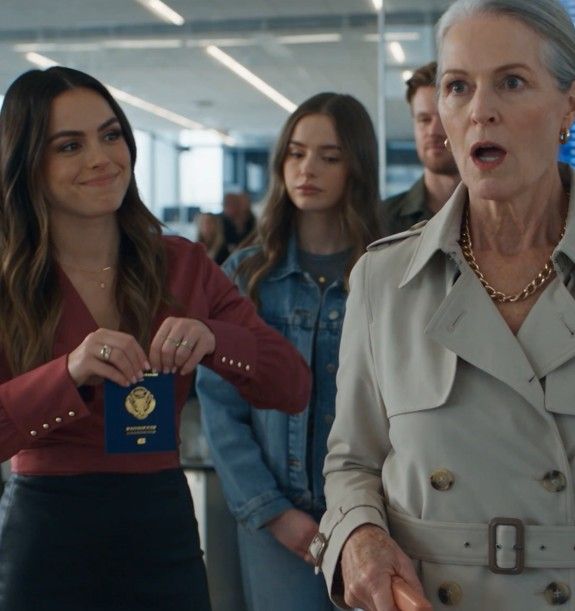
Derek leaned close enough for me to smell his coffee. “You’re punishing the kids.”
I took a step back. “Don’t use them to make me accept what you did.”
He glanced toward the seats, checking whether Emily was watching. “It was a joke.”
“Retrieve the passport pieces from my planner and explain which part was funny.”
He said nothing. Vanessa crossed her arms. She insisted they hadn’t really meant I should miss the whole trip, only that somebody needed to handle the cats. Her explanation changed twice within a minute. First I was too slow to travel; then I was supposed to follow on a later flight; then she said the damaged passport was already expired.
I opened the planner to the identification page. The expiration date was visible. I didn’t thrust it in her face. I laid it flat so she could see what she had torn.
“You didn’t ask,” I said. “You decided.”
Two airport officers arrived. They separated the conversation before it could become a larger spectacle. One asked me what happened; the other spoke with Vanessa and Derek. Anita explained what she had directly observed and made clear she had not witnessed the tearing itself.
I appreciated that distinction. I didn’t need anyone to improve the truth for me. Several travelers had seen the incident, and an officer took names from two who were willing to provide contact information. Camera footage, if available, would be requested through the airport’s procedures.
Vanessa said it was a family misunderstanding. I said it was my document and I hadn’t given permission for her to destroy it. The officer recorded the complaint and explained that the next steps would depend on the facts and the appropriate authorities. He did not promise an immediate arrest or a particular charge.
I kept the pieces and the report number. The officer reminded me that a damaged passport should not be used for international travel and would need replacement. I told him I understood. My driver’s license was still in my wallet, untouched.
Derek seized on that. “Then you could have come anyway. This whole thing was unnecessary.”
I looked at him. “You knew I could travel and still told me I’d slow you down. What exactly was necessary about that?”
His eyes shifted away. It was the first question he didn’t try to answer with a joke. The officers asked them to lower their voices, then stayed nearby while we decided how to leave the terminal.
Emily came back alone. The children were sharing crackers from her bag, watched by an airport employee who had kindly offered to stand nearby for a moment. My daughter looked pale. She reached toward my hand, then stopped.
“Mom, please. Can we just go?”
“Not together. Not today.”
She stared at the counter. “I didn’t know she was going to tear it.”
“What did you think when she told me to stay home?”
Emily swallowed. “I thought if I disagreed, she would make the whole trip miserable.”
“So you chose to make it miserable for me first.”
Her face crumpled. I didn’t enjoy saying it, but gentler words would have let her hide inside good intentions. I had spent too many years treating an unwillingness to defend me as neutrality.
“I wanted the kids to have a nice vacation,” she said.
“So did I. That’s why I paid for it.”
The answer left us both silent. Beyond the windows, an aircraft moved slowly away from its gate. People inside it had their own plans and disappointments. The world was continuing while ours rearranged itself around a customer-service counter.
I told Emily I would help arrange a safe ride home for the children if she needed one. I would not pay for replacement flights, a new villa, or a hotel for the adults. The distinction was deliberate. Children shouldn’t be stranded to teach their parents a lesson. Adults could handle the consequences of their own choices.
Derek said he would arrange transport. He sounded less certain than before, but he had a phone, money, and a home within reach. Vanessa began calling people, asking whether someone could lend her enough to restore the trip. I stepped away rather than listen to her tell the story without the passport.
Anita finished printing the documents. The activity desk confirmed several refunds, one partial credit, and a cancellation charge for the late-notice transfer. The villa manager needed to review its policy. I wrote down the deadlines and contact names as I would have at work.
Accounting had never made me cold. It had taught me that a clear record could keep fear from becoming confusion. Each confirmation on the page represented a choice I had made, not a favor I was begging someone to recognize.
Before I left, I went to the children. I knelt carefully because my knees disliked airport floors. I said the trip wasn’t happening that day, that they had done nothing wrong, and that I loved them. My older grandchild asked whether I was angry.
“I’m hurt,” I said. “But not at you.”
They hugged me with the distracted force of disappointed children. I promised only what I could keep: I would call that evening, and they could tell me about their day. I did not replace the canceled holiday with an instant bigger promise.
Emily watched me stand. “Can I come with you?”
“You need to take them home. We’ll talk when we can both listen.”
I pulled my coral suitcase toward the exit. Nobody followed me. That felt terrible for several steps, then strangely peaceful. I had thought freedom would look like walking away without pain. Instead, it looked like carrying pain in a direction I had chosen.
At home, I placed the passport pieces on the kitchen table. Richard’s photograph stood near the window. I had imagined him judging me whenever I refused Vanessa anything, as though marrying her father had created an obligation to absorb her anger forever.
I looked at his smiling face and tried to remember the man rather than the duties I had built around his absence. He had liked fairness. He had not expected me to become an unlimited account for everyone he loved.
My phone filled with messages. Vanessa demanded repayment for inconvenience. Derek accused me of wasting the money already spent. Some relatives suggested that refusing them at the airport had been too dramatic. I sent one factual message describing the damaged passport, the exclusion, and my decision to cancel bookings I had funded.
Then I stopped replying to arguments that repeated the same demands. I saved the messages, muted the threads, and made tea. The kettle clicked off. For the first time that day, I heard something in my house that wasn’t another person’s expectation.
The next week involved practical work. I contacted the passport service about replacement procedures, followed up on the report, and completed the remaining cancellation claims. Some charges stayed lost. Some credits had restrictions. A portion returned to my card. I recorded all of it without turning the total into a scoreboard against my family.
