But what Alessandro did next — what he said, and what he ordered Gabriel to do in the next sixty seconds — would change everything in that house forever.
👇
Alessandro didn’t breathe.
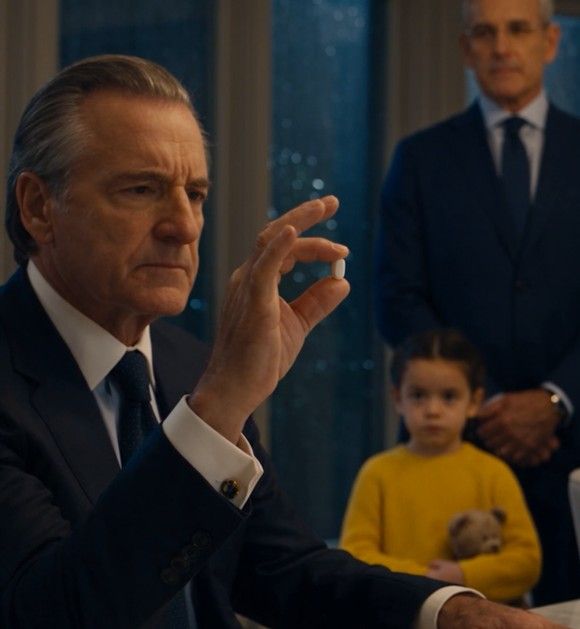
The pill was still there in his palm. A faint sheen of sweat had formed under it. He could feel his own pulse hammering against his ribs, too fast, too uneven, the way it had been for months every time he climbed the stairs.
He closed his fingers around it.
Not to take it. To keep it.
Victor took one small step forward. His shoes made no sound on the marble.
“Alessandro, you’re tired,” he said quietly. His voice was the same voice he had used for twenty-five years to calm, to advise, to manage. “Let me get you water. Let me get your doctor on the phone. The child is confused.”
Elena’s hand tightened on Sophia’s shoulder. Sophia pressed closer into her mother’s leg, but her eyes never left the bottle. Her teddy bear was squashed hard against her chest.
Alessandro looked at Victor. Really looked at him.
The tailored suit. The silver at his temples. The hands that had buttoned Alessandro’s father’s coat at his funeral, that had held Alessandro upright when his heart seized in the garden last April.
“Don’t move,” Alessandro said.
It wasn’t loud.
Victor stopped.
Alessandro pressed the call button on his phone without looking away.
“Gabriel. Now. Dining room. No sirens. Lock the east and west service doors. No one leaves this house.”
A pause on the other end. Then Gabriel’s voice, flat and immediate. “Thirty seconds.”
Victor’s jaw shifted. Just once.
“Elena,” Alessandro said, more softly, “take Sophia to the corner by the window. Sit with her.”
Elena nodded, her throat working. She guided Sophia to the upholstered bench beneath the tall window where the late light was falling in. She sat and pulled Sophia onto her lap. Sophia’s yellow sweater was too big, the sleeves pushed up. Her small sneakers didn’t touch the floor.
Victor exhaled through his nose and let out a short, disbelieving laugh.
“You are going to lock down your own home because a child heard a rattle?”
Alessandro set the pill down on the white tablecloth. Carefully. As if it might detonate.
“I’m going to lock down my home because six minutes disappeared,” he said. “And because my cameras don’t fail. You taught me that.”
Victor’s hands, clasped behind his back, flexed once.
The dining room doors opened.
Gabriel entered with two men, not in a rush, which made it worse. Gabriel was fifty, broad, quiet, the kind of man who had worked for Alessandro since he was twenty and never once raised his voice. He took in the room in a single sweep — the bottle, the pill on the cloth, the woman and child by the window, Victor standing too still.
“Mr. Moretti,” Gabriel said.
“Victor’s office. His apartment above the garage. His car. Seal them,” Alessandro said. His voice was steady now. Cold. “Take his phone. Take his keys. Do it now.”
Victor finally reacted. He stepped back, his palms coming up.
“Alessandro. Think. Twenty-five years. I carried you out of that hospital. I sat with you when—”
“Gabriel,” Alessandro said, not looking at Victor. “The bottle goes to Dr. Ferraro tonight. Private lab. I want to know what is inside that pill and every pill left in that bottle. And I want the pharmacy log for the last six months. Every refill. Every signature.”
Gabriel nodded to one of his men, who stepped forward with a small evidence bag and, with two fingers, lifted the pill from the tablecloth without touching it directly. He unscrewed the prescription bottle and dropped it in as well. The plastic cap clicked.
Victor watched it happen. The color drained very slowly from his face.
“You’re making a mistake,” he said, but his voice had thinned.
Alessandro stood. He was taller than Victor had allowed himself to remember. He walked around the table until he was a foot away from the man who had been like a brother.
“You shook the bottle at 8:12,” Alessandro said, very quietly, so Elena and Sophia wouldn’t hear every word. “The kitchen clock clicks every minute. She heard it. You taught her to be invisible in that kitchen, Victor. You told Elena her daughter could sit quietly and draw while the staff worked. You gave her the crayons.”
Victor’s lips parted. Nothing came out.
“Three months,” Alessandro went on. “I’ve been tired for three months. Dizzy. My doctor said it was age. Stress. He increased the dose. You picked it up for me every time.”
For the first time, Victor’s eyes darted toward the doors.
Gabriel stepped closer.
“Mr. Salvatore, your phone,” Gabriel said.
Victor handed it over with a hand that was no longer steady. His thumb hesitated over the screen, as if he wanted to wipe it.
Gabriel took it, checked it, handed it to his second man. “Stay with him in the study. He does not touch anything. He does not make a call.”
Victor was guided out. He didn’t struggle. At the doorway he looked back once at Alessandro, and what was in his face was not anger. It was grief, twisted and panicked.
The doors closed.
The dining room was suddenly too large and too quiet. The chandelier hummed faintly overhead.
Elena was crying silently, her face pressed against Sophia’s hair. Sophia was patting her mother’s hand with her small, chubby fingers, the way a child does when she doesn’t understand why the adult is upset but knows to be gentle.
Alessandro stood alone by the table for a long moment with his hands braced on the back of his chair. His knuckles were white.
Then he walked to the window and lowered himself onto the bench opposite them. He was careful to keep distance, to not crowd them.
