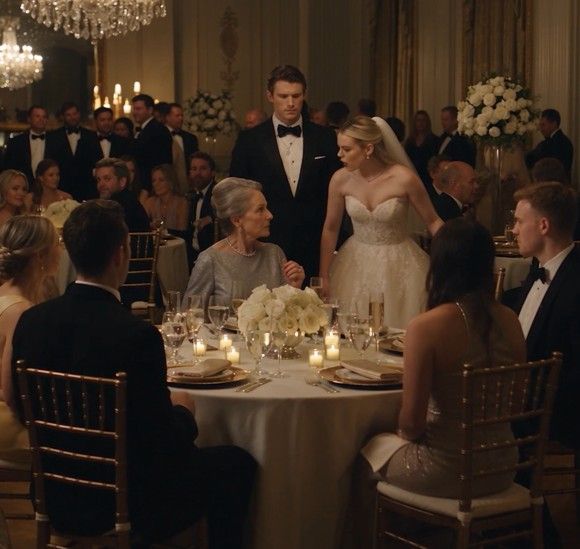
“Next time, ask the person whose chair is being moved,” Margaret said.
She nodded. They had both learned something that night, although the lesson had cost Margaret far more.
At home, Margaret put the pendant in a small dish beside her wedding ring. The house was quiet. Margaret took off the silver gown carefully, because it was still a beautiful dress and she refused to let cruelty own it forever.
Then Margaret sat on the edge of her bed and cried. Public composure had required holding each hurt at arm’s length. Alone, Margaret could acknowledge that she had paid to witness her own exclusion. Margaret could miss her husband without imagining he would have supplied a perfect speech to repair it.
The following morning, Ethan sent an apology. It was three paragraphs long and began by explaining that he had been overwhelmed. Margaret read it once, put the phone away, and made breakfast.
Later Margaret wrote back. She told him an apology needed to describe his choices before it described his feelings. He could take time to think. Margaret would not answer repeated calls to relieve his discomfort.
Her accountant came on Tuesday. He had managed the venue’s business records since the purchase, and he understood the difference between its value and her personal cash. The business was an asset, but it had wages, maintenance, and reserves. The wedding gift had still drawn heavily on retirement savings Margaret expected to live on.
Together they traced the payments. Every promise, invoice, and approved change received its own line. That patient work felt almost painfully plain after the ballroom announcement. It also gave them something stronger than anger.
Margaret hired a separate lawyer to negotiate the reimbursement agreement. Ethan did the same. Over several weeks, they reached terms that reflected their actual income and the additions they had approved. Olivia’s parents paid their agreed contribution directly to the vendors. Money already gifted was not magically reclaimed merely because Margaret regretted giving it.
Some of what Margaret had spent remained a loss. Margaret accepted that without pretending the loss entitled her to control their marriage. The purpose of the boundary was to stop the next injury, not manufacture a world in which the first one had never happened.
The venue staff heard rumors. Margaret called a meeting with the managers and told them the business would continue as usual. Their jobs, wages, and bookings were not bargaining chips in her dispute. Margaret thanked them for handling a difficult event and asked them to protect private client information, including her own.
One young server raised her hand at the end. “Are you all right, Mrs. Bennett?”
Margaret said she was getting there. She seemed relieved that Margaret had answered honestly rather than turning the question into a performance of strength.
Owning the venue had been a long-kept family confidence, not a secret fortune Margaret had conjured from nowhere. Margaret and her husband had bought it through a small company and retained its existing management. Ethan knew they had investments; he had never taken much interest in the details.
That incuriosity troubled her now. He had admired the building without wanting to know the people or work behind it. Margaret began revisiting the succession plan she and her husband had made. An inheritance could not be a substitute for learning responsibility.
Margaret met their business adviser and reviewed options. No ownership transferred that week. They discussed independent management, the staff’s future, and how a later transfer might be structured if it ever occurred. Margaret replaced an old letter of intent with instructions that protected the business while she considered the matter.
It was a difficult decision because part of her felt disloyal to her husband. He had imagined Ethan walking these rooms with pride. But he had also known how many workers depended on them. Keeping the business sound honored more of his life than simply following an old dream after its foundations changed.
Ethan asked to visit on a Thursday afternoon. He came in jeans, without Olivia, carrying a notebook. Margaret met him in the lobby before a scheduled tour for another wedding party.
“I’d like to know how this place works,” he said.
“I can show you. That won’t promise you ownership.”
“I understand.”
They began in the kitchen. The head chef discussed food costs, preparation schedules, and allergies that could make a small error dangerous. Ethan asked questions and wrote down the answers. They visited the laundry, where a woman named Celia showed him what happened when a guest spilled red wine on linen.
Near the service entrance, he stopped. It was the place where Margaret had nearly sat at his wedding, amid the passing trays and swinging doors. He looked back at her.
“I watched you come this way.”
“Yes.”
“I thought if I said something, she’d be angry with me.”
“And you decided it was easier if I was hurt instead.”
He swallowed. “Yes.”
There was no explanation left in that answer. Margaret could work with an honest word, though she could not build trust from one alone.
He told her that he and Olivia had started counseling. Olivia believed Margaret’s public announcement had humiliated her; he had told Olivia that his mother’s humiliation had preceded it. Their discussions were uncomfortable, and he did not ask Margaret to mediate them.
Margaret thanked him for keeping that responsibility between them and a professional. Margaret did not need to know whether she cried, blamed him, or apologized in private. What mattered to her was how she treated people when their wishes conflicted with hers.
Olivia eventually requested a conversation. Margaret agreed to meet in the venue’s office with Rebecca present, because the meeting included unfinished administrative matters. Olivia wore a simple coat and carried a folder instead of arriving with her parents.
“I shouldn’t have moved your chair,” she said.
“No.”
“And the necklace thing.”
“The pendant.”
Olivia looked at Margaret’s hands. “The pendant. I’m sorry.”
Margaret let the silence remain long enough that she could not mistake her attention for immediate absolution. She said she had wanted the wedding to look perfect and had felt judged whenever something did not match her picture.
“Your picture included removing me,” Margaret replied.
She nodded once. She did not defend the business associates or tell Margaret she was too sensitive. It was a beginning, though Margaret had no obligation to turn it into closeness.
