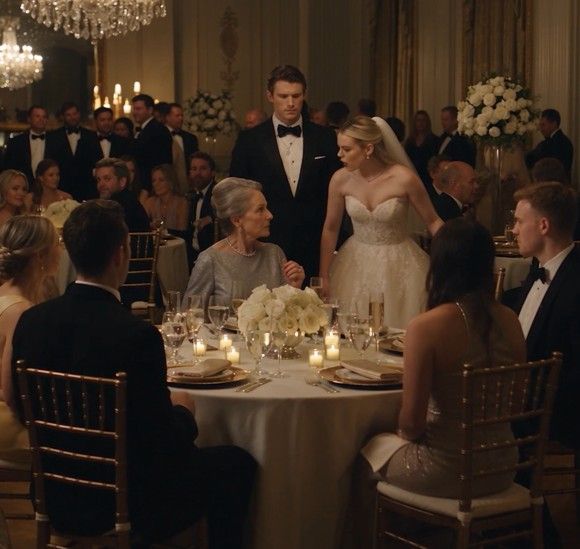
“Which card would you like us to charge?” Rebecca asked.
For several seconds, nobody answered. The silence was different from the one after the chair was pulled away. Then everyone had waited for her to absorb the insult neatly. Now the cost of their evening lay on the table where it belonged.
Ethan read the amount twice. “Mom, we can’t pay that tonight.”
“I know.”
Olivia looked up sharply. “Then this is a stunt.”
“No. It’s a bill. There will be a private discussion about what happens next. Rebecca, please ask the orchestra to continue. Our guests don’t need to be trapped inside this conversation.”
Margaret had wanted the truth heard. She did not want a roomful of employees and guests held hostage to their family dispute. The musicians resumed gently, beginning with something quieter than the song they had stopped. Rebecca gathered the invoice and invited the three parents and the couple into the adjoining meeting room.
Olivia’s mother came at once. Her father remained beside the head table until she touched his sleeve. Ethan followed Margaret through the doorway, staring at the fist Margaret still held closed.
“Can I have Dad’s pendant?”
“Not while you’re allowing someone to treat it like rubbish.”
He nodded as though Margaret had slapped him. Margaret wished the answer could have been kinder. She also knew kindness had become the wrapping around things that hurt her.
Inside the meeting room, a wall clock ticked above a framed photograph of the old riverfront. Rebecca spread the contract, amendments, payment history, and final invoice across the table. She looked tired now, away from the professional brightness she wore for guests.
“Before anybody makes a decision,” she said, “we need to be precise. Mrs. Bennett has already funded a substantial portion. Her payment obligations under signed agreements are not erased by anything said in the ballroom.”
Olivia folded her arms. “Exactly.”
“But several upgrades were ordered by the couple and approved on the understanding that their host would cover them,” Rebecca continued. “There are balances, reimbursement questions, and arrangements we can discuss. Nobody is being asked to perform an impossible card transaction without reviewing the details.”
That sentence softened the spectacle without softening the boundary. Margaret had asked for the terminal because she wanted them to face the assumption they had made. It could not manufacture money they did not have or rewrite signatures on paper.
Margaret told them plainly that she would honor obligations she had incurred. She would no longer make gifts to cover every choice they made, and she wanted a documented agreement concerning costs they had added and money she had advanced.
Olivia’s father leaned over the invoice. “How did it become this much?”
“Your daughter asked for more rooms, another floral installation, and a larger champagne order,” Rebecca said. “There were also changes to the menu and transportation.”
Margaret watched him find each line. His surprise was not Margaret’s to manage. He had thanked Ethan for providing such a magnificent evening without once asking how it had been funded.
“We thought Margaret was pleased to help,” Olivia’s mother said.
“I was pleased to help my son marry someone who loved him. I was not pleased to become a service everyone could use while moving my chair out of the picture.”
Her eyes dropped. For a moment Margaret thought she might apologize. Instead she straightened a page that was already straight.
Ethan pulled his chair closer to the table. “What do you want us to do?”
“Read the agreements. Take responsibility for your requests. Stop treating my savings as money that doesn’t belong to a person.”
He asked Rebecca for a copy. Olivia watched him with an expression that made Margaret understand the pendant was part of a much larger struggle about what he would be allowed to value.
“This is our wedding night,” she said to him.
“I know.”
“You’re letting her ruin it.”
“No,” he said, and the word was so quiet that they all leaned forward. “I let you ruin something already. I should have stopped you at the table.”
She blinked. Margaret felt no triumph. A sentence spoken after the harm could not spare her the memory of standing beside an empty place setting. But it was the first sentence he had said that evening which belonged to him.
Rebecca proposed that the reception proceed with the services already underway, while unresolved charges and reimbursement were addressed through scheduled meetings. Olivia’s parents agreed to contribute to the outstanding balance. Ethan would obtain independent advice before signing any repayment arrangement.
Margaret did not demand an immediate signature from a distressed man on his wedding night. Pressure had helped create this evening. Margaret would not use it simply because the power had changed hands.
They returned to the ballroom separately. Olivia went first, gathering two bridesmaids around her. Ethan stayed by the meeting-room door.
“Where will you sit?” he asked.
“With people who want me there.”
Margaret’s sister Louise had drawn an extra chair to her table. Louise stood when she saw Margaret, then made room beside her without offering a pitying embrace. A waiter replaced the place setting from the service entrance. Margaret thanked him by name.
For the rest of dinner, Margaret let herself eat. The salmon was warm, the bread still soft. Louise told her about a train delay that had nearly kept her from arriving, and Margaret loved her for offering a conversation she could inhabit without defending her dignity.
Ethan came to their table before the speeches. He asked whether Margaret wanted to dance. Margaret said not tonight. His face tightened, but he accepted her answer. Learning to hear no would be more useful to him than a photograph of them smiling beneath the chandeliers.
Margaret left before the final song. Rebecca walked her to the car. At the door, she admitted she had wanted to intervene when Olivia moved the chair but had not known whether Margaret wanted a scene.
