Within months, the installation simplified how civilian employees and junior service members reported recurring supervisory misconduct. Reports still required evidence. Leaders still had due process. But complaints no longer had to pass through the same immediate chain when that chain was part of the concern.
The change produced no dramatic scandal. It produced earlier conversations.
One supervisor learned that his habit of publicly mocking late paperwork had made junior staff hide mistakes until deadlines. Another discovered that civilians stopped suggesting maintenance improvements because he dismissed anyone without rank. Neither man was removed. Both changed behavior before the pattern became something worse.
That pleased Daniel more than the stories people told about Logan.
“Prevention is boring,” he told Ward over the phone.
“You say that like it is a compliment.”
“It is.”
Meanwhile, Logan’s planning assignment forced him to work closely with people whose jobs he once treated as background. Civilian schedulers controlled access windows. Supply clerks understood delays better than officers reading summaries. Maintenance technicians could stop a training event with one documented defect.
At first Logan experienced every dependency as frustration.
Then he began asking questions before issuing conclusions.
A civilian planner named Rosa Nguyen became his most relentless teacher. She returned his first schedule with twelve corrections marked in red.
Logan walked to her desk ready to argue.
Rosa looked at him and said, “Do you want the exercise to happen, or do you want this draft to be right because your name is on it?”
He stopped.
Months earlier, he would have heard disrespect. This time he heard Daniel asking why he needed somebody else to be wrong.
“Show me the twelve,” he said.
Rosa did.
Nine were clearly his errors. Two came from outdated data. One was hers.
When they finished, Logan thanked her.
“Do not get sentimental,” Rosa said. “You still schedule like a man who thinks vehicles teleport.”
Logan laughed.
It was the first time in months he had laughed after being corrected.
Slowly, the thing he had once treated as a loss of status became ordinary work. He still wanted authority. He still had ambition. Remediation did not erase personality. It taught him that ambition became dangerous when every correction felt like theft.
When his supervisor finally recommended limited return to leadership, the report cited no dramatic transformation. It cited consistent behavior: accurate credit, documented decisions, respectful correction, and willingness to reverse a plan when new information was better.
Daniel would later say those were exactly the kind of boring details that deserved trust.
A year after the cafeteria incident, Daniel received a letter.
He almost threw it away when he saw Logan’s name.
Inside was a single page.
Logan did not ask for forgiveness.
He wrote that he had been approved to return to a limited supervisory position. He had also asked that Aaron Bell be included on a training panel about decision-making under pressure.
At the bottom was one sentence:
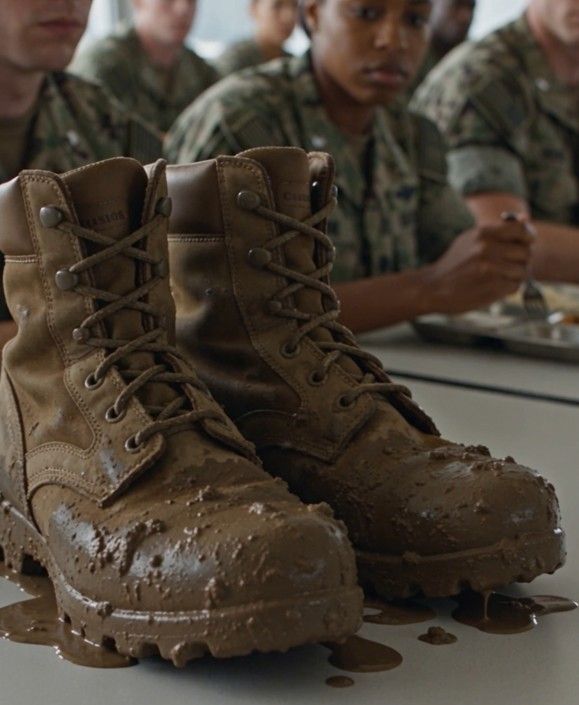
I finally understand why you left the cloth on the table instead of cleaning my boots.
Daniel smiled despite himself.
He wrote back.
Good. Now clean up your own messes before somebody has to teach you twice.
Before that conference, Ward sent Daniel one final photograph from the command. It showed a planning table covered with maps, schedules, and coffee cups. Logan stood at one end, but he was not speaking. Rosa Nguyen was pointing to a route while three officers listened. Aaron Bell was beside her, adding something to the board.
Daniel studied the picture longer than he expected.
There was no caption about leadership. No award. No ceremony. Just a room where the person with the highest rank was not automatically the person with the last useful idea.
He printed the photograph and pinned it above his workbench at home.
Two years later, Daniel returned to the base for another conference.
He was older. His knees complained. The garden at home had become more attractive than military travel.
He stopped at the cafeteria anyway.
The manager recognized him and pushed a gray work shirt across the counter.
“Absolutely not,” Daniel said.
“We are short one person.”
He looked at the shirt.
“You planned this.”
“Prove it.”
He put it on.
During lunch, Logan entered with three junior officers.
