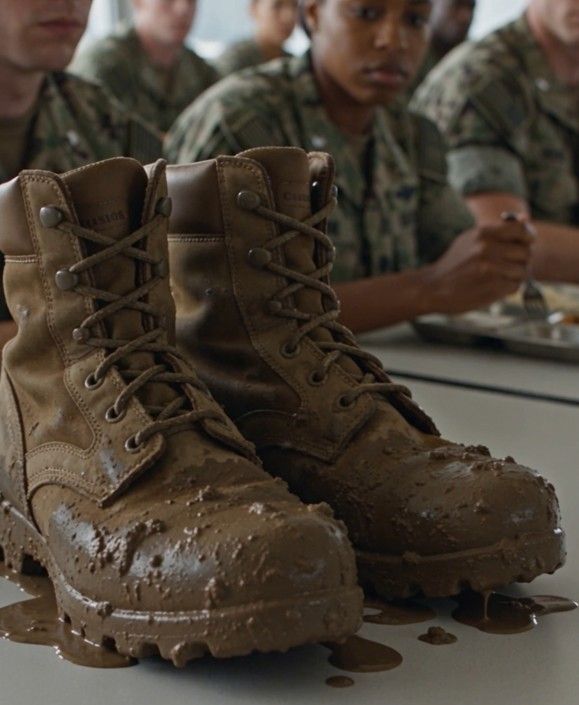
The dining facility manager asked him to stay two extra mornings because one worker had not recovered.
He stayed.
The first morning, several officers became comically polite around him.
One carried three trays back at once and nearly dropped them.
Daniel shook his head.
“You know I am retired, not royalty.”
The room relaxed.
On the second morning, Specialist Aaron Bell came through the line.
Daniel recognized his name from the after-action report.
Bell did not recognize Daniel.
He returned his tray, wiped a small spill beside the bin, and thanked the civilian worker collecting cups.
Daniel watched him leave.
That was the leader he wanted to remember from the mission.
Months passed.
Logan completed the remediation program without enthusiasm at first. His supervisor required him to review team decisions and identify contributions from people junior to him. The exercise sounded simple. Logan found it uncomfortable.
He had spent years narrating success from the top down.
Now he had to describe it accurately.
One report listed a junior sailor’s maintenance warning as the reason a training delay prevented equipment damage. Another credited a logistics specialist for catching a scheduling error. The more Logan practiced naming other people’s contributions, the less threatening it became.
His hardest assignment was meeting Aaron Bell.
They sat in a small office with no observers except the supervising commander.
Logan apologized for retelling the mission in a way that erased Bell’s decision.
Bell listened.
Then he asked, “Did you think giving me credit made you look weak?”
Logan answered honestly.
“At the time, yes.”
Bell nodded. “It made me trust you less when I heard what you were saying afterward.”
That was the consequence Logan had not understood.
He had been hoarding credit to protect authority and losing authority because of it.
Daniel did not participate in Logan’s remediation, but Ward occasionally sent him updates because the cafeteria incident had become part of the conference curriculum. Daniel always responded with the same warning: do not build a morality play around one man.
“If everyone leaves thinking Logan was uniquely bad, they learn nothing,” he said. “The useful question is why the room made it easy.”
Ward took that seriously.
She asked small groups of officers to review the cafeteria video without sound. They watched body language instead of dialogue: the way junior officers avoided eye contact, the way laughter appeared only after Logan smiled, the way Daniel kept working, and the way people waited for someone with greater authority to enter before they felt safe changing their behavior.
Then Ward played the audio.
The difference was uncomfortable.
Several officers admitted that they had been in rooms with the same pattern, even when nothing as obvious as muddy boots occurred. A senior person made a joke at someone’s expense. People laughed because not laughing felt visible. A junior employee raised a concern. Everyone looked toward the leader before deciding whether the concern was legitimate.
The lesson became less about Logan and more about permission.
Who gives a room permission to act decently when the most powerful person in it does not?
Daniel visited one session at Ward’s request. He stood at the back until she forced him forward.
A young lieutenant asked whether Daniel had known Logan would behave differently if he thought Daniel was important.
“I suspected it,” Daniel said.
“Was that why you did not identify yourself?”
Daniel considered the question.
“No. I did not identify myself because I was washing dishes. My biography was not relevant to whether his boots belonged on a table.”
The lieutenant nodded slowly.
Another officer asked what Daniel would have done if Ward never walked in.
“Finished the lunch rush.”
A few people laughed.
Daniel did not.
“Then I would have reported it through the same process available to any civilian worker. That matters too. If your system only works when the person mistreated happens to know a commander, your system does not work.”
Ward wrote that sentence down.
