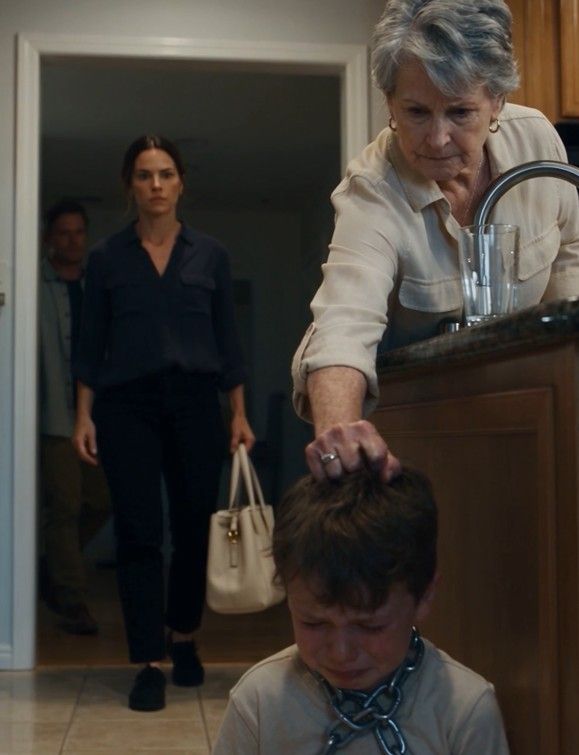
Diane and Ryan were charged with child endangerment, false imprisonment, and assault. Ryan was also charged with failure to protect. The video was the centerpiece of the prosecution’s case. The jury watched it three times. I watched it too. It never got easier.
Diane’s lawyer tried to argue that she was from a different generation. He said she didn’t understand modern parenting. He said she was trying to help.
The prosecutor asked Diane one question: “Did you chain a four-year-old boy to a pipe and force him to eat from a dog bowl?”
Diane said, “I was teaching him respect.”
The jury took two hours to convict.
Ryan’s lawyer tried to argue that Ryan was under his mother’s influence. That he was a victim too. That he didn’t know how to stand up to her.
The prosecutor asked Ryan: “Did you hear your son crying?”
Ryan said yes.
“Did you do anything to stop it?”
Ryan said no.
“Why?”
Ryan said, “I didn’t know what to do.”
The jury convicted him too.
Diane was sentenced to twelve years. Ryan was sentenced to eight. They were both taken away in handcuffs. Diane didn’t look at me. Ryan did. His eyes were wet. He mouthed the word “sorry.”
I turned away.
The house on Linden Street was sold. Noah was the legal owner, but he was four. I was the trustee. I sold the house and put the money into a fund for him. We moved into a small apartment near Rachel’s. It was too small. It was too loud. But it was safe.
Noah started seeing a therapist. Her name was Dr. Chen. She was patient and gentle. She helped Noah understand that what had happened wasn’t his fault. She helped him learn to trust again. She helped him learn to speak up when something was wrong.
One evening, about six months after the trial, Noah came into my room. He was holding a piece of paper. He had drawn a picture. It was our apartment. The window. The couch. The lamp.
Beneath the picture, he had written, in his shaky four-year-old handwriting: “This is where I am safe.”
I sat down beside him. “That’s right, baby. This is where you’re safe.”
He looked at me. His eyes were clear. “Mommy, why did Daddy do that?”
I didn’t know how to answer. I had asked myself the same question a hundred times. I had wondered if I had missed something. If I had been blind. If I had failed him.
But I hadn’t. I had come home. I had seen. I had acted.
“I don’t know,” I said. “I don’t know why he did that. But I know it wasn’t your fault. And I know I will never let anyone hurt you again.”
He nodded. He leaned against me. I put my arm around him.
We sat there for a long time. The TV was off. The apartment was quiet. And for the first time in months, I felt something loosen in my chest. Something that had been clenched tight since the moment I had stepped into that kitchen.
The final twist came a year later.
I was cleaning out the storage unit. I had packed up everything from the house on Linden Street. I hadn’t gone through it. I hadn’t been able to. But now, I was ready.
I found a box labeled “Ryan—childhood.” I opened it. Inside were old report cards, old photographs, old letters. And at the bottom, a small, leather-bound journal.
It was Diane’s. The entries were dated forty years ago.
