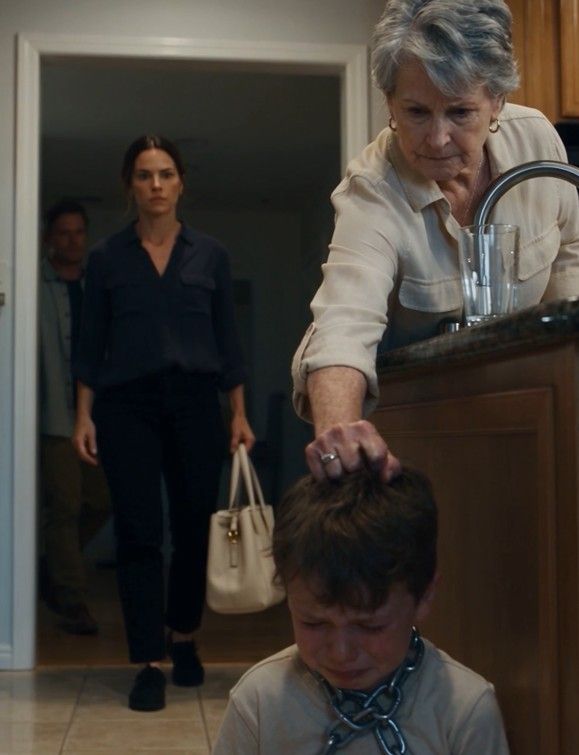
Ryan finally spoke. His voice was thin. “Emily, let’s talk about this. We can work it out. Mom was just trying to help.”
“Help,” I repeated. The word tasted like poison. “She chained him to a pipe. She made him eat from a dog bowl. You filmed it.”
“It was discipline,” Diane said. Her arms were crossed now. She had regained some of her composure. “Children need discipline. You’ve been too soft on him. That’s why he’s like this.”
“Like what?” I asked. “Four years old? Terrified? Crying so quietly I almost didn’t hear him?”
Diane’s lip curled. “He’s dramatic. Just like you.”
The sirens came sooner than I expected. Blue lights flashed through the kitchen window. Doors slammed. Boots on the porch.
Officer Martinez was the first one through the door. I knew her. She had been to our house once before, when Diane had called the police on me for “harassment” after I told her she couldn’t take Noah to church without asking. The charges had been dropped. But Martinez remembered.
She took one look at the scene—Noah in my arms, the chain on the floor, the dog bowl, Diane and Ryan standing frozen—and her face went hard.
“What happened here?” she asked.
I handed her the chain. Then I handed her my phone. “They recorded it. The video is on Ryan’s phone. I copied it to mine.”
Martinez watched the video. Her jaw tightened. She looked at Ryan. “Sir, is this your phone?”
Ryan didn’t answer.
Martinez nodded to the second officer. “Cuff them both.”
Diane started screaming. It was a shrill, piercing sound. She called me a liar. She called me a bad mother. She said I had turned Noah against her. She said I was trying to steal her son.
Ryan didn’t scream. He just looked at me. His eyes were the eyes of a man who had finally understood that he had made a terrible mistake. But it was too late.
They were led out in handcuffs. Diane was still screaming when the police car door shut behind her. Ryan just stared at the floor.
Noah and I were taken to the station to give statements. A detective named Kowalski interviewed me. She was kind. She had a daughter of her own. She listened to everything I said. She watched the video three times.
“This is enough,” she said. “This is more than enough.”
Noah was examined by a doctor. He had bruises on his wrists and ankles. He had a cut on his lip. He was dehydrated. But he was alive. He was safe.
They asked him questions. He answered them in a small voice. He said Grandma Diane said he was bad. He said Daddy watched. He said he was hungry. He said he was scared.
I sat beside him the whole time. I held his hand. I told him he was brave. I told him he was good.
Afterward, we went to my sister’s house. Her name is Rachel. She lived twenty minutes away. She had two kids of her own. She took one look at Noah’s face and burst into tears. She wrapped us both in her arms and didn’t let go for a long time.
That night, I lay in bed beside Noah. He was sleeping. His breathing was soft and even. The chain was gone. The dog bowl was gone. The house on Linden Street was gone.
But the memories were not.
I kept seeing it. Diane’s hand in his hair. The kibble. The phone recording. Ryan standing there, doing nothing.
I kept thinking about the night before. Ryan had been quiet. Distracted. I had asked him if everything was okay. He had said yes. He had kissed my forehead. He had told me he loved me.
He had known what his mother was going to do. He had helped her plan it. He had recorded it.
I had been sleeping in the same bed as a man who chained our son to a pipe.
The next morning, I called a lawyer. Her name was Sarah. She was a friend of Rachel’s. She specialized in family law. She listened to my story without interrupting. When I finished, she said, “We’re going to bury them.”
The trial took four months.
