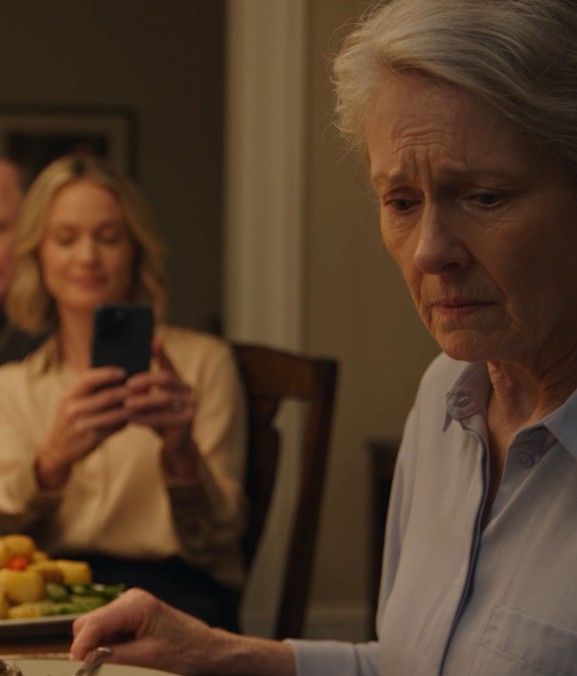
“You got a lawyer against your own son.”
“I got a lawyer for myself.”
He watched the water run over my hands.
“I was trying to save the business.”
“Tell that to the people reviewing the records.”
“If they shut everything down, nobody gets paid.”
“Then you needed to ask for help honestly. You did not need to make me appear incapable of answering.”
He leaned against the counter. For the first time, I saw fear without the grin from the dining room. It might have moved me if he had not followed it with another request.
“Could you just say you signed it and forgot?”
I turned off the tap.
“No.”
He opened his mouth, then shut it. I had given him no argument to improve, no guilt to press. The answer was complete.
Ruth stayed for several nights. After she went home, another friend visited in the evenings. I kept my bedroom locked and stored important papers elsewhere. The attorney told me what to do if either resident threatened or obstructed me.
I did not feel brave every hour. Sometimes I waited in my room until I heard them leave for work. Sometimes I stared at the door and wondered how a home could feel unfamiliar without any furniture moving.
I began walking each morning. The air was cold enough to make my eyes water, and the route passed houses whose owners had their own worries. It helped to remember that my life was larger than a dispute unfolding behind one set of walls.
Several birthday guests called. Most began with embarrassment. They had thought it was a joke, they said. They had not understood the bowl.
“You didn’t need to understand the bowl to hear the words,” I told one cousin.
She fell silent. Then she apologized without explaining herself again. We spoke for a few minutes about what she had seen. She offered to provide a truthful account if requested.
Another guest asked me not to make Brian’s life difficult. I ended that call politely and did not return to it. I had spent enough years doing unpaid work for other people’s comfort.
Melissa’s recording became part of the evidence, but not because I posted it. She had sent a short clip to friends before the documents were discovered. One recipient contacted me privately, ashamed, and offered the copy.
I gave it to Ms. Cole. It showed the bowl, the words, and my quiet departure. It did not prove a financial fraud. It did contradict the suggestion that I had erupted in confusion and imagined the confrontation.
I refused to turn it into entertainment a second time.
The lender’s investigation took weeks. Its records showed the home-equity application had been initiated using contact details associated with Melissa and uploaded documents containing a copied version of my signature.
The purported power of attorney had not passed the lender’s full review. Questions about its execution were one reason the application remained pending when I discovered it.
That delay, which Brian had apparently found frustrating, had protected my house. I felt grateful to a procedure I had never known existed.
The earlier loan was more complicated. Money had already been paid to Brian’s company. The creditor initially treated the account as mine because my information appeared in the application.
Ms. Cole challenged that conclusion with the documents, my statement, and the available transaction records. We requested a full investigation rather than a casual removal of a payment.
I could not force the process to become instant. While it continued, I followed written advice about disputes and payments so that panic would not create another problem.
One morning, Brian asked for a meeting with our attorneys present. Melissa would not attend. She had obtained separate advice, and their accounts of who prepared which document had begun to differ.
At the meeting, Brian admitted he had supplied my personal information to support borrowing for his company. He said Melissa had prepared the scans. He said he believed I would have helped if the business had survived long enough for him to explain.
“That isn’t consent,” Ms. Cole said.
He nodded without looking at her.
I asked whether he had believed I was cognitively impaired.
“No.”
“Then why did you tell people I was?”
He covered his mouth with one hand. The silence lasted so long that I thought he would not answer.
“It made things easier.”
There it was. Not a misunderstanding, not an act of care carried too far. He had needed people to doubt me so they would ask fewer questions of him.
I did not shout. I felt as though a knot I had carried for years had finally been given a name.
Brian’s attorney stopped him from discussing certain disputed details while the investigation continued. I accepted that. My purpose was not to obtain a theatrical confession that could later be challenged. I wanted decisions supported by records.
