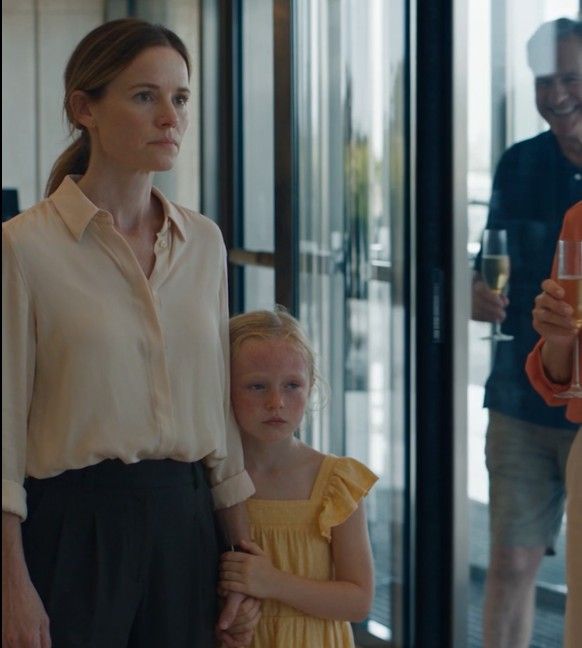
I sat on one side of the courtroom with Lily beside me. She held my hand the entire time, her small fingers wrapped around mine, squeezing occasionally when the judge spoke about the evidence.
My parents sat on the other side. My mother had hired an expensive attorney who tried to reframe the incident as a “miscommunication” and a “difference in parenting philosophy.” The judge — a silver-haired woman with reading glasses and the patience of someone who had seen every version of human failure — listened to the entire argument without expression.
Then she turned to the security footage.
She watched my mother close the door. Watch the latch slide. Watch the thermostat get adjusted. Watch seven adults walk toward the elevator without a backward glance.
She watched it twice.
The courtroom was silent.
“Mr. and Mrs. Holloway,” the judge said, removing her glasses. “What I see on this footage is not a difference in parenting philosophy. What I see is deliberate, calculated, and sustained endangerment of a child who had no means of escape and no way to call for help. The child’s age, the conditions of the room, the systematic removal of communication and cooling — these are not accidents. These are choices.”
She paused.
“Choices made by adults who were supposed to protect her.”
My mother’s attorney started to stand. The judge held up her hand.
“I am issuing a permanent restraining order. Mr. and Mrs. Holloway are prohibited from having any unsupervised contact with the minor. All future contact, if any, must be supervised by a licensed professional and approved by this court. I am also referring this case to the state for a full child welfare review. If any further incidents are reported, I will not hesitate to escalate.”
She looked at my parents one final time.
“You left a child to suffer in a locked room. You left her alone and afraid and you walked away and you went to have fun. There is no version of this story where you are the victims. There is no version where this was okay. And this court will make sure it never happens again.”
My mother sat rigid, her face white, her eyes burning. She didn’t cry. She didn’t speak. For once in her life, she had no words.
My father stared at his hands.
We left the courtroom into bright sunlight. Lily squinted and held up her hand to shield her eyes. I crouched down in front of her on the courthouse steps.
“How do you feel?” I asked.
She thought about it.
“Safe,” she said.
I pressed my lips to her forehead and stayed there for a long time.
The months that followed were not easy. Nothing about healing is ever clean or fast or complete. There were nights Lily woke up crying because she dreamed about the hot room. There were mornings I sat in the car outside the courthouse replaying the judge’s words and wondering if I should have done more, sooner, louder. There were phone calls from my mother’s attorney that I let go to voicemail. There were long silences that I filled with the sound of Lily’s breathing beside me.
But there were other things too.
There was Lily, two weeks after the hearing, laughing so hard at a silly cartoon that milk came out of her nose and she rolled on the carpet gasping while I scrambled for paper towels and laughed so hard my ribs ached.
There was Emily, showing up every Saturday morning with pastries from the bakery, sitting at my kitchen table, talking about everything and nothing, slowly becoming the sister I had always needed but never thought I’d have.
There was the first night Lily slept all the way through without waking up screaming.
There was the afternoon she climbed into my lap — she was getting too big for it, her legs dangling almost to the floor — and whispered, “Mom, I’m glad you’re my mom.”
There was the Tuesday I got a letter from my mother. Three pages, single-spaced. I read the first line, folded it in half, and put it in a drawer. I wasn’t ready. I might never be ready. And that was okay.
There was the morning I stood in the kitchen watching Lily eat cereal and draw pictures of horses and I realized I was not waiting for something anymore. I was not bracing. I was not rehearsing arguments. I was just standing in my kitchen on a Tuesday morning watching my daughter draw a horse with a purple mane, and the sunlight was warm, and the coffee was hot, and I was okay.
Not perfect. Not fixed. Not untouched by what had happened.
But okay.
Six months later, on a Sunday afternoon, Lily and I were lying on a blanket in the park. She was reading a book about a girl who could talk to animals, and I was watching the clouds move across the sky and thinking about nothing in particular.
“Mom,” she said, not looking up from her book.
“Yeah?”
“Do you think people can change?”
I considered the question seriously, the way she deserved.
“I think some people can,” I said. “I think it takes a lot of work and a lot of honesty. And I think the people who do the work are the ones who are worth trusting again.”
She nodded slowly, processing this with her usual careful gravity.
Then she looked up from her book and smiled — not the cautious smile she had worn for those first weeks, the one that always seemed to be asking permission, but a real smile, wide and unguarded and certain.
“I think I want a dog,” she said.
I laughed. A real laugh. The kind that starts in your chest and takes over your whole body and leaves you feeling clean and light.
“A dog,” I said.
“A big one,” she said. “With floppy ears. And I want to name him Sunshine. Because sunshine means it’s always going to be warm.”
I pulled her close and kissed the top of her head. She smelled like strawberry shampoo and grass and summer.
“Then we’ll get a dog,” I said.
She went back to her book. I went back to the sky. The clouds kept moving. The grass was soft beneath us. Somewhere across the park, a dog barked, and Lily looked up, and her face lit with that specific kind of wonder that only exists in childhood — the belief that the world is full of good things just waiting to be found.
I watched her face in the golden afternoon light and I thought: this is it. This is the thing. Not the courtroom victory or the restraining order or the justice system working the way it should. All of that mattered. All of that was necessary.
But this — this blanket, this park, this sunlight, this girl with her purple-maned horses and her dream of a dog named Sunshine — this was the whole point. This was what we had been fighting for. Not a verdict. Not an ending. A beginning. A life that was hers, that was safe, that was warm, that was finally, finally hers.
She turned a page. The wind moved through the trees. The sun crossed the sky.
And we lay there together in the light, two people who had survived the worst thing and come out the other side still whole, still holding on, still choosing each other with every breath.
The world kept turning.
