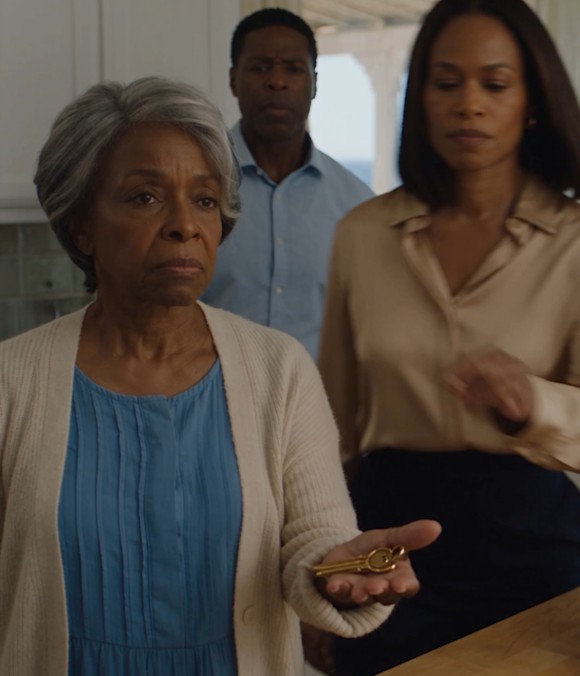
“Thank you.”
“I should have checked with you first.”
“Yes.”
He accepted the answer without filling the silence.
Before hanging up, he asked whether she wanted him to call the next Sunday.
Dorothy looked through the open window at the water.
“Yes,” she said. “You may.”
Brooke’s first apology arrived by text.
It began with how stressful the celebration had been and ended with how painful it was to have private history brought into an argument.
Dorothy read it twice.
Then she wrote, “I will speak with you when you can discuss what you did without making me responsible for it.”
There was no reply that day.
At home, Brooke tried to persuade Bradley that the incident had become larger than it deserved. But the messages remained on his phone, complete with the instructions to disregard his mother’s objections.
He could no longer turn her certainty into his own excuse.
They attended counseling. During the first session, Brooke called Dorothy manipulative for mentioning the library.
Bradley asked her what she called telling him his mother was confused.
She had no answer he could live with.
Their separation began six weeks after the canceled party.
Dorothy learned about it during a Sunday call.
“Is this because of me?” she asked before she could stop herself.
“No,” Bradley said. “It’s because of what happened, and what kept happening when we tried to talk about it.”
He had rented a small apartment close to work.
He did not ask to move into the cottage.
That mattered more to Dorothy than he knew.
By autumn, the divorce was proceeding. Brooke had lost the marriage she had assumed would protect her from consequences, the unquestioning support she had relied on, and any claim to enter Dorothy’s life on her own terms.
There was no public spectacle.
There were papers signed at separate tables, belongings divided, and a future neither of them had expected.
The consequences did not disappear when Brooke finally began telling the truth.
Her next letter arrived in a plain envelope.
Dorothy opened it on the porch.
“I wanted your house because it made me look generous without requiring me to give anything,” Brooke wrote.
“I told Bradley you were forgetting things because I knew he might listen if you said no. I wanted to decide what your no meant before you could say it.”
Dorothy read that sentence three times.
The letter did not ask her to intervene in the divorce. It did not mention forgiveness until the last page, where Brooke wrote that she understood it might never come.
“I was frightened of being powerless again. I made someone else powerless whenever I could. That explains something about me. It does not excuse what I did to you.”
Dorothy folded the letter and left it on the table overnight.
In the morning, she agreed to meet Brooke at a café in town.
Brooke arrived without makeup, carrying only her purse. She waited beside the table until Dorothy sat down.
For a while, neither touched the coffee.
“I remember the back room,” Brooke said.
