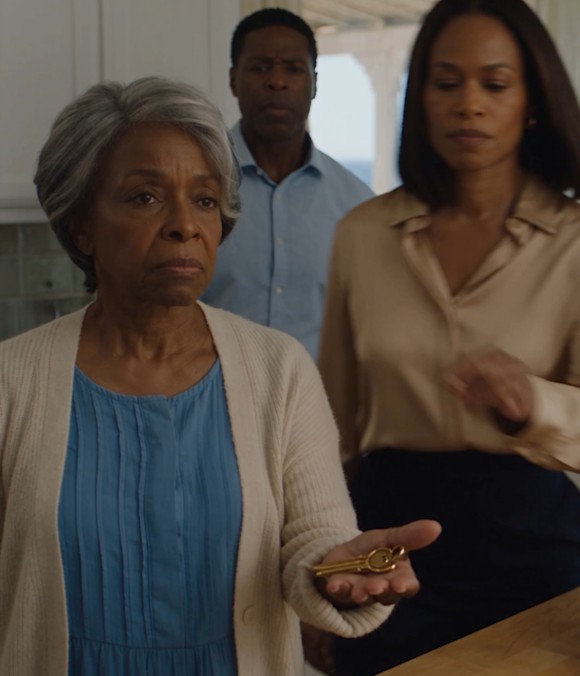
Brooke snatched the brass key from Dorothy’s hand.
“Cook for all twenty-two guests, or I’ll put you in a nursing home!”
Dorothy’s empty palm remained open for a moment. Then her fingers closed around the small indentation the key had left behind.
At seventy-four, the Black American retired librarian had finally bought the beach cottage she’d spent eight years saving for.
Not borrowed. Not given to her. Bought with money she had earned across thirty-two years behind a library desk.
Eight years of putting her own dream first.
And now her daughter-in-law stood inside that dream, holding its key as though Dorothy needed permission to remain there.
Behind Brooke stood Dorothy’s son.
Dorothy looked at him, waiting for something small. A protest. Her name. Even a quiet, “That’s enough.”
Nothing.
He said nothing while his wife threatened his mother in her own home.
Twenty-two guests were coming, and somehow the woman who owned the cottage had become the person expected to cook, clean, and disappear.
Brooke hadn’t asked whether Dorothy wanted a celebration there. She had decided there would be one—and apparently decided what would happen if Dorothy refused.
The brass key looked so small in Brooke’s hand.
Dorothy remembered how it had felt in hers: solid, warm, real. Proof that all those years of saving had finally led somewhere.
“Please.”
The word came softly, barely louder than the ocean beyond the windows.
Brooke smiled.
There it was: the moment she thought she had won. The older woman was pleading. Her husband wasn’t objecting. The guests would arrive, and Dorothy would serve them.
But Dorothy wasn’t looking at the key anymore.
She was looking directly at Brooke, with an expression that made the smile linger awkwardly on the younger woman’s face.
“Not here.”
Brooke waited, still holding the key.
“This was supposed to be my safe place.”
Dorothy’s son watched his mother now. The silence he had allowed suddenly seemed to demand something from him, but still he offered her nothing.
Dorothy did not raise her voice.
That was what changed the room.
Brooke knew how to respond to an argument. She could dismiss a complaint, repeat a demand, talk over an objection.
But Dorothy’s quiet steadiness left her waiting.
There was something personal in the older woman’s gaze now. Something that had nothing to do with dinner, guests, or a beach house.
Dorothy could have asked her son to explain his silence.
Instead, she kept her eyes on his wife.
For a moment, the demand to cook for twenty-two people seemed almost absurd beside whatever Dorothy was preparing to say.
Then she spoke with the same gentleness Brooke had mistaken for surrender.
“Remember the library’s back room?”
Brooke’s smile vanished.
Dorothy’s son looked between them.
For the first time since the key had been taken, Brooke appeared to have no immediate answer.
The key trembled against Brooke’s wedding ring, making a faint, uneven clicking sound.
“Don’t,” she said.
