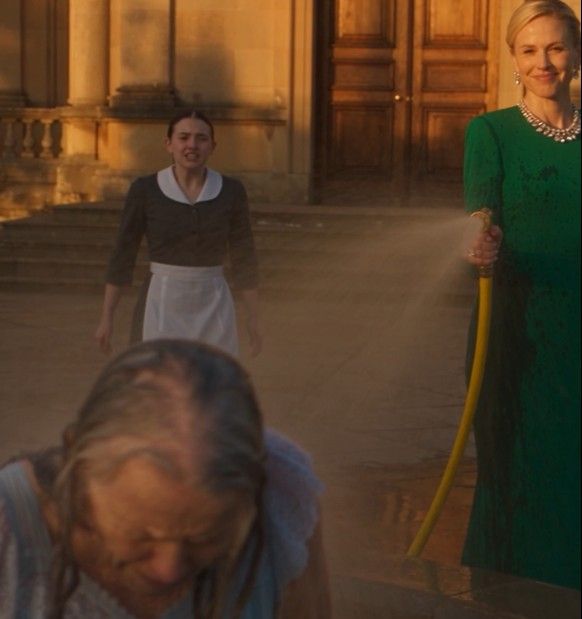
“Come here, love,” Margaret whispered.
Clara came. Margaret pulled her close until Clara was sitting on the quilt too, until the three of them were in a tight, strange, warm huddle that smelled like wet hair and tea and towels.
“I heard her tell you to leave today,” Clara whispered, her forehead against Margaret’s temple. “Like a servant. I couldn’t— I couldn’t let her—”
“You stood in front of the water,” Margaret said, stroking Clara’s wet hair. “You always stood in front.”
The doorbell rang downstairs. Hard, insistent.
Daniel stood, his face going stone again.
“It’s her lawyer,” Clara whispered, afraid.
“No,” Daniel said. “I told the gate to not let anyone in. That’s the police. I called them.”
Margaret’s eyes widened.
“For the paper,” Daniel said quietly. “Forgery. Elder abuse. What she did is not a family fight. It’s a crime. And I want it on record that she doesn’t live here anymore.”
He went downstairs. Clara and Margaret listened to the low voices in the foyer, the calm, professional tones of the officers taking a report, taking the damp, ruined paper from the courtyard as evidence, photographing the small laundry room with its narrow cot.
They listened until the front door closed again, and Daniel’s footsteps came back up the stairs, slow.
He stopped in the doorway. In his hands he held something dripping, wrapped in a towel.
“The hose?” Clara frowned.
“No,” he said.
He unwrapped it. It was a small, muddy, wooden box. The kind that holds gardening tools. It had been knocked over in the courtyard scuffle, spilled behind the rose bushes.
Margaret made a small noise.
“Oh,” she said. “My box.”
Daniel knelt and opened it. Inside, carefully wrapped in plastic against the weather, were three small journals, bound in faded blue cloth, swollen slightly with damp but intact. On top of them, a sealed envelope with Daniel’s name on it, in his father’s handwriting.
Daniel stared.
“What is this?” he whispered.
Margaret’s hands fluttered under the quilt, suddenly shy.
“After your father died,” she said, her voice very small, “I started writing to you. For when I couldn’t say things well on the phone. I wrote what I cooked. What the roses did. What Clara said that made me laugh. I didn’t want to forget the good days. Victoria found the first one. She said it was nonsense. She threw it away. So Clara helped me hide the others. In the rose box. Your father’s box. He made it.”
Clara nodded, tears spilling again. “We took turns bringing it in at night so it wouldn’t get wet. Today— today Mrs. Victoria saw Mrs. Margaret writing on the patio. That’s why— that’s why she was angry. She said Mrs. Margaret was spying on her.”
Daniel’s hands were shaking now. He opened the top journal to a random page. Margaret’s handwriting, looping and neat, even at seventy.
*May 3 – Danny called. 6 minutes. He sounded tired. I made his favorite soup but Victoria said he doesn’t eat soup anymore. I kept it for Clara. She said it was perfect.*
*June 11 – The pink roses opened. I wanted to show Danny. Victoria said not to bother him at work. I pressed one for him instead.*
*August 9 – Clara’s mother is sick. I sent the money. Don’t tell Clara I told you, journal. She is too proud. She is my daughter in every way that matters.*
Daniel made a sound that was not a word. He pressed the journal to his face. His shoulders caved. All the efficient, controlled stillness broke at once.
Clara put her arms around him from the side, awkward and fierce, and Margaret leaned forward under the quilt and put her hands on her son’s head.
For a long time, the only sound in the room was breathing and quiet crying.
Then Daniel lifted his head. His eyes were red, but clear.
“She tried to make me think you didn’t love me,” he said to Margaret, his voice hoarse. “And I let her.”
“No,” Margaret whispered, touching his cheek. “You came. You saw. You stood in front of me. That’s love. That’s always love.”
He laughed, wet and broken, and picked up the envelope. He turned it over. The seal was still unbroken, his father’s familiar scrawl across it: *For Daniel – when your mother needs you to listen.*
“Did you know this was there?” he asked his mother.
Margaret shook her head, eyes wide. “Your father— he put it there before he died? He never told me.”
Daniel slid his finger under the seal. Inside was a single sheet of paper, not a long letter. A short, blunt note in that same handwriting, dated four years earlier, a few months before his death.
*Son, this house is your mother’s house until her last day. No one can take it. I put it in trust. The lawyer has the papers. If anyone ever makes her feel small in it, you get them out. That’s your job. Take care of Clara too. She takes care of your mom when you’re not looking. Love, Dad.*
Daniel read it twice. Then he handed it silently to Clara, who read it and sobbed and handed it to Margaret, who read it through blurred eyes and then pressed it to her heart.
The late afternoon light had changed. It came through the bedroom windows golden now, slanting low, turning the dust motes over the quilt to slow gold.
“Clara,” Daniel said after a while, his voice steady again, “you don’t work here.”
Clara looked up, startled, frightened.
“I mean—” Daniel smiled, a real smile for the first time that day, tired and wet. “You haven’t been ‘staff’ for a long time, have you? Dad knew.”
Clara bit her lip, shaking her head.
Daniel looked at his mother, then at Clara, and made a decision out loud.
“I’m fixing the house,” he said. “Tonight. Margaret’s room will be Margaret’s room again. Blue chair, photographs, everything from storage. Clara— your room by the laundry? No. You get the south guest room. The one with the big window you always liked. And you both get keys that no one else has. And tomorrow, we go to the lawyer and put your name on the papers too, Clara. Not as staff. As family. If that’s what you want.”
Clara stared, her mouth open, tears running unashamed down her cheeks. She tried to speak, failed, nodded.
Margaret reached out and took Clara’s hand and Daniel’s hand and put them together on top of the quilt. Her hands were warm now. Pink.
“Stay,” she whispered. Not a command. A plea. “Both of you. Stay home.”
They stayed.
Later, when the sun was gone and the house was warm, Mrs. Ana brought soup up on a tray, the soup Margaret had taught her to make, with too much pepper exactly the way Daniel liked it as a boy. She set it on the bed and fussed over Margaret’s pillows and pretended not to see the man’s eyes were red, and Clara’s hair was still damp.
They ate together, the three of them, cross-legged on the big bed like children, the journals open between them, the wooden box on the nightstand where the lamplight caught its scratched surface.
Outside, the courtyard stones dried. The hose lay coiled neatly where Daniel had left it after the police took their photos, and the roses Margaret had planted with her husband thirty-four years before lifted their heads in the cool dusk, pink and white and stubborn, still blooming against every cold thing that had tried to make them stop.
Margaret leaned back against her pillows, her son’s shoulder on one side, Clara’s head on the other, both breathing in the quiet house that was finally, completely hers again, and she closed her eyes.
She was home, she was warm, and she was no longer alone.
