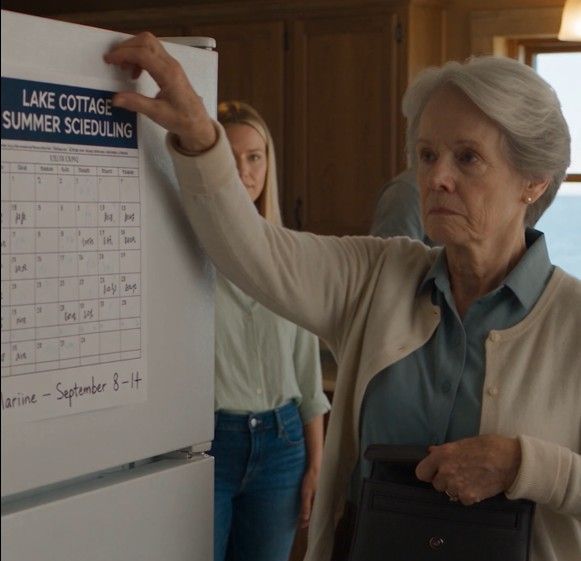
But if it wasn’t rent, what was all that money for?
The question hung in the kitchen like smoke, filling every corner, pressing against the walls. Ashley’s lips parted, but nothing came out. Her phone screen was still lit in her hand, and on it, Marianne could see a list of names — people she didn’t recognize — with dollar amounts beside each one.
Bradley set Daniel’s sailboat mug on the counter. It landed harder than he intended, and coffee slopped over the rim, spreading across the granite in a thin brown river. He didn’t wipe it.
“Ashley. I’m asking you a question.”
Ashley stood up from Daniel’s chair. She moved toward the window, one hand pressed against the small of her back the way she always did when she wanted to look like the weight of the world sat on her shoulders.
“It was a coordination fee,” she said. “People wanted to use the cottage. I helped organize everything. Scheduling, cleaning, supply lists. It’s not like I was charging them to stay.”
“How much?”
The silence lasted three seconds. In that silence, Marianne watched her son’s jaw tighten in a way she hadn’t seen since he was fourteen and had been caught lying about a car accident he’d caused in the grocery store parking lot.
“Bradley—”
“How. Much.”
Ashley swallowed. “Around… eleven thousand. Over the past two summers.”
The coffee kept spreading on the counter. Nobody moved to stop it.
Marianne lowered herself into the chair at the kitchen table — her chair, the one Daniel had built a cushion for when her back started going bad in 2019. She placed both hands flat on the wood and pressed, feeling the grain under her palms, anchoring herself to something solid.
“Eleven thousand dollars,” she repeated.
“It wasn’t—” Ashley turned from the window. “Marianne, I wasn’t stealing. These were voluntary contributions from people who were grateful to have access to—”
“Access to what? My home?”
Ashley’s mouth closed.
Bradley pulled out a chair and sat down across from his mother. He was shaking. Not visibly, not in a way a stranger would notice, but Marianne had carried this boy, nursed this boy, watched this boy sleep for thousands of nights, and she could see the tremor in his hands where they rested on the table’s edge.
“Mom,” he said. His voice cracked on the single word.
Marianne looked at her son, and something in her chest broke open — not with anger, but with a grief so old it had roots in the earth beneath the cottage.
“Daniel saw this,” she said quietly. “He saw it coming.”
Bradley’s eyes searched her face.
“The envelope,” Marianne continued. “The letter. He wrote it years ago, Bradley. Before he got sick. He knew.”
“Knew what?” Bradley asked.
“He knew that someday someone would try to turn our home into something it was never meant to be.”
From the living room, the sound of the attorney’s voice drifted through the still-open speakerphone. Richard Fenwick had not hung up. He had been listening.
“Marianne,” Richard said, his voice careful and steady, “I think it would be wise for everyone to sit down and have a full conversation. I’m fifteen minutes away.”
—
Richard arrived with a leather briefcase and the expression of a man who had seen exactly this kind of family fracture before and knew exactly how deep it could go.
He was seventy-three, white-haired, and walked with the deliberate pace of someone who understood that urgency rarely improved legal outcomes. He shook Marianne’s hand at the door, touched her shoulder briefly, and then moved into the kitchen without ceremony.
Ashley had not left. She sat on the far side of the room in the armchair she’d vacated, her phone face-down on her lap, her posture rigid. Bradley stood at the sink, his back to everyone.
Richard opened his briefcase at the table and laid out three documents.
“The cottage,” he said, “was deeded to Marianne Anne Keller in 2016 by Daniel James Keller via a revocable living trust. Daniel anticipated that family dynamics might change and included specific protections.”
He pointed to a paragraph.
“No member of the family, by blood or marriage, may lease, rent, sublease, assign scheduling rights to, or collect any form of payment — voluntary or otherwise — for the use of the property during Marianne’s lifetime. Any such action constitutes a violation of the trust terms and may result in legal action and forfeiture of the受益iciary interest.”
He looked up.
“The beneficiary interest being Bradley’s inheritance from the cottage trust.”
Ashley’s head snapped up.
“That’s not fair,” she said. “We put work into that place. We cleaned it, we maintained it, we—”
“You collected eleven thousand dollars from people who believed they were paying for access to a private family property,” Richard said, his voice flat. “You did this without the owner’s knowledge or consent.”
“They were happy to pay! Everyone loved staying there. I gave them a great experience.”
“You gave them something that didn’t belong to you.”
The words landed like a stone dropped into still water. Ashley’s face went through a rapid series of expressions — defiance, fear, a flash of something that might have been shame — before settling into a hard, tight mask.
“Bradley,” she said. “Are you going to let him talk to me like this?”
Bradley turned from the sink. His eyes were red.
“Like what, Ashley? Like someone who just found out his wife has been running a business out of his mother’s house without telling anyone?”
“It wasn’t a business—”
“You had a spreadsheet.” Bradley’s voice rose. “I saw the spreadsheet on your laptop. You had names, dates, amounts, what each group wanted in the fridge, how much extra to charge for weekends versus weekdays.”
“I was being organized—”
“You were being a thief.”
