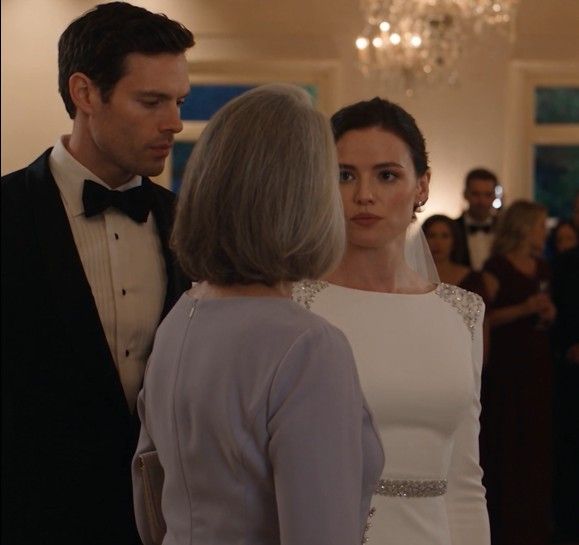
The venue manager’s name was Charles. He was a tall man with silver hair and kind eyes, the kind of man who had spent thirty years orchestrating weddings and had seen every possible family drama unfold beneath his chandeliers. But he had never seen anything like the letter Judith handed him.
He unfolded the first page. His face went pale. He read the second page. His hands began to tremble. By the third page, he was already reaching for his phone.
“Mrs. Whitmore,” he said quietly, “is this authentic?”
“It’s notarized,” Judith said. “It’s dated. It’s witnessed by my attorney. It’s legally binding.”
Charles looked at the letter. Then at Judith. Then at Amanda, who was still standing in the middle of the ballroom with her arms crossed, watching the exchange with growing unease.
“I’ll make the announcement,” Charles said.
“No,” Judith said. “I will.”
She walked past him, toward the stage where the band had been playing soft jazz. She climbed the three steps. She picked up the microphone. The music stopped. Two hundred guests turned to look at her.
Amanda’s face went white. “What is she doing?”
Jacob finally looked up.
Judith spoke into the microphone. Her voice was calm. Steady. The voice of a woman who had spent thirty-eight years being told to be quiet and had finally decided to speak.
“Good evening,” she said. “My name is Judith Whitmore. I am the mother of the groom.”
The room was silent.
“Three months ago, I paid for this wedding. Every flower. Every glass of champagne. Every plate of food. Every light in this ballroom. The venue deposit alone was forty-eight thousand dollars. I signed every page.”
She paused. She looked at Amanda. Then at Jacob.
“Three days after the payment cleared, I was moved to Table Nine. Behind a column. Beside the kitchen doors. When I asked why, I was told it was for symmetry.”
A ripple of whispers moved through the crowd.
“This morning, I was told to leave. I was told I don’t belong here. By the bride. In front of two hundred guests. And my son said nothing.”
Jacob’s face crumpled. He took a step toward the stage, but Amanda grabbed his arm.
“However,” Judith continued, “what Amanda and Jacob don’t know is that the contract they signed had a clause. A clause I insisted on. A clause my late husband’s attorney helped me write.”
She held up the letter.
“This letter is a formal revocation of payment. Because the terms of the agreement were violated. Because I was publicly humiliated at an event I funded. Because the bride and groom acted in bad faith.”
Charles stepped onto the stage. He took the microphone from Judith.
“The venue has received legal notice,” he said. “The wedding is cancelled. The reception is over. All vendors have been instructed to stop services immediately. The bar is closed. The band is dismissed. Security will escort guests to the parking lot.”
The ballroom erupted.
Amanda screamed. She lunged toward the stage. Two security guards caught her before she could reach Judith. She kicked and clawed and called Judith names that made the older woman flinch.
Jacob stood frozen. He didn’t move. He didn’t speak. He just watched his mother walk off the stage, through the crowd, toward the exit.
“Mom,” he finally called out. “Mom, wait.”
Judith stopped. She turned.
“You had your chance,” she said. “Thirty-eight years of chances. And you chose her. Every time.”
She walked out the door.
The next few weeks were chaos.
Amanda’s parents tried to sue. They claimed breach of contract. They claimed emotional distress. They claimed Judith had ruined their daughter’s wedding. But Judith’s attorney, Marcus, had prepared well. The clause was ironclad. The violations were documented. The witnesses were many. The lawsuit was dismissed.
Amanda and Jacob broke up. Not immediately. Not cleanly. But the cracks that had always been there became canyons. She blamed him for his mother. He blamed her for the humiliation. They screamed. They cried. They threw things. And then, one day, Amanda packed her bags and left.
Jacob moved back home. Not to Judith’s house. He was too proud for that. He rented a small apartment on the other side of town. He started therapy. He started calling his mother. Not every day. Not even every week. But enough.
Judith didn’t answer the first few calls. She needed time. She needed space. She needed to remember who she was without him.
But she did answer eventually.
The final twist came a year later.
Judith was cleaning out the attic. Harold had been gone for five years, but she still couldn’t bring herself to go through his things. But today was the day. She opened the boxes. She touched his old sweaters. She read his old letters. And at the bottom of a box labeled “Important Documents,” she found something she had never seen before.
It was a letter. In Harold’s handwriting. Addressed to Jacob.
She opened it.
“My son,” it read. “If you are reading this, I am gone. I am sorry I couldn’t stay. I am sorry I couldn’t see you get married. I am sorry I couldn’t be there for all the moments a father should be there for.”
She continued reading.
“I want you to know that I am proud of you. I have always been proud of you. Not because of your job or your money or your achievements. Because of your heart. Because of the way you used to run through the kitchen with spaghetti sauce on your cheeks. Because of the way you drew your mother in a red cape and told her she always fixed everything.”
Harold wrote about the wedding. About the future. About the family he hoped Jacob would build.
“I want you to marry someone who sees you,” he wrote. “Not someone who sees what you can give her. Not someone who sees what you can do for her. Someone who sees you. Someone who loves you the way your mother loved me.”
The letter ended with three sentences.
“Your mother is the best person I have ever known. She gave me everything. She gave me you. Take care of her. She deserves the world.”
Jacob read the letter in Judith’s kitchen. He cried. He cried for his father. He cried for his mother. He cried for the years he had wasted. And then he looked at Judith.
“I’m sorry,” he said. “I’m so sorry.”
