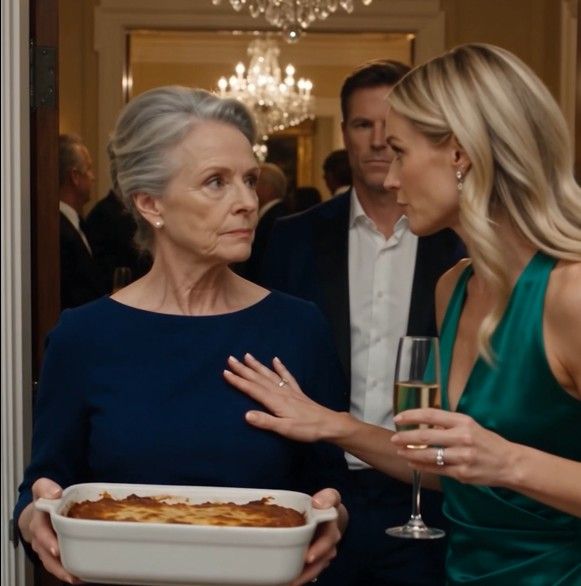
Ethan arrived early carrying a casserole.
“My favorite?” I asked.
“Your recipe.”
Brandon came ten minutes later with bread and no expectation that I would forgive anything faster than I was ready to.
We stood on the porch for a moment before I opened the door.
Then Ethan grinned.
“Do we qualify as real guests?”
Brandon closed his eyes.
I burst out laughing.
Even he eventually laughed too.
“Come through the front,” I said.
The words were simple.
But for all three of us, they meant something.
Months later, the criminal case was fully closed and the last restitution payment connected to the false filings arrived. I used part of it to establish a small emergency grant at Ethan’s university for students facing sudden housing instability.
I named it after my late husband.
When Ethan asked why, I told him the truth.
“Your grandfather believed a home should make people safer, not more powerful.”
That was the beautiful thing I chose to carry forward from the entire mess.
Not the humiliation at the door.
Not the signatures.
Not the sale.
The purpose behind the help before entitlement corrupted it.
The following spring, Ethan came by after finals. He still had a key to my new house, but he knocked anyway.
I opened the door.
He stood there holding groceries and a bunch of crooked yellow tulips.
“I thought we could make dinner.”
I stepped aside.
“Front door?” he asked with a smile.
“Always.”
He walked in, and I closed the door behind us—not to keep family out, but because at last I knew exactly whom I was choosing to welcome inside.
The new house changed the rhythm of my life in ways I had not anticipated. There were fewer rooms to maintain, no formal dining room to stage, no cellar anyone could use to impress strangers. I bought furniture because I liked it, not because it matched some expectation of what a successful family should display. For the first time in years, the place where I lived did not feel like an investment I was managing for someone else’s future.
Brandon noticed before I did.
One afternoon he stood in my kitchen looking at a row of mismatched mugs hanging beneath a shelf.
“You never would have put those in the old house.”
“Why?”
“You would have said they looked messy.”
I considered that.
“Maybe the old house made all of us perform a little.”
He nodded.
“That doesn’t excuse anything.”
“No.”
But it explained something useful. The estate had become a stage where Brittany displayed success, Brandon displayed recovery, and I displayed generosity. None of us had noticed how dangerous it was when the performance became more important than the relationships inside it.
Ethan understood that lesson fastest.
During his final year at university, he turned down an internship his mother’s old country-club contact arranged and took a paid research job instead. It paid less and impressed almost no one, which was precisely why I was proud of him.
“I want to know I earned one thing without anyone’s name opening the door,” he told me.
I smiled.
“Then make sure you remember who holds the door for other people later.”
He promised he would.
Brittany and Ethan’s relationship took longer to repair. Her conviction did not erase the fact that she was his mother. At first he refused to see her. Then, with the help of a counselor, he agreed to short visits. She apologized too broadly at first—sorry for everything, sorry for the mess, sorry things got out of control. Ethan kept asking for specifics.
Eventually, she gave them.
