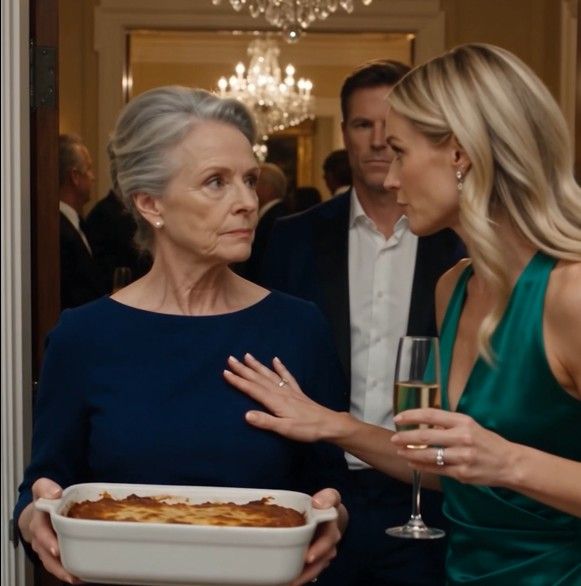
“You did.”
“I liked the house.”
“So did I.”
He smiled sadly.
Then he asked the question that mattered.
“Can I pay you back someday?”
“This is education money your grandfather and I set aside for you. The way you pay us back is by becoming someone who knows the difference between being given something and owning someone.”
He looked at me for a long time.
“I think I understand.”
I hoped he did.
The new owners took possession in early summer. They were a family with three children and an elderly father who would live in the first-floor suite. At closing, the buyer asked whether I wanted to walk through the house one final time.
I almost said no.
Then I did.
I entered through the front door.
That detail mattered.
The foyer looked exactly as it had on graduation day, but without the champagne, music, and performance. Sunlight fell across the floor. The chandeliers were off.
I walked to my late husband’s study and stood beside the desk where I had called Arthur to accept the offer.
Six years earlier, I had bought the house because Brandon was scared and embarrassed and needed somewhere safe to raise his son.
I had never regretted helping him.
What I regretted was allowing help to become a permanent suspension of boundaries.
The difference was finally clear.
Brittany eventually pleaded guilty to reduced felony fraud charges. The court imposed restitution, probation after a short custodial term, and a prohibition on serving in fiduciary roles. At sentencing, she apologized to me.
Her voice shook.
“I thought the house was going to be ours eventually.”
I believed that part.
Entitlement rarely begins as a plan to become cruel. Sometimes it begins as an expectation repeated so often that gratitude feels insulting.
“I hope you build something that is actually yours,” I told her.
That was all.
Brandon and I did not repair our relationship quickly.
He rented a townhouse and began rebuilding his business on a smaller scale. For months, he called too often. Then too little. Eventually, he learned to call without needing money, advice, or rescue.
One Sunday he asked if he could take me to lunch.
“No agenda?” I asked.
“No agenda.”
I went.
He apologized for the front door.
Not for Brittany.
For himself.
“I heard her,” he said. “And I looked away because correcting her in front of guests felt uncomfortable.”
I waited.
“I let you carry the discomfort instead.”
That was the first apology that reached me.
“Yes,” I said. “You did.”
He nodded.
“I’m sorry.”
We ate lunch.
Healing came from conversations like that, not from pretending the years before them had never happened.
With part of the sale proceeds, I bought a smaller house twenty minutes away. It had no servants’ entrance.
That was not intentional, but when Ethan pointed it out, we both laughed.
The front porch was wide, with two rocking chairs and enough room for pots of herbs. I chose it because the kitchen faced the morning sun and because I could manage the garden without hiring three people.
The first family dinner there happened in October.
