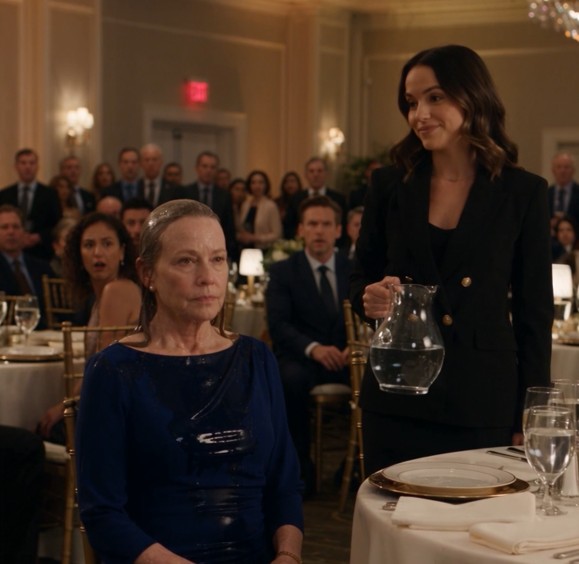
Before the scholarship launch, I had one more conversation with Travis that mattered almost as much as the one with Kendra. He came to my house on a rainy Sunday carrying a folder from the retirement committee. Inside were copies of the speeches, photographs, and notes people had submitted for the event. I assumed he wanted me to keep them. Instead, he sat at my kitchen table and said, “I need to apologize for something too.” I raised an eyebrow. He told me he had known Kendra was growing resentful for months. She had made comments about the banquet, complained that the family would spend another night “celebrating Loretta,” and accused Grant of caring more about my career than her feelings. Travis had dismissed it as jealousy that would burn out on its own. “I thought if I warned you, I’d ruin the surprise,” he said. “Then I thought if I confronted her, I’d make it worse.”
I looked at him. “You are not responsible for what she did.”
“I know. But I think I’m responsible for my silence.”
That distinction sounded familiar.
He admitted he had inherited some of my habits. Work first. Feelings later. Fix what can be measured and hope the rest settles on its own. I laughed because the description was painfully accurate. “Maybe the scholarship should come with family therapy,” I said. Travis smiled. Then he became serious. “I’m proud of you, Mom. But I think sometimes we all used being proud of you as a shortcut for knowing you.” That sentence stopped me. I had spent decades being useful, dependable, competent. People knew which machine failure could wake me at midnight and which production manager I trusted under pressure. Fewer people knew I hated surprise parties, loved cheap diner pancakes, or sometimes sat in my car for ten minutes after work because I needed silence before becoming anyone’s mother, sister, mentor, or problem-solver.
After he left, I opened the folder. Among the notes was one from a technician I barely remembered mentoring fifteen years earlier. He wrote that the most important thing I had ever done for him was not redesign a process or recommend a promotion. It was the night his wife was in labor and I told him to go home even though the line was short-staffed. “Machines remember nothing,” I had apparently said. “People do.” I had forgotten the sentence completely. He had not. I sat at the kitchen table and cried harder over that note than I had over the scholarship announcement.
That became part of my retirement work too: learning that importance was not the same thing as visibility. Kendra had attacked visibility because she believed the room’s attention proved I had taken something from everyone else. But the deepest parts of a life rarely looked like a ballroom. They looked like small permissions, remembered sentences, and choices nobody applauded. Once I understood that, the retirement dinner stopped feeling like a contest over who deserved the center of the room. It became one imperfect snapshot of a much larger history.
When Kendra and I met again several months after the coffee-shop conversation, I brought no folder, no evidence, and no rehearsed speech. We walked through a public garden. At one point she stopped beside a bench and said, “I keep thinking about the towel.” I laughed. “So does half of Hawthorne, apparently.” She smiled briefly. Then she said, “You handed me something to dry myself with after I poured water on you. I thought you were being smug.” I considered that. “Maybe a little.” She looked surprised. “Really?” “I was angry. I wanted you to know I was not going to give you the reaction you wanted.” Kendra nodded. “Thank you for not pretending you were saintly.” We both laughed. That small honesty made the relationship feel more possible than any polished forgiveness scene could have.
The scholarship launched that fall.
The first recipient was a forty-six-year-old machine operator named Elena Ruiz who wanted to complete an industrial-maintenance certification. She had two teenagers and had postponed school twice because of money.
At the award breakfast, Howard asked me to hand her the certificate.
I nearly refused.
Then Elena said something that changed my mind.
“My daughter told me it was too late to go back to school,” she said. “Then she corrected herself and said, ‘Actually, I think that’s what you always tell me not to believe.’”
I laughed.
So did Elena.
I handed her the certificate.
The applause was smaller than at my retirement dinner.
It meant more.
Afterward, Travis found me near the coffee urn.
“Mom.”
He held out a folded white linen towel.
I stared at it.
“What is that?”
“The hotel manager sent it.”
I unfolded it.
In one corner, someone had embroidered a tiny line in blue thread.
YOU MAY NEED THIS MORE THAN I DO.
I covered my mouth.
Travis laughed.
“Apparently it became a staff legend.”
I shook my head. “That is horrifying.”
“It’s funny.”
“It’s a little funny.”
I folded the towel carefully.
For months, I had worried that the pitcher would become the story people remembered about my last night at Hawthorne.
Instead, the story had changed shape.
The water dried.
The dress was cleaned.
The scholarship stayed.
Kendra and I stayed cautious with each other. Grant stopped managing our conversations. Travis stopped trying to force family harmony. I stopped giving advice before asking whether it was wanted.
Retirement turned out to be quieter than work and more difficult in different ways.
I learned pottery badly.
I volunteered one morning a week at a technical high school.
I took a train trip alone because I had spent forty-one years scheduling vacations around production calendars.
And once a year, I returned to Hawthorne for the scholarship breakfast.
At the third one, a young recipient asked why the scholarship carried my name.
Before I could answer, Elena Ruiz, now a certified maintenance technician, leaned across the table.
“Because she noticed the washer on the floor.”
Everyone laughed.
I did too.
That was good enough for me.
On the way out, I passed a framed photograph from my retirement dinner hanging in the lobby.
It was not the photograph of me soaked in water.
It showed the room standing after Howard announced the scholarship.
I was seated in the middle, stunned, Travis’s jacket around my shoulders.
Kendra was barely visible at the edge of the frame.
For a long time, I had thought that evening was about whether she could shrink me.
The photograph reminded me of something better.
A life is not measured by the loudest person trying to define it.
