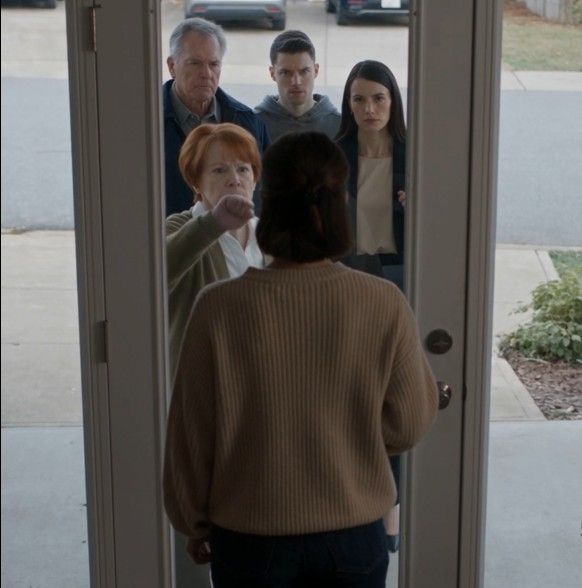
Renee made a small, broken sound.
“No,” she said. “No, he wasn’t.”
Everyone turned to look at her.
Her eyes were wet now. The paper in her hands drooped.
“He told me he was going to leave you,” she said, not to them, to me. Through the glass, directly to me. “He told me every month for a year that he was going to tell you after the holidays, after your promotion, after your mother’s surgery. He told me you were cruel and that you controlled all the money. He told me you wouldn’t let him see his family unless he obeyed you.”
My mother-in-law flinched.
Renee laughed once, a terrible, wet laugh.
“He told you I was a homewrecker, didn’t he?” she said to me. “When he died, your mother-in-law called me and said if I didn’t bring this paper today, she would tell everyone I killed him by stressing his heart. She said you would sue me for everything.”
The gold notary sticker caught the light and I saw, up close, that it wasn’t a real seal at all. It was a sticker from an office supply store.
I unlocked the glass door.
Just the deadbolt. Just an inch. The cold air rushed in.
“Give it to me,” I said to Renee.
She slid the folded paper through the gap. Our fingers brushed. Hers were ice cold.
I unfolded it on my side of the glass. Up close it was even worse. Daniel’s signature was real, I knew his hurried scrawl, but the language was clumsy, copied from the internet. The notary signature was smudged. The date was six months ago, the same week Daniel had told me he was at a conference in Denver. The witness line, in his mother’s neat, tight handwriting: *Diane Mercer.*
Diane, who was now pressing her hand to her mouth.
“Did you forge this, Diane?” I asked quietly.
“No,” she whispered. “Daniel wrote it. He asked me to sign. He said — he said it was just to make Renee feel secure. It wasn’t supposed to be real.”
“And you told Renee it was real,” I said. “You told her to bring it here and scare me.”
Caleb stepped back as if he could separate himself from his mother. Sirens sounded two blocks over, getting louder.
Renee was crying now without trying to hide it.
“I’m sorry,” she said. “I didn’t know where else to go. He owed three months rent on my apartment. He told me he couldn’t pay because you froze his cards, but you froze them because he died. I have nowhere — I lost my job when I kept leaving to see him in the hospital. I thought — I thought if I had something with his name on it —”
She wasn’t a mastermind. She was twenty-six. She was broke and grieving a man who had lied to both of us.
The police cruiser pulled up to the curb. A second one behind it. Two officers got out, hands resting lightly on their belts, not threatening, just present.
Marissa’s car pulled in right behind them. She got out in her dark wool coat, her hair pulled back, holding a manila folder like a shield. She had come in person even though I told her she didn’t have to.
One of the officers stepped onto the porch.
“Folks, we need you to step off private property,” he said. “This is a civil matter. No one is entering this home today.”
“This is my son’s house!” Diane cried, one last time, but her voice cracked in the middle. No one echoed her.
Caleb stared at the SOLD stamp as if it might peel off if he looked hard enough. My father-in-law put his hands in his pockets and looked at the ground. He would not meet my eyes. He had not met my eyes since the day Daniel told me his father was proud of me for “handling the finances so well.”
Renee stayed at the glass. She wasn’t trying to come in. She was just standing there, shivering.
“I’m so sorry,” she whispered again. To me. Not for the paper. For everything.
