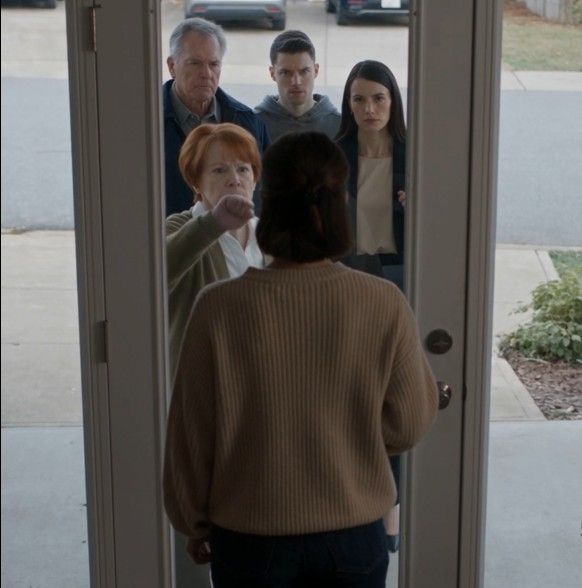
The phone in my back pocket buzzed.
It was my attorney, Marissa. I had texted her three words five minutes before they arrived: *They are here.*
I answered without taking my eyes off Renee’s paper.
“Put me on speaker and hold the phone to the glass,” Marissa said. Her voice was low and even, the way it had been when she told me three days ago, *He was never on the deed, honey. He couldn’t promise what was never his.*
I did what she told me. I held the phone up.
“Who is holding a document purporting to convey my client’s property?” Marissa asked, loud enough that all five of them could hear.
Renee blinked. The composure slipped, just for a fraction.
“I am,” she said. “Renee Adler. Daniel gave this to me.”
“Ma’am, I’m Marissa Cho, counsel for the owner of 1847 Laurel Way. What you are holding, even if it is exactly what you say it is, is not a deed. It’s not a transfer. It conveys nothing. The property is titled solely in my client’s name, acquired before the marriage, never transmuted. Your document has no legal effect.”
My mother-in-law made a sharp sound.
“That’s a lie,” she snapped at the phone. “My son lived in that house for seven years! He paid — he paid the utilities!”
“He paid the utilities with her money,” Marissa said. “Just as you did.”
That landed.
Caleb’s face twisted. He turned on Renee.
“You said this would work,” he hissed. “You said he signed the house over!”
Renee’s smile was finally gone. Her hands were trembling for real now. She looked at Caleb, then at my mother-in-law, and something raw and panicked moved across her face that had nothing to do with triumph.
“I didn’t say that,” she whispered. “You told me to bring it.”
The porch went quiet except for the traffic on the street behind them.
I saw it then. Really saw it. Renee wasn’t the one who had been driving this. She was the one who had been told to stand in front. Her purse was clutched so tight her knuckles were white. Her coat was too thin for the wind. She looked exhausted in a way that had nothing to do with makeup.
My father-in-law tried to recover.
“We have rights,” he said to the glass, to the phone. “We are his family. There is personal property in that house. His tools. His father’s watch.”
“His father’s watch is in a safe deposit box that was also in my client’s name and you were removed from access yesterday,” Marissa said. “If you attempt to enter this home, you will be trespassing on a property that is under contract to a third-party buyer with a recorded notice. The police are two minutes away. I suggest you step off the porch.”
I had not called the police. Marissa had.
My mother-in-law stared at me through the glass and for the first time since Daniel’s funeral, her voice dropped the performance.
“You think you’re clever,” she said, so softly I had to lean in to hear. “You think selling his house makes you the victim. You were cold. You were always working. You never gave him a child. Don’t pretend you’re innocent.”
The words should have cut. A month ago they would have.
Now I just looked at her. Really looked at the woman who had sat in my kitchen and let me refill her coffee while she knew her son was kissing someone else. Who had told me “Finally” when he died, as if I had been the obstacle.
“You knew,” I said. My voice didn’t shake. It barely carried through the glass, but she heard it. “You all knew about Renee. You had dinners with her. You told me she was a colleague. You let me pay for your groceries the same week you bought her birthday flowers. You knew.”
My father-in-law had the decency to look away. Caleb didn’t.
“Daniel was going to leave you anyway,” Caleb spat. “He told us. He was just waiting for the right time. That house should have been ours. You trapped him here.”
