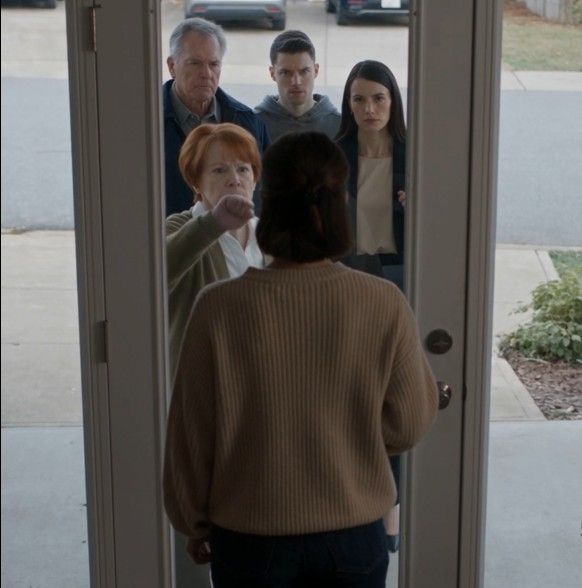
I looked at her through the glass one more time and I saw not the other woman, but the other version of me. The one who had believed him when he said he was working late. The one who had defended him.
I closed the door gently and locked it.
Marissa was on the porch now, speaking quietly to the officers, showing them the deed copy, the sale contract. Diane was arguing in a high, thin voice that kept breaking. Caleb was already walking back to their car, yanking his collar up against the wind.
I watched through the glass until they all stepped off the porch. All five of them, down the two steps, onto the walkway, onto the public sidewalk where they had to stay.
Renee was the last to leave. She looked back once. I lifted my hand, just a little. Not a wave. An acknowledgment. She nodded and turned away.
The cruisers stayed until the family’s car pulled away. Marissa stayed longer. She came to the glass door and I finally opened it all the way.
The cold air came in and I didn’t flinch.
“You okay?” she asked.
I handed her Renee’s fake promise. My hand was steady now.
“It’s a sticker,” I said, and almost laughed.
“It’s always a sticker,” she said, and took it. She put her hand on my elbow. “You did everything right. The title company has the deed. The buyer wires tomorrow. You don’t owe them a thing. Not a funeral, not a watch, not a story.”
I nodded. My throat was tight.
Inside, the house was quiet. The kind of quiet that had scared me for three weeks. Now it just felt empty in a way that could be filled.
Marissa left after we went over the closing disclosure at my kitchen table. She hugged me at the door and said, “Call me if they come back. They won’t.”
After she was gone, I sat alone at that table where I had once served Diane’s favorite lemon bars while she told me Daniel was lucky to have a “strong woman.” The contract with the red SOLD was still there, next to my coffee that had gone cold.
Someone knocked. Softly. One knock, not pounding.
I went to the glass door again and saw Renee standing alone on the sidewalk. No family around her. Just her, her thin coat, and a large, worn tote bag.
She held up a different envelope. Not folded. Thick. She mouthed, “Please?”
I hesitated, then opened the door six inches.
“I was going to leave this in your mailbox,” she said quickly, as if she was afraid I would close it again. “But I wanted to give it to you myself. It’s not — it’s not a claim. It’s his.”
She held out the envelope with both hands. Inside I could see a phone, a cheap prepaid phone with a cracked screen, and a folded letter.
“He left it at my apartment the night he died,” she said. Her voice was hoarse. “He was having chest pains. He said if anything happened to him, I should give this to you. I didn’t read all of it. I read enough. I was angry at you for a long time because of what he told me about you. But then I met you today, and — you’re not what he said you were at all.”
My fingers closed around the envelope before I could think.
“He recorded a voice memo,” she whispered. “On that phone. The night before. He knew he was cheating on both of us. He knew his mother was using you. He — he says it in there.”
The wind moved through the porch light, making it swing a little.
“Why are you giving this to me?” I asked.
“Because you paid for his funeral and they didn’t even thank you,” she said, tears spilling over. “Because he lived in your house and told me it was his. Because I’m tired of lying for people who never protected me.”
She stepped back.
“I didn’t want your house,” she said. “I just wanted him to be who he said he was.”
I held the envelope to my chest. It was warm from her tote, from being carried.
