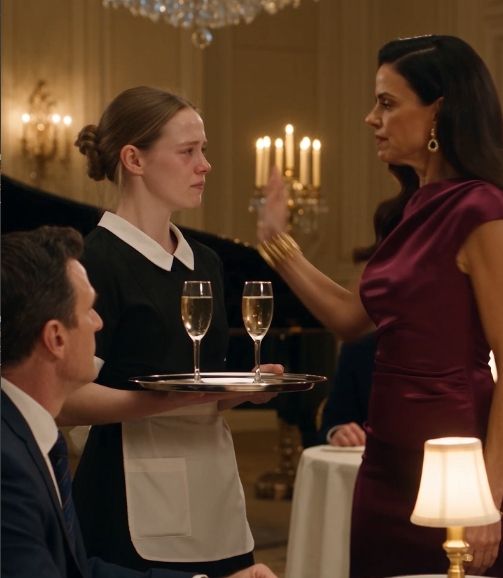
The judge looked at her for a long moment and replied, “No. You destroyed one.”
—
Vivienne — the wife, who was not a villain but had been used as one — moved out of the Castellano estate the day after the arrest. She rented a small apartment in the city. She called Elena every Sunday. Sometimes Elena answered. Sometimes she didn’t. But Vivienne kept calling, because she understood that trust rebuilt cannot be rushed.
Six months later, Elena invited her for coffee. They sat in a small café in Brooklyn, across from each other in a booth near the window, and they talked for four hours. Vivienne cried twice. Elena cried once. At the end, Vivienne slid a small velvet box across the table. Inside was a pair of pearl earrings — Isabella’s. She had found them in Sebastian’s childhood drawer.
“She would have wanted you to have these,” Vivienne said.
Elena held them up to the light. The pearls caught the afternoon sun and glowed softly, like small captured moons.
“Thank you,” she said. And meant it.
—
Arthur Voss continued to play piano. But he played differently now — with a freedom that hadn’t been there before. He played at a small jazz club on weekends, and sometimes Elena sat in the audience and listened, and sometimes she brought Sebastian, and they sat together in the back with their drinks untouched and their heads tilted toward the music.
One night, after the last set, Arthur came to their table and sat down heavily, his old hands flat on the table.
“I want you to know,” he said to Elena, “that your mother’s last words were about you. She said, ‘She’ll be safe now.’ And she was right.”
Elena reached across the table and placed her hand over his.
“You gave me a life,” she said. “You gave me Maria. You gave me a chance. That’s not something I’ll ever stop being grateful for.”
Arthur’s face crumpled, and then rebuilt itself, and then crumpled again, and he laughed through his tears and said, “You have Isabella’s stubbornness.”
“Good,” Elena said.
—
Sebastian sold the Castellano estate. Every room, every portrait, every piece of furniture that carried the weight of what his family had done. He kept only two things: the cream blanket with the golden hawk, and the portrait of Isabella that had been hidden in the family wing after the fire.
He hung the portrait in his new home — a modest house by the coast, with wide windows and a garden that Elena helped him plant. Marigolds, because Isabella had loved them. Arthur said so.
Elena moved into the house the following spring. She brought three suitcases, a shoebox of documents, and a framed photo of Maria standing on the porch of her Queens apartment, grinning with her whole face.
The first morning in the new house, Elena woke early. She walked barefoot to the kitchen, started coffee, and stood at the window watching the light change over the water. The garden was misty and still. A bird called once from somewhere in the olive trees, and the sound was so clean and so simple that it felt like a gift.
Sebastian came downstairs a few minutes later, rumpled and half-asleep, and leaned against the doorframe.
“You’re up early,” he said.
“I couldn’t sleep,” she said. “I kept thinking about something Maria told me once. She said, ‘You are not what happened to you. You are what you choose to become.’ I used to think she said that because she wanted me to be strong. Now I think she said it because she wanted me to be free.”
Sebastian crossed the kitchen and stood beside her at the window. They looked out at the garden together — at the marigolds, at the mist, at the light climbing slowly over the water.
“Isabella planted marigolds,” Elena said softly. “She planted them because they turned toward the sun no matter what. Even in bad soil. Even in shade. They just kept turning toward the light.”
Sebastian didn’t say anything. He reached over and took her hand, and they stood together in the quiet kitchen while the morning opened around them like a door finally, mercifully, swinging wide.
On the garden wall, catching the first real warmth of the day, the marigolds leaned toward the sun.
