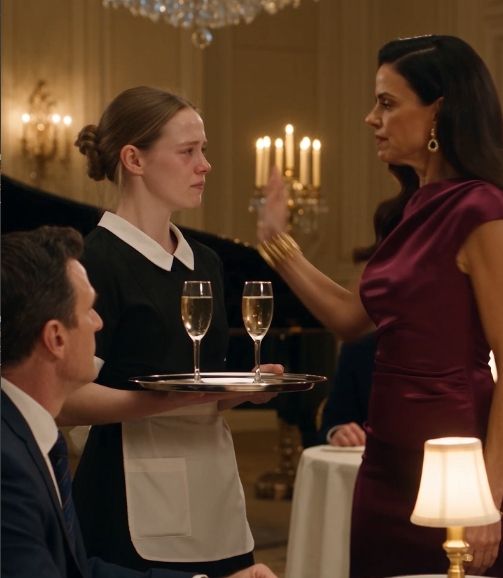
“Mother,” Sebastian said. His voice was flat. Empty. The voice of a man standing on the edge of a cliff, looking down.
“I heard there was a disturbance at dinner. Are you all right? Is Vivienne —”
“She’s here,” he said. “And so is Elena. Isabella’s daughter. The baby you told me died in the fire.”
Silence on the other end. A silence so deep and so complete that everyone in the room could hear it through the phone’s speaker.
Then Vivian Castellano laughed. It was a thin, brittle sound — the laugh of a woman whose carefully constructed world had just developed a crack so deep that light was pouring through.
“Sebastian, darling. You can’t believe —”
“Arthur is here too, Mother. He told us everything. About the forged documents. About the threats. About the night Isabella begged him to take the baby. About the fire you started.”
The silence that followed was different. Heavier. The silence of a lie that had finally run out of air.
“I don’t know what that old man told you,” Vivian began, and her voice had shifted — sharper now, harder, the warmth replaced by something that sounded like a blade being drawn from a sheath. “But I can assure you —”
“I have Isabella’s handwriting, Mother. In the photo. On the back. Elena has the birth certificate you tried to destroy. Arthur has letters. And I have fifteen years of grief that you manufactured.” His voice broke on the last word. He pressed his hand over his eyes. “My sister died in your garden. She died because of what you did. And you made me cry at her funeral while you sat there and knew the baby was alive.”
No one in the room moved.
Then Vivian Castellano said something that sealed her own fate.
“That child was never meant to be a Castellano.”
The words fell like a guillotine.
Sebastian lowered the phone slowly from his ear. He looked at Elena. At her mother’s face. At the eyes that were the same shape as his own. At the jaw, the cheekbones, the slight tilt of her chin that was so perfectly Isabella’s that it physically hurt to look at.
“She was always a Castellano,” he said to his mother through the phone. “And so are you no longer.”
He ended the call.
The click of the connection breaking was the loudest sound in the room.
Then Vivienne stepped forward. She walked toward Elena with slow, deliberate steps — each one carrying the weight of a woman who understood that she had been a weapon in someone else’s war, and who needed to lay that weapon down with her own hands.
Elena watched her come. She did not step back. She did not flinch. But her hand — the one that still held the creased photo — trembled at her side.
Vivienne stopped an arm’s length away.
“I struck you,” she said. The words came out broken, each one separated by a breath that sounded like it hurt. “I walked across this room and I struck you because a voice on the phone told me to be afraid. And I was so afraid. Not of you. Of losing him. Of losing everything I built. And that fear — that manufactured, poisoned fear — made me put my hands on someone who came here for nothing more than the truth.”
She reached into her clutch and pulled out a folded piece of paper — a handwritten note, on heavy cream stationery, with Vivian Castellano’s monogram at the top.
“She sent this to me this morning,” Vivienne said, holding it out. “She told me the server was dangerous. That she had a history of extortion. That she needed to be stopped before she ‘destroyed our family.'” Her voice cracked. “I believed her. I believed her because I wanted to. Because it was easier than wondering why an elderly woman would call me personally to warn me about a waitress.”
Sebastian took the note. Read it. His face went gray.
“Mother,” he said into the phone — he had called again, and this time she picked up — “you are no longer welcome at the estate. The trust restructuring is suspended. Your access to the family accounts is revoked as of tonight. I am calling the district attorney in the morning.”
“Sebastian —”
“You burned my sister. You buried her in silence. You tried to steal her child. And when that child grew up and came looking for her family, you sent my wife to destroy her instead of facing what you did.” His voice was shaking now, but it was the shaking of a man who had finally found the bottom of his grief and was standing on solid ground for the first time. “This is not a discussion, Mother. This is the last call you will ever make to me.”
He hung up again. This time, he turned the phone off and set it on the table.
The restaurant was a cathedral of silence.
Then Arthur Voss walked to the piano. He sat down on the bench, straightened his back, and began to play.
Not a funeral march.
A lullaby. Isabella’s lullaby — the one she used to sing to Elena as an infant, the one she had hummed to her in the garden on the last night of her life. Arthur had heard it only once, through a nursery window, fifteen years ago. But he had never forgotten it. He had carried it inside himself all this time, waiting for the day he might need to give it back.
Elena closed her eyes.
The melody filled the restaurant the way light fills a room when someone finally opens the curtains. It was simple and aching and impossibly tender, and it reached into Elena’s chest and touched the place she had been protecting since she was old enough to understand that she had been thrown away.
Tears slid down her cheeks. Not the tears of humiliation. Not the tears of a woman who had been slapped in public. These were different. These were the tears that come when a grief you have carried alone is finally witnessed by someone who says: I know. I saw. I remember her too.
Sebastian watched his niece cry, and something inside him broke open in a way that felt less like destruction and more like birth.
He crossed the distance between them. Slowly. Carefully. The way you approach a wild animal that has been hurt by humans.
“Elena,” he said.
She opened her eyes.
“I’m your family,” he said. “I should have known. I should have looked for you. I should have questioned what they told me. And I’m sorry that I didn’t. I’m sorry for every year you spent wondering if anyone was looking.”
Elena stared at him. Her lips parted, but no words came. Instead, she held out the creased photo — the photo she had carried in her apron for three years, waiting for the moment she would be brave enough to walk into a room like this.
He took it from her gently. Turned it over. On the back, in faded blue ink, was a single line in handwriting he recognized instantly.
“Protect her. — Isabella.”
He pressed the photo to his chest. And for the first time in fifteen years, Sebastian Castellano wept openly in a room full of strangers, and not one of them looked away.
—
Three weeks later, the district attorney opened a formal investigation into Vivian Castellano for arson, insurance fraud, falsification of death records, and obstruction. The evidence was overwhelming. Arthur Voss provided testimony. Maria, Elena’s foster mother, flew in from Queens and brought every document she had kept in a locked shoebox under her bed — birth records, letters, a lock of Elena’s first hair, and the cream blanket with the golden hawk, folded neatly and wrapped in tissue paper.
Vivian was arrested on a Tuesday morning, at the Castellano estate, in the garden where her daughter-in-law had died. She was led out in handcuffs past the rose bushes Isabella had planted, and not one member of the household staff opened a window to watch.
Sebastian testified at the preliminary hearing. He sat in the witness box and told the court everything — the fire, the forged documents, the funeral for a child who was alive, the phone calls, the manipulation. He did not look at his mother in the gallery. He looked at the photograph of Isabella that Elena had placed on the evidence table, and he spoke directly to her.
The trial lasted two months. Vivian Castellano was found guilty on all counts. She was sentenced to twenty-two years in a federal facility. She never apologized. She never admitted what she had done. In her final statement to the court, she said only: “I protected my family.”
