I waited.
“He said he finally understands that he didn’t want the house. He wanted what he thought the house proved.”
“What did it prove?”
“That you had a life before him. A life he could never control.”
I looked at the greenhouse glass, where the children’s reflections moved like small fragments of light.
“That is not understanding,” I said. “That is a better explanation.”
Vanessa accepted the correction.
“You’re right.”
We stopped beside the oldest garden bed.
“I still care about him,” she said.
“I know.”
“I don’t know what that means.”
“It means you cared about someone who hurt you.”
“Can both be true?”
“They have to be. Otherwise you will keep lying to yourself in one direction or the other.”
She nodded slowly.
The children began laughing near the fence.
Vanessa looked at me. “Do you think you’ll ever see him again?”
“I don’t know.”
“And if you do?”
“I will decide then.”
For the first time, she seemed to understand that uncertainty could be a boundary.
That evening, I received a final letter from Derek.
He did not ask for money. He did not ask me to contact the parole board. He did not ask me to say he had changed.
He wrote that he had started working in the prison kitchen. He wrote that he had met two men whose families had lost homes through schemes like his. He wrote that he had begun paying a small portion of his prison wages into restitution.
At the bottom, he wrote:
I wanted to be the man who owned the house.
I should have wanted to be the man who deserved to stand in it.
I folded the letter and placed it beside Thomas’s.
Then I wrote back.
I told Derek that remorse was not a bridge he could ask me to build. It was a road he had to walk, even if I never met him at the end of it.
I told him I loved the child he had been.
I told him the man he became had caused real harm.
I told him those truths would remain together.
When I finished, I did not feel healed.
Healing, I had learned, was not a door that opened once.
It was the decision to stop returning to the room where you had been wounded.
That night, I walked through the house alone.
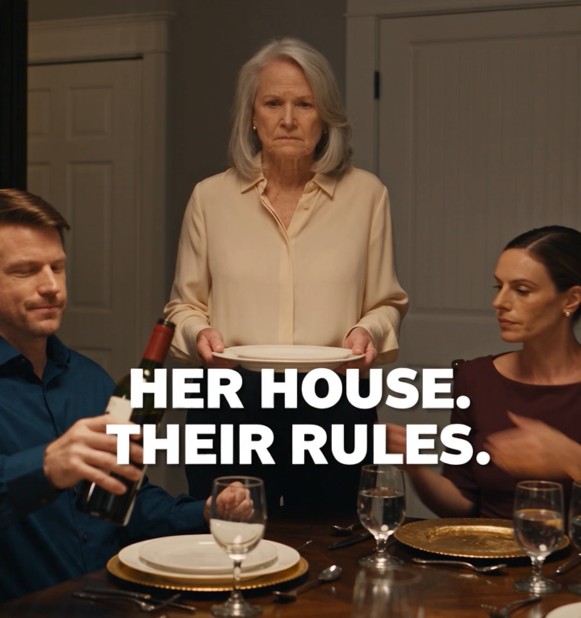
The dining room table had been cleared. The candles were gone. The plate Vanessa had taken rested in the cabinet with the others.
I touched the back of one chair.
For years, I had believed a family stayed together because everyone remained seated at the same table.
Now I understood differently.
A family stayed together only when no one had to surrender their dignity to keep a place there.
I went to the front door and turned on the porch light.
Its glow spread across the garden, touching the greenhouse, the benches, and the brass plate bearing my name.
Beyond the fence, a breeze moved through the trees.
Somewhere in the house, the old clock began to chime.
I stood beneath the light and listened.
The house did not belong to the past.
It did not belong to Derek.
It did not even belong entirely to me.
It belonged to every person who entered afraid and left knowing they still had a choice.
And for the first time since the night my son tried to take everything, I understood what Thomas had meant.
The person who kept the light on was not the person who refused to let anyone leave.
It was the person who finally learned that love could open the door without handing over the keys.
