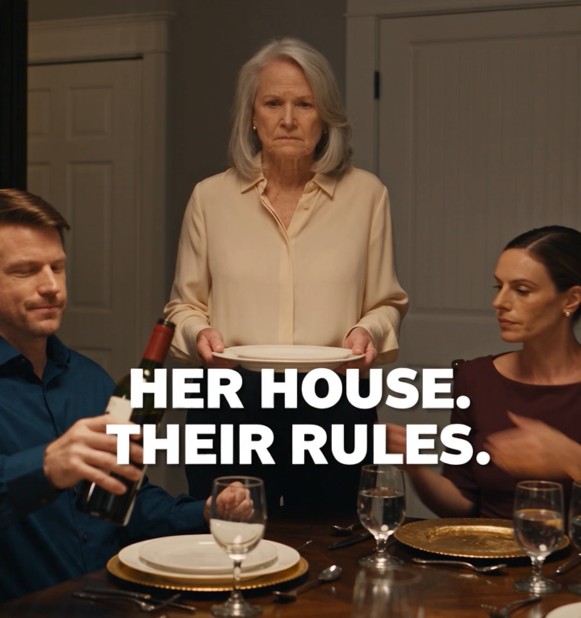
I have watched you do that too many times.
And there was one more thing I needed to tell you.
The first deed was never meant to be our final arrangement. Before I became ill, I created a trust for the house. The papers are in the false bottom of the desk in my study. The trust names you as the sole lifetime beneficiary and gives the property to the Hale Family Garden when you die, provided the home remains a place where people can begin again.
I did this because I knew what you would do if the house passed directly to Derek.
You would give it to him.
I love our son. But love cannot be allowed to destroy the person who carries it.
Keep the light on.
Thomas.
The letter slipped from my fingers.
For several seconds, I could not breathe.
Martin came toward me but did not touch me until I nodded.
“I thought I knew everything he left me,” I whispered.
“You knew what he wanted you to know.”
I laughed through my tears.
“That sounds like him.”
We went downstairs to the study.
The old desk had belonged to Thomas’s father. I had opened every drawer over the years but had never examined the carved wooden panel beneath the writing surface.
Martin found the hidden latch.
Inside was a packet of legal documents, preserved in waxed paper.
Rebecca confirmed the trust was valid.
It had been filed privately because Thomas wanted to avoid publicity and because he knew I would refuse to discuss the future while he was still alive.
The trust changed everything.
Derek had never been entitled to inherit the house.
Not because I had rejected him.
Because Thomas had seen the danger before either of us could name it.
The final twist did not make the betrayal smaller. It made the years before it clearer.
Thomas had not left me merely a home.
He had left me permission to keep it.
I read the letter again that night beneath the lamp in the study. The words were the same, but they no longer sounded like instructions from a dying man.
They sounded like the voice of the person who had known me most completely.
A month later, the Hale Family Garden opened in the backyard.
It was not an organization with grand offices or polished brochures. It was six raised beds, a greenhouse, a long wooden table, and a small kitchen where people could learn to cook affordable meals.
Rebecca helped me complete the paperwork. Martin built the benches. Vanessa donated the first set of gardening tools and never asked to be thanked.
The garden welcomed older adults who were afraid of losing their homes, people rebuilding after financial abuse, and children who needed somewhere quiet to do homework.
The first person to speak there was an elderly woman whose grandson had tried to force her to sign over her apartment.
She sat across from me, twisting a tissue in her hands.
“I feel stupid,” she said.
I reached across the table.
“You are not stupid.”
“I trusted him.”
“So did I.”
She looked at me, surprised.
I told her the truth without softening it. Trust was not stupidity. Love was not stupidity. The person who betrayed trust was responsible for the betrayal.
Her shoulders lowered.
Outside, sunlight fell across the garden beds.
The house changed after that.
Not physically. The same windows looked toward the same street. The same clock hung above the fireplace. But the rooms no longer felt like evidence of what Derek had tried to take.
They became evidence of what had survived.
One Sunday morning, children planted tomatoes beneath the greenhouse roof. Martin carried trays of seedlings from the kitchen. Vanessa arrived with a box of donated books and stood uncertainly near the gate.
I waved her in.
She had cut her hair and found work at a small accounting firm. She had begun therapy. She had not spoken to Derek in weeks.
“I brought something,” she said.
She opened the box.
On top was a book about restoring old houses.
“Why this?” I asked.
“I thought you might like it.”
“I might.”
She smiled faintly.
We walked along the garden paths together.
“I received a letter from Derek,” she said.
