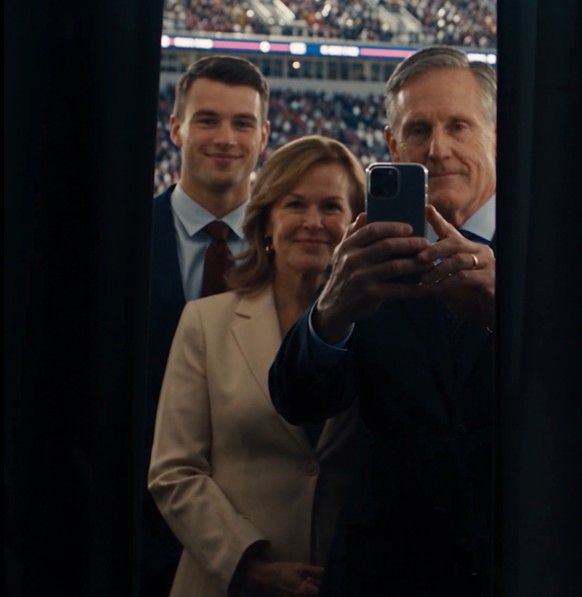
“Leave them.”
He looked confused.
“This is your graduation,” I said. “I don’t need you to shrink your life to prove mine mattered.”
That sentence changed something between us. For years, comparison had been the language our family spoke most fluently. If Derek was praised, I believed I had been diminished. If my career was finally respected, he feared his place might disappear. I did not want our repair to repeat the same system with the roles reversed.
At dinner, Dad raised his glass to Derek. He hesitated before speaking, then lowered it again.
“I think I have spent too much time deciding which accomplishments count,” he said.
No one rescued him from the discomfort.
He looked at me. “Sarah, I do not know enough about your work to give some grand toast. I should have learned more years ago.”
Then he turned to Derek. “And I am proud of you without needing your sister’s life to be less important.”
Derek swallowed hard.
It was clumsy, but it was new.
Later, Mom asked if she could see the commissioning speech that had once sat beside my cold coffee. I told her I still had it in a box. She did not ask me to send it immediately. She only said, “If you ever want me to read it, I would like to.”
That distinction mattered too. She was learning that remorse did not create a right to every piece of the past.
Over the next year, the changes were small enough that no one outside our family would have noticed.
Mom stopped asking whether I was “still doing Army things” and started asking what I was allowed to tell her about my work.
Dad learned the difference between a battalion, brigade, and division because he chose to read, not because I lectured him.
Derek and I began calling each other without our parents on the line. For the first time, we learned who the other person was when no one was comparing us.
He admitted that being the favored child had frightened him in ways I had never considered. Every success became something he had to repeat. Every mistake felt like a threat to his place in the family.
“I thought you were free,” he told me one night.
“I thought you were loved more.”
“Maybe we were both wrong.”
Maybe we were.
Six months after the ceremony, I returned to the academy for a leadership seminar. Mom asked whether families were allowed to visit the grounds.
“Yes.”
“Would it be strange if we came?”
I considered the question longer than she probably expected.
“No,” I said. “But I do not want a replacement graduation.”
“I understand.”
And she did.
They came on a quiet Friday morning when there were no crowds and no applause. I walked them past the field where I had crossed alone years earlier. Dad stopped near the edge and looked toward the stands.
