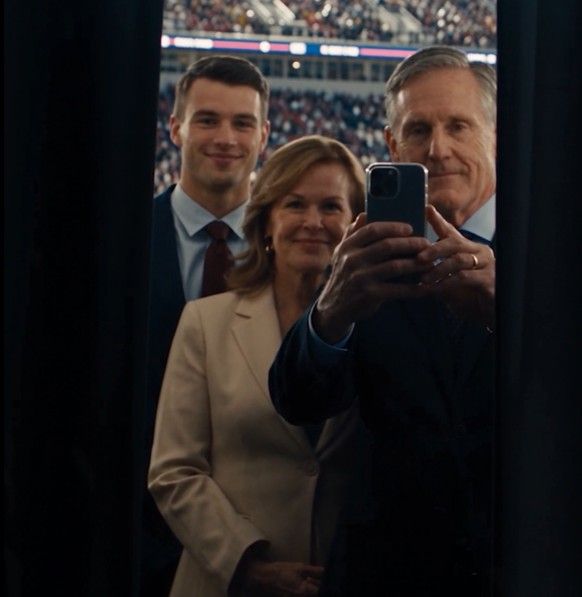
My mother once told me that graduating from one of America’s most respected military academies was not worth buying a plane ticket for. Two years later, she flew across the country for my brother’s MBA graduation, never realizing that the ceremony’s Guest of Honor would be the daughter she had chosen not to watch graduate. My name is Sarah Mitchell, and the message that changed something inside me arrived at 9:47 on a Tuesday morning. My dress uniform hung beside the closet. My commissioning speech rested on the kitchen table beside cold coffee, a yellow legal pad, and half a bagel I had forgotten to finish. In less than twenty-four hours, I would complete the final requirements for one of the most demanding accomplishments of my life and begin my career as a U.S. Army officer. Then my phone buzzed. Mom. “Sarah, your father and I have decided that we won’t be attending your graduation. We feel you’ve spent too many years chasing a military career that keeps you away from home. Your brother’s MBA graduation is in two years, and that is the one that will truly determine his future.” I read it twice. Another message appeared. “It’s embarrassing telling people that our thirty-year-old daughter is still going through military training.” Outside, cadets crossed campus toward graduation rehearsals. Inside, I stood beside the uniform I had spent eight years working toward and finally understood that my parents did not see discipline, sacrifice, or service. They saw something embarrassing. I completed every remaining requirement with distinction. When the commanding general shook my hand, he looked directly at me. “Congratulations, Second Lieutenant Sarah Mitchell.” Three days later, I adjusted my dress uniform alone. No mother fixing my collar. No father taking photographs. No brother waiting in the stands. When my name was called, I crossed the parade field while thousands of strangers applauded. That evening, I ate takeout alone and kept checking my phone, hoping for something that sounded like pride. Mom eventually sent four words. “Did everything go okay?” That was when I stopped trying to convince my family that my life mattered. I focused on becoming the officer I wanted to be. I completed Ranger School, led soldiers through demanding training, accepted difficult deployments, and served beside people who measured me by my judgment and leadership rather than whether my choices impressed anyone at home. Promotion followed promotion. By 2028, I had become one of the youngest Colonels in the United States Army, trusted with major responsibilities and helping guide younger officers. Then the academy invited me back as Guest of Honor and keynote speaker for a new commissioning ceremony. By coincidence, it fell on the same weekend my younger brother Derek would receive his MBA from a nearby university. The schools were holding a joint recognition event for distinguished alumni and graduating students. My parents arrived days early for Derek. Hotel rooms. Family dinners. Expensive cameras. Endless excitement about celebrating their son. They had no idea I was waiting backstage only a few miles away. Through the curtain, I saw Mom in a cream blazer. Dad held his phone ready to record. Derek sat beside them smiling. Then the academy superintendent stepped to the microphone. “Please join me in welcoming Colonel Sarah Mitchell, one of our most distinguished graduates, whose leadership and service to the United States Army have inspired officers across the nation.” The stadium erupted. I stepped into the light. Dad slowly lowered his phone. Derek turned toward our parents in disbelief. And before I reached the podium, I looked directly at the mother who had once decided my graduation was not worth the trip—and watched her proud smile disappear. She still had no idea what I was about to say. 👇
I reached the podium and let the applause settle on its own.
From where I stood, the stadium looked different than it had from behind the curtain. Thousands of faces rose in curved rows around the field. Families leaned toward one another. Graduates sat straighter in their seats. Cameras lifted.
My father’s did not.
He was still holding his phone at chest level, but the screen had gone dark. Derek stared at me with his mouth slightly open. Mom’s hands were folded tightly over the program in her lap.
For one strange second, I was thirty again, standing alone in a dress uniform while a crowd applauded an accomplishment my family had decided was not worth seeing.
Then I looked at the new officers seated below me and remembered why I had agreed to return.
“Thank you,” I began. “It is an honor to stand here again.”
My voice did not shake.
I spoke about discipline first. About the dangerous belief that courage arrives fully formed, when in reality it is built through repeated decisions no one sees. I spoke about failure, exhaustion, responsibility, and the quiet discipline of doing what is required when there is no applause waiting at the end.
The graduates listened closely.
I did not mention my parents.
Not at first.
Instead, I told the cadets that one of the hardest parts of service was learning the difference between being supported and being understood. Sometimes the people who loved you would not understand your choices. Sometimes they would be afraid of them. Sometimes they would reduce them to the part they could explain to other people.
“That can hurt,” I said. “But do not build your identity around the approval of people who have not carried your responsibilities.”
A stillness moved through the stadium.
I saw Mom lower her eyes.
I continued.
“When I graduated from this academy, some of the seats I had hoped would be filled were empty.”
Derek turned toward our parents.
Dad’s jaw tightened.
I did not say who had stayed home. I did not repeat Mom’s message. I did not turn a commissioning ceremony into a family trial.
“The empty seats taught me something I did not want to learn,” I said. “A meaningful life cannot depend on whether someone else recognizes it in time.”
Several cadets nodded.
“So serve well when people understand. Serve well when they do not. Lead people in a way that makes them safer, stronger, and more capable. Let the work become evidence.”
I paused.
“And when you are given the chance to show up for someone else, show up. Do not assume there will always be another ceremony.”
That was the only sentence that nearly broke me.
I finished with the oath, the weight of command, and the privilege of leading soldiers who would trust these new officers with their lives. When I stepped away from the podium, the applause rose again.
This time, I did not look toward my family.
The superintendent met me at the stairs and shook my hand. A line of graduates waited near the side of the stage, and for the next twenty minutes I spoke with young officers and their parents. One mother cried while asking me to take a photograph with her daughter. A father told me his son had nearly quit after an injury but had returned.
I stayed present.
That mattered.
By the time I was escorted toward the reception area, I had almost convinced myself my family might leave without approaching.
Then Derek appeared.
He stopped six feet away.
“Sarah.”
I looked at him.
He was still wearing his university stole from the joint event, the edge of it folded over one shoulder. For most of our lives, Derek had been the child whose milestones came with reservations, hotel rooms, framed photographs, and planning. I had spent years pretending I did not resent him for benefits he had not personally demanded.
He took one cautious step closer.
“I didn’t know.”
“About what?”
He gave a helpless glance toward the field. “Any of this. Colonel. Ranger School. The keynote. All of it.”
“You never asked.”
The sentence landed harder than I intended.
He looked down.
“No. I didn’t.”
Behind him, Mom and Dad were moving slowly through the crowd.
Derek followed my eyes. “Can we talk before they get here?”
I considered saying no.
