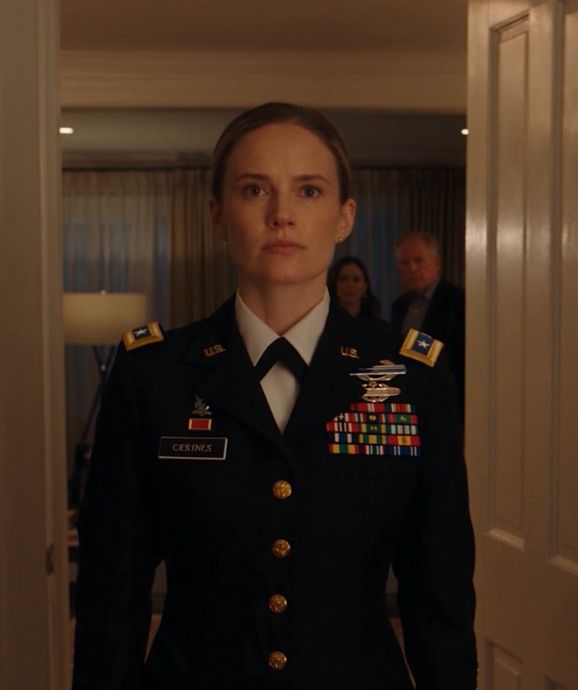
My sister mocked my military rank in front of hundreds of people watching her livestream, and my father warned me not to embarrass the family. Twenty-six minutes later, two police officers walked through the front door and told me I needed to leave with them. Nobody in that house knew what I had really been doing for the last five years. I had been home less than thirty minutes when Tiffany opened the door with her phone already aimed at my face. “Oh my God,” she laughed toward the livestream. “She actually showed up.” My mother immediately began explaining that I had disappeared for five years without photographs, updates, or explanations. That was not true. I had given Tiffany the emergency contact number and secure mailing address I was permitted to provide. But the limits surrounding my work were much easier to turn into a family story about abandonment. Tiffany pointed the camera toward my uniform. Her eyes moved over the insignia on my shoulder before she smiled. “So… that’s your rank?” Several people laughed. Her boyfriend Brad stepped closer. “You’re actually military? You don’t exactly look like someone in leadership.” Tiffany watched comments race across her screen. “Brad has an actual leadership position. My sister basically has some low-level job on a base somewhere.” I could have corrected her. I didn’t. There were reasons my family had never seen my medals, reasons they had never been told where I was stationed, and reasons five years of my career remained behind classifications I could not discuss with them. Dad finally looked at me. “Whatever you do tonight, don’t embarrass this family.” I almost laughed. Then a voice drifted from his office. “Sign here, and we can finalize the transfer.” The door stood slightly open. I moved closer. Documents covered Dad’s desk: a transfer packet, notary page, county recording forms, and an inventory of assets that still carried my grandmother’s name along the margin. Grandma had left those assets to me. Across the thickest packet, one word was printed in bold letters. TRANSFER. Mother appeared behind me. “It’s going to Tiffany,” she said. “You were gone. We needed to be practical.” Practical. I looked toward the wall beside the desk. The silver-framed photograph of Grandma and me from the day I shipped out was gone. Only a faded rectangle remained. I said nothing. I photographed every document I could see—the signatures, stamps, watermark, business card, and recording information—then returned to the party. Three heavy knocks struck the front door. The music stopped. Two police officers entered. One opened a complaint summary. The other watched my hands. Tiffany pointed immediately. “That’s her.” My parents did not ask what I was supposedly accused of doing. If anything, they looked relieved. One officer stepped toward me. “Ma’am, you’ll need to come with us.” I didn’t argue. I didn’t plead. And I still did not explain myself. Then headlights swept across the living-room curtains. A black SUV stopped outside. Then another. Then a third. Tiffany’s livestream was still running when the front door opened again. A man in full dress uniform entered. Four stars caught the porch light. The room went silent. His gaze moved from the officers to Tiffany’s phone, then toward the complaint in one officer’s hand and the transfer documents visible through the open office doorway. Finally, he saw me. His expression changed immediately. He crossed the room, stopped directly in front of me, and saluted. Brad’s grin disappeared. Dad went pale. Tiffany slowly lowered her phone. Then the four-star general turned toward the two police officers and began to speak—but nobody in my family had heard his first sentence yet. 👇
The general’s first words were not loud, but they changed the shape of the room.
“Officers, before anyone leaves, I believe you should hear the full context of what brought you here.”
He did not tell them to stand down. He did not claim authority he did not have. He simply turned his body enough to include everyone—the officers, my parents, Tiffany, Brad, and me—and waited until the last trace of party noise had disappeared.
The older officer holding the complaint looked at him, then at me. “Sir, this is a local matter.”
“I understand,” the general said. “And I respect that. I’m asking for two minutes because Colonel Evelyn Ward is scheduled to meet with me tonight, and the timing of this complaint may be relevant to what you decide to do next.”
Tiffany made a small sound behind her phone.
Colonel.
That one word did more damage to her confidence than anything I could have said earlier.
Brad stared at the insignia he had laughed at as if it had changed while he was not looking. Dad gripped the back of a chair. Mother’s face went strangely blank.
The officer with the complaint turned to me. “Colonel Ward?”
“Yes.”
“What is this complaint about?” the general asked.
The officer read from the summary. Tiffany had reported that I entered the home, threatened family members, photographed private financial records without permission, and refused to leave when told. She had also claimed that I had become “aggressive and unstable” after being confronted about property that no longer belonged to me.
I felt something inside me go still.
Not because the words surprised me. Because they were so carefully arranged around the truth.
“I was invited here,” I said. “I have not threatened anyone. I photographed documents in the open office after I recognized assets identified with my grandmother’s estate. I was never told to leave before you arrived.”
Tiffany stepped forward. “She’s lying.”
The second officer lifted one hand. “Ma’am, please let her finish.”
That was the first time all evening anyone had interrupted Tiffany instead of me.
The general looked toward the office. “Are those the documents?”
Dad moved so quickly that his shoulder struck the doorframe. “Those are family papers.”
“Then no one should touch them until the officers decide whether they matter to the complaint,” I said.
Dad looked at me as if I had betrayed him.
For years, my silence had been useful to them. It allowed them to fill every blank with whatever version of me caused the least inconvenience. I was absent because I did not care. I never sent photographs because I was ashamed. I never discussed work because my work was unimportant. Now, for the first time, my refusal to explain myself was not protecting their story.
It was protecting mine.
The officer asked Tiffany when she had called. She gave a time.
I unlocked my phone and showed him the photographs. The metadata placed me in the office less than four minutes before the call. Then I showed him Tiffany’s livestream, still running, still recording comments from strangers who had watched the evening unfold.
“Your broadcast has been live the whole time?” he asked her.
Tiffany lowered the phone another inch. “Most of it.”
“Then it may help establish what happened.”
Her mouth tightened.
Brad glanced toward the kitchen as if considering whether he could quietly disappear.
The officer did not arrest me. He did not arrest Tiffany either. He separated us, took statements, and asked everyone to stop handling the documents until he finished. The general waited without interfering. That mattered to me more than the salute.
When the officers finally left, they told Tiffany the complaint would be reviewed with the available video and statements. They told me I was free to go.
I should have walked out then.
Instead, I turned toward the office.
“Who prepared the transfer?”
Dad’s expression hardened. “You don’t get to interrogate me in my own house.”
“I asked a question.”
Mother answered before he could. “A lawyer helped us with some paperwork.”
“Which lawyer?”
Silence.
I looked at the business card I had photographed. “Daniel Kessler?”
Dad’s face changed just enough.
The general noticed.
So did I.
I called the emergency number for the attorney who had handled Grandma’s estate years earlier. I had not spoken to her since before my last assignment, but I still had the contact saved. She answered on the fourth ring, listened without interrupting, and asked me to send the photographs through her secure client portal.
“You have not signed anything authorizing a transfer?” she asked.
“No.”
