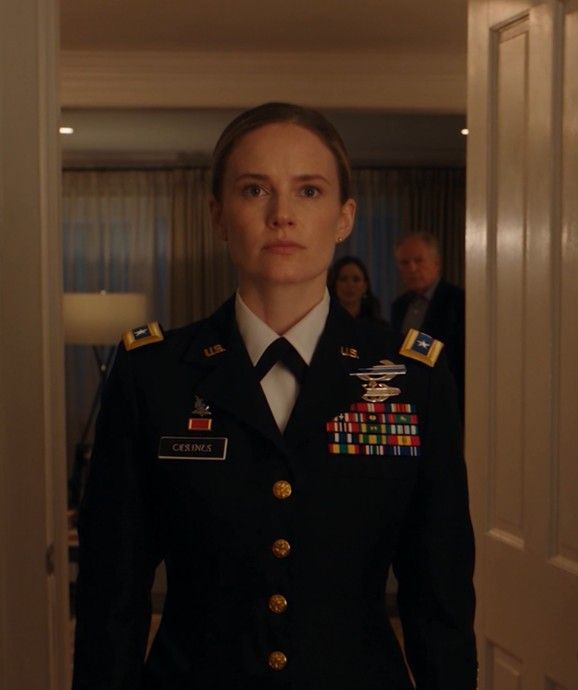
“No.”
“Who sent the frame?”
“Dad.”
I looked at Grandma’s handwriting again.
“Why didn’t he call?”
Tiffany was quiet. “He said he didn’t know what he could say that wouldn’t sound like another excuse.”
That was the first honest thing I had heard from him in years.
I did not rush back into the family. I did not pretend one package repaired five years of dismissal or one abandoned transfer erased what they had tried to do. But I agreed to dinner two months later, with no livestream, no boyfriends, no documents on the table, and no one allowed to ask me questions I could not answer.
Dad arrived first.
He stood when I entered.
For a second, neither of us moved.
Then he said, “I spent years calling your silence arrogance because it was easier than admitting I didn’t understand your life.”
I put my coat over the back of the chair.
“That’s true.”
He nodded.
“I’m sorry.”
It was not a perfect apology. It was not eloquent. It did not erase anything.
But it did not contain a defense.
So I sat down.
Tiffany arrived ten minutes later carrying no phone in her hand. Mother brought Grandma’s old recipe box. We ate slowly. There were awkward pauses. There were things nobody knew how to say. There were also moments when no one rushed to fill the silence.
That felt new.
We did not become a repaired family in one dinner. The next months were slower and less cinematic than anyone would have wanted. Tiffany and I met twice without our parents. The first time, we spent forty minutes talking about practical things because neither of us trusted the larger subjects. The second time, she brought up the livestream herself. She told me she had downloaded the recording before deleting it because she wanted to understand what she had looked like from the outside. She said the hardest part was not hearing herself laugh. It was watching our parents remain silent while the police entered.
“I kept thinking they would ask what happened,” she said. “They never did.”
“No,” I answered. “They didn’t.”
She apologized for the complaint, for the transfer, and for turning uncertainty about my life into entertainment. I accepted the apology without telling her that acceptance meant trust had returned. It had not. Trust was something she would have to build through repetition: no filming without permission, no using family conflicts as content, no treating access to me as proof that everything was fine.
Dad had his own work to do. The independent accounting showed no missing fortune, but it did show how casually he had made decisions about property that was not his. My attorney required future notices to go through the management company, not through him. He hated that boundary at first. Then, gradually, he began forwarding documents without commentary. The small change mattered. He was learning that helping did not mean controlling.
Mother started calling once a month. Sometimes we talked for ten minutes. Sometimes two. She never again asked where I was when I told her I could not say. The first time she simply replied, “All right. Call when you can,” I had to close my eyes for a second because respect, after years without it, could feel almost as disorienting as cruelty.
A year later, I moved into a small house near my next assignment. I did not choose one of Grandma’s properties. I kept those professionally managed and used part of the income to maintain the scholarship she had established long before any of us understood how much paperwork could divide a family.
On the first night in my new home, I unpacked almost nothing.
One lamp. One mug. One uniform bag.
