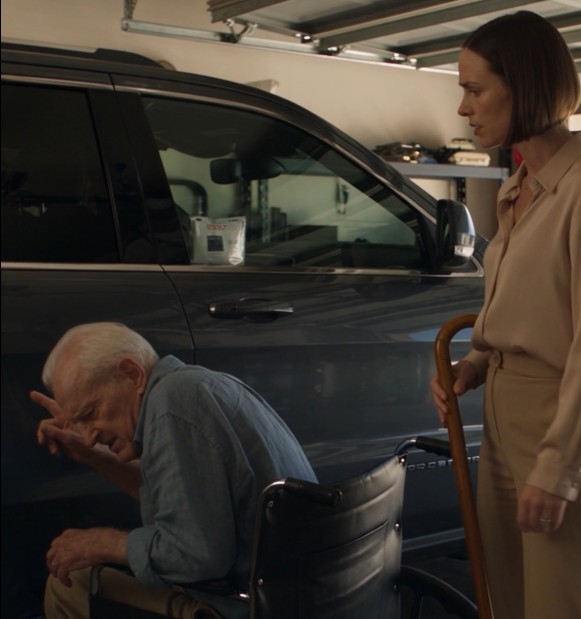
She admitted throwing the cane, pushing the wheelchair, and resenting the money she believed he should give them.
She also wrote that she had convinced herself Henry was exploiting David by living in the house.
Henry almost laughed at the inversion.
He had paid his own expenses and more.
But he kept reading.
At the bottom, Lauren wrote: I turned you into a cost so I would not have to look at what I was costing everyone else.
That sentence was the first part he believed.
He did not write back.
Forgiveness was not correspondence he owed on a deadline.
David visited every Sunday.
At first, the visits were heavy with confession.
Henry stopped him after the third week.
“I do not want our relationship to become a courtroom where you keep pleading guilty.”
David looked surprised.
“What do you want?”
“A son who notices when the coffee is empty.”
David laughed.
Then he got up and made more coffee.
The ordinary ritual helped.
They talked about baseball. Weather. A documentary Henry disliked. David’s work. The knee exercises Henry kept trying to avoid.
Sometimes they talked about Lauren.
Mostly they did not.
Henry’s adjustment to the new apartment was not as effortless as he pretended to David. The first night, every unfamiliar sound woke him. An elevator bell in the hallway. A cart rolling across tile. A neighbor closing a cabinet. Twice he woke convinced he was back in the garage, wheels gathering speed beneath him. His hand reached automatically for a brake that was not there. The second time, he turned on the bedside lamp and sat with both feet on the floor until his breathing slowed. The social worker had warned him that danger sometimes remained in the body after the danger ended. Henry had nodded politely and assumed that happened to other people.
He began seeing a trauma counselor at the medical center. At the first appointment, he complained that the whole thing felt excessive. “I was pushed in a wheelchair, not sent to war,” he said. The counselor asked whether he believed fear had to compete for legitimacy. Henry had no answer. Over several sessions, he admitted that Lauren’s behavior before the driveway had already changed him. He had stopped entering the kitchen when she was there. He timed his showers so he would not be accused of using too much hot water. He kept medication in his room because she made comments about clutter when his pill organizer sat on the counter. None of those details had seemed important enough to report. Together, however, they described a life becoming smaller. “The driveway was fast,” he said one afternoon. “The shrinking was slow.” The counselor nodded. That became the sentence Henry used to understand what had happened.
David’s counseling moved differently. He began reconstructing the years in which arguments with Lauren had become predictable loops. She would demand something, he would resist, she would escalate, and eventually he would agree in exchange for calm. Each time, the next demand began from the new baseline. David had told himself compromise was part of marriage. His counselor asked whether compromise required both people to retain the right to say no. David called Henry afterward and said, “I think I forgot no was supposed to remain available.” Henry replied, “So did I, in that house.” Neither man liked realizing how similar their adaptations had become.
The financial work exposed another pattern. Lauren had often framed purchases as symbols of whether David believed in their future. The SUV meant they were successful. The kitchen meant the house was becoming valuable. The vacations meant they were not living like frightened people. Saying no to a purchase became, in her language, saying no to the life they were building. David had participated willingly for years, but once the debt grew, the symbols became chains. The credit counselor made him list each balance and interest rate in plain numbers. “No symbolism,” she said. “Just math.” David later told Henry that watching emotion drain out of the spreadsheet felt like opening a window.
Henry also reviewed his own finances with an adviser, not because anything had been stolen, but because he wanted certainty. Every pension deposit, investment account, beneficiary designation, and recurring transfer was documented. He changed passwords. He ended the monthly household contribution he had been sending to David’s old address and redirected that amount into his own housing expenses. The first month he saw the new balance, he felt guilty. The feeling surprised him. He had spent so long being told his presence cost money that using his own money for his own accessible apartment felt selfish. His adviser said, “You saved for retirement so retirement could support you.” Henry laughed. “Apparently I needed professional permission to believe that.”
David refused money when Henry offered to pay part of the divorce attorney’s retainer. “You said you would help me get advice, not finance my escape,” he reminded him. Henry felt oddly proud and annoyed at the same time. “You are becoming difficult,” he said. David smiled. “I’m practicing.” That exchange became another marker of change. David was not replacing Lauren’s control with his father’s rescue. He was learning to make decisions he could afford and consequences he could carry.
One afternoon, Lauren’s apology letter arrived while Henry was at physical therapy. He left it unopened on the kitchen counter for two days. In the past, a letter from her would have controlled the entire room until he read it. This time, he finished his exercises, watched a baseball game, ate dinner, slept, and chose the moment himself. The envelope did not become less important. He simply remembered that urgency belonged to him now. When he finally opened it, he read slowly and stopped whenever his body tightened. That was new too. He did not owe anyone access to his nervous system on demand.
The senior community gave Henry small ways to rebuild confidence. He joined a walking group that moved slowly around the indoor atrium on bad-weather days. He volunteered once a week at the front desk, mostly helping residents figure out package deliveries and printer problems. One woman named June teased him because he polished his cane even on days he did not use it. “Sentimental?” she asked. Henry considered the question. “Evidence,” he said. She raised an eyebrow. “Of what?” He looked toward the automatic doors opening for a resident in a wheelchair. “That things can be repaired without pretending they were never damaged.” June nodded as if that made perfect sense.
Those months changed Henry’s idea of independence. He had once imagined it as never needing help. After the driveway, independence became the ability to choose help without surrendering authority. He let David carry groceries when his hip hurt. He asked the pharmacist to deliver medication during snow. He accepted a shower bar installation from the building maintenance team. None of those choices made him smaller. The difference was consent. Help offered and accepted felt nothing like control imposed and endured.
The criminal case ended with a plea that included probation, mandatory counseling, and no contact with Henry except through legal channels. The exact language mattered less to Henry than the fact that the record did not call the wheelchair incident a misunderstanding.
Something happened.
It had a name.
He no longer had to argue for reality.
David filed for divorce after several months of separation.
He did not ask Henry whether he was making the right choice.
He told him after the paperwork was filed.
“I kept waiting to be sure enough,” David said.
“And?”
“I realized fear was already information.”
Henry nodded.
He had said something similar months earlier without knowing whether his son heard it.
Apparently he had.
The divorce forced the debt into the open. Assets were sold. Accounts divided. David’s credit score fell. He moved into a smaller apartment.
He survived.
That fact seemed almost offensive after years of being told every boundary would cause financial ruin.
One Saturday in spring, David arrived at Henry’s apartment carrying a long narrow package.
“What is that?” Henry asked.
“Open it.”
