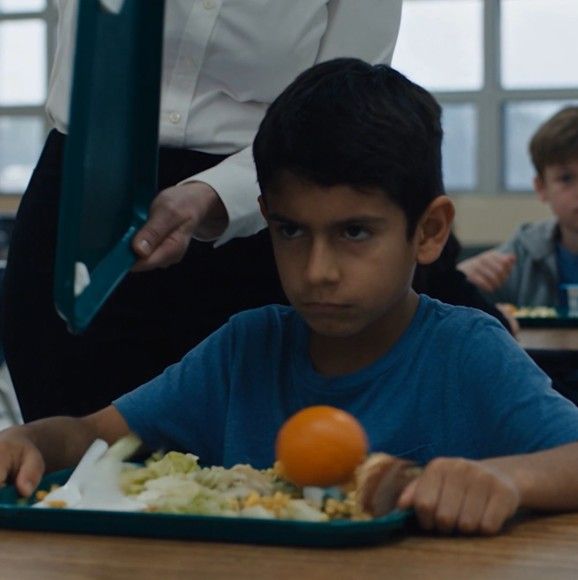
“I’m not hungry,” he said.
She sat beside him. “You do not have to be hungry right now.”
She left the tray between them.
After a minute, Mateo picked up the orange.
He did not peel it. He just held it.
His mother told him the payment envelope was not his responsibility after he handed it to the office. She told him that adults sometimes made children feel responsible because it was easier than admitting an adult had made a bad choice.
Mateo looked at her shoes.
“I didn’t want you to have another number.”
She frowned. “What number?”
He told her about the grocery totals on the backs of envelopes. He told her he knew she counted twice. He told her he had decided not to worry her about lunch because she already had enough things to add.
His mother covered her mouth.
Then she pulled him against her so suddenly the orange rolled onto the floor.
“You are not a number,” she said into his hair.
Mateo started crying then.
Not loudly. He had held the tears so long that they came out as small, angry breaths.
His mother let him hide his face against her shoulder until he was finished.
The next day, the school district sent an administrator to review the cafeteria records. The principal interviewed students and staff. The yellow legal pad became the center of the review because it showed the problem had not been an accident or a single delayed entry.
Mrs. Kessler had created her own system.
She had been accepting cash, including it in school deposits, then withholding meal credits from children whose families she believed needed pressure. Sometimes she restored the credit later. Sometimes only after a parent called. She had convinced herself the money was safe because every dollar eventually reached the school.
What she had ignored was what happened to the children in the meantime.
Several had been given smaller substitute meals. Two had skipped lunch rather than stand in the separate line. One had begun telling his mother he was not hungry at school.
The district removed Mrs. Kessler from cafeteria supervision while the review was completed. She did not return to student meal service.
For Mateo, the hardest part of the review was not hearing what Mrs. Kessler had done. It was hearing how many children had found ways to make the humiliation invisible. One girl had learned which days her account was low and claimed stomachaches before lunch. The fourth-grade boy had thrown away notes from the cafeteria because he did not want his father to know he had been given a substitute meal. Another child had started keeping crackers in a coat pocket. None of them had used the word afraid. They had used words like annoying, embarrassing, weird, or not a big deal. Mateo recognized the translation immediately.
At home, his mother began leaving the grocery envelopes on the counter instead of hiding them beneath a cookbook. She did not suddenly have more money, and Mateo did not suddenly stop noticing when she counted. What changed was that she explained what the numbers meant. Rent was paid. The electric bill was covered. Groceries had a limit, but a limit was not a disaster. If something went wrong, she wanted him to tell her before he tried to solve it alone.
One evening Mateo asked whether the missing lunch payment had caused trouble.
His mother was washing rice at the sink. She turned off the water before answering.
“It caused me anger,” she said. “That is different from trouble.”
He waited.
“Trouble is something we handle together. What happened at school was an adult putting shame on you because she thought you would carry it quietly.”
Mateo looked at the grocery list taped to the refrigerator. “I did carry it quietly.”
