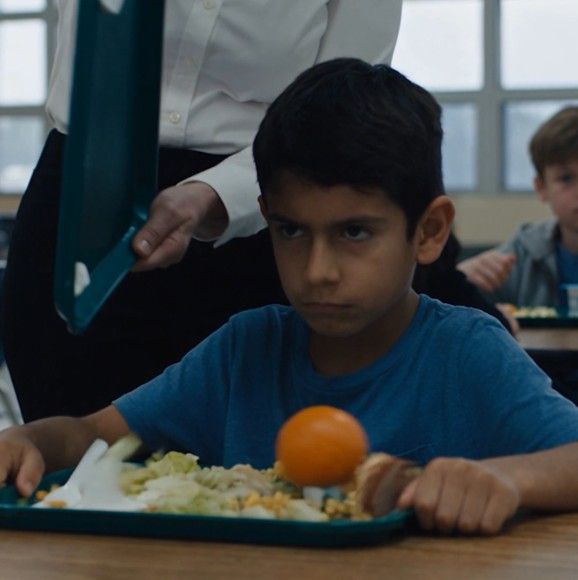
The cafeteria supervisor tipped the tray into the trash while the boy was still holding his spoon. Behind him, the lunch line went quiet in sections, one table after another noticing that he had not moved.
“If your family won’t pay, you don’t get this meal,” Mrs. Kessler said. Ten-year-old Mateo looked at the orange rolling between a milk carton and somebody else’s sandwich crusts.
His mother had given him an envelope that morning. He remembered its soft corner beneath his thumb and the way she made him repeat where it should go before she hurried toward the bus stop in her nursing shoes.
He had handed it to the school office before the first bell. The secretary had been on the telephone, so he placed it beside the little dish of wrapped peppermints and waited until she nodded.
“I brought the money,” he said. Mrs. Kessler leaned close enough that he could see a coffee stain on her badge.
“Then someone is lying.” Her voice carried farther than it needed to, past his shoulder and into the places where children were pretending to keep eating.
Mateo’s best friend, Owen, pushed an unopened yogurt toward the empty seat beside him. The supervisor moved it back without looking at either boy.
Mateo sat at the end of a table reserved for children who needed extra time. He did not need extra time; he needed everyone to stop watching him hold a spoon with nothing underneath it.
At home, his mother wrote grocery totals on the backs of envelopes. He knew the shape of her silence when she counted twice, and he had promised himself never to become another number she had to worry over.
When the custodian came to wipe the table, Mateo stood immediately. “Sorry,” he said, although there was no food where he had been sitting.
Mr. Bell glanced at the clean spoon. He had known Mateo since kindergarten, back when the boy used to narrate every loose wheel on the custodian’s cart.
“Where’s your lunch?” he asked. Mateo glanced toward Mrs. Kessler and said he wasn’t hungry.
Mr. Bell did not argue with him in front of the room. He found a spare chair, sat down sideways, and asked what had happened to the envelope Mateo had been carrying at the entrance that morning.
The boy’s eyes lifted. Being remembered felt almost as frightening as being accused, because now someone might expect him to explain things without crying.
Mrs. Kessler approached before he finished. “We’ve handled this,” she said, reaching for the empty tray Mr. Bell had pulled from the stack.
At the office, the secretary searched her desk while Mateo waited with the custodian. She found field-trip forms, a permission slip, and the indentation where the peppermint dish had sat before someone moved it.
“The lunch envelopes went down together,” she said. Her forehead tightened as she checked the delivery sheet, which recorded a single bundle collected shortly before eleven.
Mrs. Kessler arrived behind them, brisk and breathless. She said there must have been a mix-up, that nobody should make a scene over a child’s misunderstanding.
The secretary turned the delivery sheet around. Mateo recognized the supervisor’s handwriting because she used the same sharp letters on the cafeteria rules.
Before anyone spoke, another student appeared in the doorway holding an empty lunch envelope. Then a second child stopped behind her, and Mateo saw that his mother’s careful payment was no longer the only thing missing. 👇
The second child did not step fully into the office. She stayed in the doorway with the empty envelope pinched between two fingers, as if she were afraid someone might accuse her of bringing the wrong thing simply by holding it.
Behind her stood a boy Mateo recognized from fourth grade. He was not carrying an envelope, but his face had the same stiff, embarrassed look Mateo had worn in the cafeteria.
The secretary looked from them to the delivery sheet.
“Why are you here?” she asked.
The girl lifted the envelope. “My dad put money in this. Mrs. Kessler said it was empty.”
Mrs. Kessler exhaled sharply. “Children misremember things. We cannot turn every lunch problem into an investigation.”
Mr. Bell remained beside Mateo.
“Nobody said investigation,” he said.
The supervisor looked at him. “You are a custodian.”
“Yes.”
He said nothing else.
For some reason, that made Mateo feel steadier than if Mr. Bell had argued.
The secretary pulled the delivery sheet closer. “I put the lunch envelopes in one bundle at ten forty-seven. You signed for them at ten fifty-two.”
Mrs. Kessler tapped the paper. “And I took them downstairs. Like I do every day.”
“Then Mateo’s payment should have reached his account.”
“There can be data-entry delays.”
Mateo finally spoke. “You said my family didn’t pay.”
Mrs. Kessler turned toward him with the same expression she had used in the cafeteria, but it no longer had a room full of children behind it.
“I said what the system showed.”
“You said someone was lying.”
Her mouth tightened.
The secretary reached for the telephone.
Mrs. Kessler asked whom she was calling.
“The principal.”
“Over a lunch account?”
The secretary looked at the two children in the doorway, then at Mateo. “Over several.”
The principal arrived from a parent meeting five minutes later. She asked the children to sit in the chairs along the wall and told Mrs. Kessler not to return to the cafeteria until they understood where the payments had gone.
Mrs. Kessler objected immediately. Lunch service was her responsibility. The deposit had to be reconciled. The staff downstairs would not know how to close the registers.
The principal listened, then repeated the instruction.
Mateo watched something change in the supervisor’s posture. In the cafeteria she had moved as though every rule belonged to her. In the office, the rules suddenly existed outside her.
