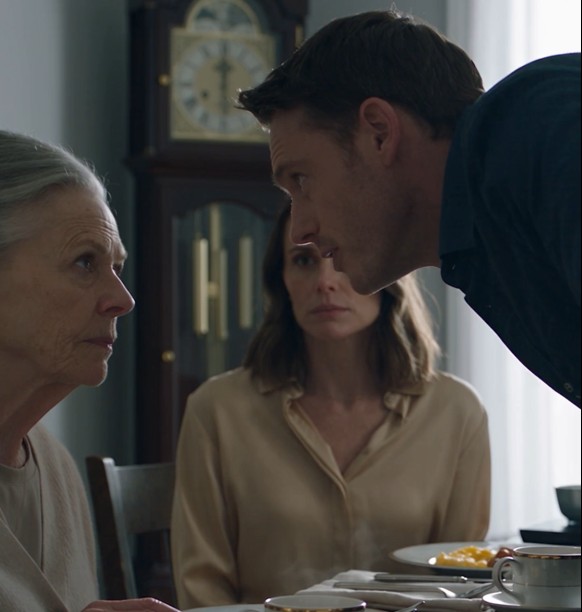
“Don’t.”
“Tell her about the letter.”
Anika ended the meeting before anyone could bargain over what came next. She kept the photocopy with the solicitors’ agreement and called Detective Saye. Eleanor remained seated while chairs scraped and voices lowered. Julian tried to approach her, but Ruth stood.
“Give her room.”
This time, he obeyed immediately.
The police found the original in a file at Julian and Mara’s house under a search warrant obtained as the financial investigation developed. They also found Arthur’s actual letter, torn into six pieces and pushed into an envelope behind it.
He had written to a solicitor about suspected forgery.
He had named his son.
Two days later, Saye returned with news about the camera. The unit inside the clock sent copies to a storage drive in Arthur’s locked desk. Eleanor had assumed the small box was part of his printer. Mara had disabled the internet connection that morning, apparently believing that would stop all recording.
It had stopped remote viewing.
The local recording had continued.
Saye sat opposite Eleanor, both feet flat on the floor.
“You don’t have to watch it. We can explain what it shows.”
Eleanor looked at Ruth. Then at the pale rectangle on the wall where the clock had hung.
“Tell me first.”
Arthur had confronted Mara with the loan documents shortly after eleven. Julian arrived a few minutes later. There was an argument. Arthur said he would report the forgery and tell Eleanor everything when she returned.
Then he gripped the edge of the desk.
Saye paused.
“He asked them to call an ambulance.”
Eleanor’s hand stopped moving over her wedding ring.
“Did they?”
“Not immediately.”
“How long?”
“Eighteen minutes.”
Ruth made a small sound beside her.
Saye continued carefully. Arthur had remained conscious for part of that time. Mara searched his desk while Julian stood by the doorway. When Julian reached for his phone, Mara told him an ambulance would bring questions. They needed the paperwork first.
Julian put the phone away.
Eventually he left through the kitchen. Mara called emergency services afterward and said she had just arrived.
Eleanor stared at the detective’s pen. It had a cracked clip. She would remember that absurd detail for years.
“He knew they were there.”
“Yes.”
“He knew they weren’t helping.”
Saye did not soften the answer with something she could not know.
“Yes.”
The silence afterward had weight. Eleanor felt it against her chest, against the chair, against the walls Arthur had painted pale yellow because she hated dark winters. She had imagined him slipping away quietly. Now she had to make room for a truth she could barely bear to touch.
“I want to see the part before he became ill,” she said at last. “Not the rest. Not today.”
They arranged it at the station.
On the screen, Arthur entered carrying the cream Eleanor had needed. He set it beside the clock. His cardigan hung crookedly, one cuff folded back. Alive, he looked less solemn than memory had made him.
He held up the forged loan papers.
“You will not put this on her,” he told Mara. “She built that shop. Every early morning. Every bill paid when there wasn’t enough.”
Julian appeared at the edge of the picture.
“Dad, be reasonable.”
Arthur turned.
“I’m trying to give you the chance to be.”
Eleanor asked them to stop there.
She went into the corridor and bent forward, palms against the cool wall. Ruth stood beside her until she could breathe.
“He wasn’t ashamed of me,” Eleanor said.
“Never.”
The fraudulent letter had wounded something the assault had not reached. Hearing Arthur’s voice restored it, though the restoration hurt.
The arrests followed. Searches recovered messages about the false signature, drafts of the fabricated letter, and instructions to erase records. The camera gave those documents their terrible context. Mara’s certainty at the breakfast table had come from watching a phone screen go black; she had never checked what Arthur’s equipment continued to store.
For months, Eleanor’s days acquired unfamiliar landmarks: witness statements, medical reports, meetings with Anika. The bakery opened shorter hours. Some mornings she kneaded dough with such force that Ruth gently took it from her and gave her something else to do.
Expert evidence established that the delay had deprived Arthur of urgently needed treatment and materially contributed to his death. Both Julian and Mara were charged over their failure to seek help, as well as the fraud. Julian also faced the assault charge.
Mara initially blamed him for everything. His access to the documents. His inheritance. His hand striking Eleanor.
The messages answered her.
So did her voice on the recording.
Julian eventually pleaded guilty and gave a full account. It did not absolve him. The prosecutor made that clear, and Eleanor was grateful. She could not endure having his late honesty turned into innocence.
Mara’s trial ended with convictions for manslaughter and fraud. Julian was sentenced for his own part in Arthur’s death, the financial crimes, and the assault. Both received substantial prison terms. Orders prevented contact with Eleanor, and the court directed repayment from their remaining assets.
There was no bakery left for them to inherit. Eleanor had changed her will.
When the verdicts were read, Mara looked toward her once, apparently searching for the woman who could be frightened into silence.
Eleanor held her gaze until Mara looked away.
