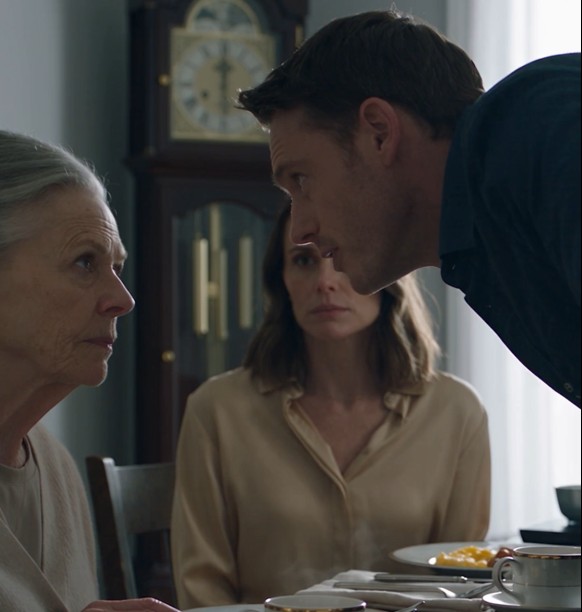
A detective came that afternoon, after a doctor had examined her bruised cheek and shoulder. Detective Saye spoke without rushing, leaving room for Eleanor to answer. Arthur had died seven months earlier. A heart attack, the certificate said. He had been sixty-eight, with a drawer full of tablets and an infuriating habit of calling every symptom indigestion.
Eleanor had been at the bakery when Mara telephoned.
“She said she’d found him,” Eleanor told the detective. “She said there was nothing anyone could have done.”
Saye wrote that down.
“And the camera?”
“Arthur installed it after money went missing from his desk. He showed me how to watch it on the little tablet. I never wanted to.”
She looked toward the clock, now silent because an officer had unplugged it for examination.
“Last night was the first time I was grateful he’d put it there.”
The detective explained that old footage might no longer exist. The system needed examination; there might be stored copies elsewhere. Eleanor nodded, ashamed of how badly she wanted certainty, even if certainty meant losing Arthur a second time.
Before leaving, Saye asked about the papers Julian had wanted signed.
They lay beneath a bread catalogue on the sideboard. Eleanor had not read beyond the words transfer of ownership. Saye photographed them and asked permission to take them.
That evening, Ruth from the bakery arrived carrying soup, a spare nightdress, and the shop’s cashbook.
“I’ve locked up,” she said. “The ovens are off. Nobody died because we ran out of custard slices.”
Eleanor almost smiled.
Ruth had worked beside her for twenty-three years. She set the soup down, saw the bruising clearly, and pressed her lips together. She did not demand an explanation. She found clean towels, turned on the hallway light, and stayed.
At two in the morning, Eleanor woke shouting Arthur’s name.
Ruth came to the doorway but did not cross it until Eleanor beckoned. They sat on the bed with their feet on the cold floor.
“I sent him out for cream that morning,” Eleanor said. “He came back here instead of bringing it to the shop. I was cross. That was our last conversation.”
“What did you say?”
“That I couldn’t do everything.”
Ruth held her hand.
“You couldn’t.”
For the first time since the funeral, Eleanor wept without apologizing for the noise.
Three days later, Julian called through his solicitor, requesting a meeting permitted under his bail conditions if lawyers were present. He said it concerned the bakery. Eleanor’s own solicitor, a blunt woman named Anika Bell, advised that anything necessary could be put in writing.
Then Anika received the lender’s letter.
A loan had been secured against the bakery premises with a signature that looked like Eleanor’s. Payments were overdue. The amount made her sit down.
“I never borrowed that.”
“I believe you,” Anika said. “But we need to challenge it properly.”
Eleanor agreed to the meeting. She wanted Julian to look at her when she asked.
They sat across a polished conference table on Friday. Mara accompanied Julian with her own solicitor. Eleanor had brought Ruth, who placed a glass of water beside her and moved her chair close enough for their sleeves to touch.
Julian looked exhausted. Mara looked prepared.
“The transfer would have simplified things,” she said. “We were trying to keep this in the family.”
“You borrowed against my building,” Eleanor said.
Julian studied the table.
“We were going to pay it back.”
“What with?”
“The development deal.”
Eleanor looked at Anika. This was the first she had heard of any development.
Mara opened a folder. A property company wanted the entire corner, including the bakery. The loan had funded an investment that failed. A sale would clear the debt and leave money over. Julian and Mara had promised a building they did not own, then tried to make their promise true.
Anika stopped the discussion.
“My client will not be signing anything. The alleged security is being disputed as fraudulent.”
Julian raised his head.
“Mum, if you tell them you agreed to the loan, we can fix it.”
There it was: the choice he had brought her here to make. Her home and livelihood, or his escape. His eyes filled with the same pleading expression he had worn outside a headmaster’s office decades before.
Then Mara put a photocopied letter on the table.
“Arthur understood that she wasn’t managing. He wrote it down.”
Eleanor recognized her husband’s signature beneath a paragraph describing her as confused, forgetful, incapable of handling financial decisions.
The room seemed to move away from her.
“He wouldn’t.”
Mara’s solicitor reached for the page, frowning.
“This was not in the material you provided me.”
“It explains the situation,” Mara said.
Eleanor read it again. Arthur, who had asked her to check every supplier’s invoice because he trusted her figures more than his own. Arthur, supposedly preparing to strip her of control while smiling across their breakfast table.
Her grief turned briefly, terribly, against him.
Then she saw the date.
“That was written the day he died.”
Mara said nothing.
Anika asked for the original. Mara said it was at home. Julian closed his eyes.
“Tell her,” he whispered.
His wife turned toward him.
