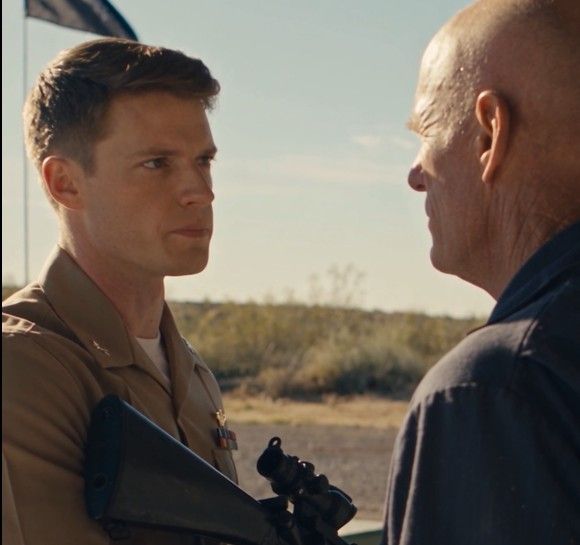
“What was your record?”
Daniel sighed.
“You were doing well until that question.”
Before the review, Jensen asked Daniel why he was wearing a contractor badge at all.
He gave her the answer he had been giving everyone: because that was his contract.
The fuller answer was more personal.
After retirement, Daniel had tried staying completely away from ranges. For nearly a year he succeeded. Then a former student called about a target system that kept failing in ways the maintenance team could not reproduce. Daniel drove out for one day, found that he enjoyed solving the problem more than he missed carrying a rifle, and began taking occasional technical contracts.
The work suited him.
Machines did not care about reputation. A worn spring remained worn whether the person inspecting it had thirty years of experience or three. A loose connection did not become correct because a senior person insisted it was fine. The evidence either supported the conclusion or it did not.
Daniel liked that honesty.
He also liked working beside civilian technicians who had no interest in old war stories. They asked whether he could repair a target actuator, not whether he had once held a record. When he got something wrong, they told him.
“Best professional development I ever had,” he told Jensen.
She laughed. “You were impossible before retirement too.”
“Exactly.”
The contractor rotation at Logan’s range had another purpose. The motorized rail system was nearing replacement, and Daniel had been asked to document failure patterns from the maintenance side because he understood both how the mechanism behaved and how shooters interpreted it. He had spent nine mornings watching the system cycle before dawn, listening for changes in the motor and checking parts after training.
That was why the rifle bench caught his attention too. Precision problems rarely came from one dramatic cause. Small shifts accumulated. Equipment changed. Weather changed. People changed. The dangerous moment came when someone became so invested in one explanation that they stopped checking the others.
Daniel had watched Logan move in that direction all morning.
After the optic issue was documented, he asked the safety officer to inspect two other rifles from the same rack. They were fine. The problem was isolated, which meant the maintenance process worked exactly as it should once someone listened.
The supply specialist who had approved Daniel’s rotation approached him during lunch. Her name was Petty Officer Nina Chen. She looked furious.
“He told me to find somebody qualified.”
Daniel nodded. “I heard.”
“I wanted to tell him who you were.”
“Why didn’t you?”
“Because Chief Miller told us not to treat you differently.”
Daniel smiled. “Good order.”
Nina did not smile back. “It did not feel good while he was throwing your things in mud.”
Daniel’s expression softened.
“No. But now you know something useful about the range. Not the equipment. The people.”
She looked toward Logan, who was speaking with the senior range officer.
“What am I supposed to do with that?”
“Next time somebody dismisses your qualification because your title is inconvenient, document it and use the process. And if the issue affects safety, speak clearly even if the person is angry.”
Nina nodded.
“You make that sound simple.”
“It is simple. It is not always easy.”
That afternoon, before formal interviews began, Nina submitted her own statement. She described the maintenance assignment, Logan’s demand for a different worker, and the way he had treated qualification as something he could define after seeing a person’s badge.
Her statement mattered because it shifted the review away from Daniel’s hidden history. Even if Daniel had never served a day in uniform, Nina wrote, he was the qualified maintenance person assigned to the equipment. Logan had been given that answer and rejected it because it conflicted with what he thought maintenance support should look like.
Daniel read the statement only months later, with Nina’s permission.
That paragraph became his favorite part of the entire incident.
It meant someone had learned the right lesson without needing to know who he used to be.
The command review started that afternoon.
The problem was not that Logan had missed.
Nobody disciplined a precision instructor for missing a difficult target.
The issue was how he responded to being watched while missing.
Witnesses described him humiliating Daniel, throwing the cleaning cloth into mud, dismissing a qualified supply specialist, snapping at Caleb for giving a wind observation, and attempting to continue firing after a maintenance warning until another instructor intervened.
The range camera supported the accounts.
Then previous trainees spoke.
Several described Logan treating questions as challenges to his expertise. One said he had stopped offering observations because Logan reacted badly whenever a junior person’s correction proved useful. Another recalled a safety pause being mocked as hesitation until a different instructor supported it.
Logan had strong technical scores.
He also had a leadership problem that technical scores had been hiding.
He was removed as lead demonstrator and suspended from independent instructor duties pending retraining. His championship status remained on the performance board because the scores were legitimate. His instructor authority did not.
