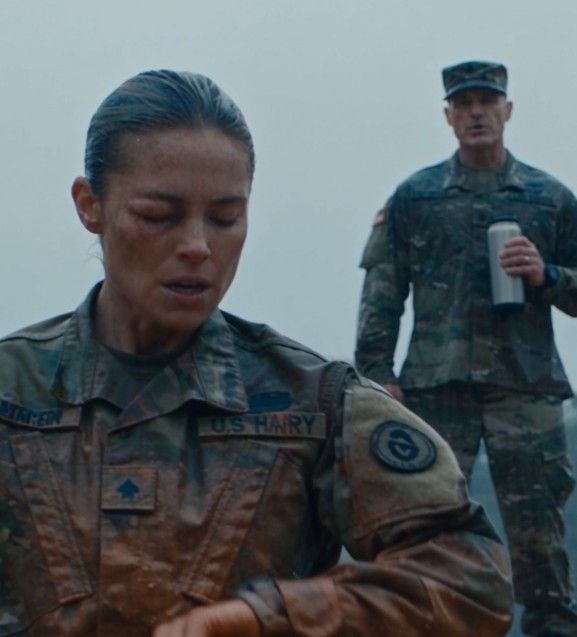
The medics confirmed the fracture that afternoon.
Small, but real.
My course status changed before sunset.
Medical removal.
Selection incomplete.
I stared at those words on the form until they blurred for reasons that had nothing to do with my eye.
Fourteen days of mud, sleep deprivation, stress drills, timed runs, judgment exercises, and humiliation reduced to two words that felt like failure.
Medical removal.
Vance signed the form.
I watched him do it.
His hand shook once.
“You happy?” I asked.
He put the pen down.
“No.”
“You spent two weeks trying to make me quit.”
“I spent two weeks trying to find out whether you would make bad decisions because you wanted this too much.”
I laughed bitterly.
“Congratulations.”
He took that without flinching.
“Yes,” he said. “Congratulations to me.”
That was not the answer I expected.
He sat across from me.
“I crossed lines with you.”
I looked up.
“Which ones? There were a few.”
His mouth tightened.
“The comments about you occupying a man’s position. The mommy garbage. None of that was instruction. It was me deciding humiliation was useful because I survived it when I was a candidate.”
“You think?”
“I know.”
He rubbed both hands over his face.
“And then today I was on my knees with a shotgun against my head, hoping the candidate I’d spent two weeks calling weak was somewhere in the trees.”
I said nothing.
“You didn’t hesitate.”
Seattle pressed against my ribs.
“I did before.”
“Not today.”
“That doesn’t erase before.”
“No. It doesn’t.”
For the first time, I understood that Vance was not offering me the cheap gift I had secretly wanted: a declaration that Seattle no longer mattered because I had succeeded once.
He was refusing to lie to me.
That helped more.
The investigation into the escape and shooting kept me on site for three additional days. I gave statements. I walked investigators through what I saw from the ledge without turning it into a lesson in marksmanship. I described the silence in the forest, the two men, the shotgun against Vance’s head, the moment the image doubled in my injured eye, and the decision to fire when it cleared.
They asked whether the selection scenario influenced me.
“I knew Vance was unarmed,” I said. “That made the threat more obvious, not less.”
They asked whether I had been trying to prove something after Seattle.
That question hurt.
“I was trying to stop a man from being shot.”
It was the truest answer I had.
The shot was ruled within the circumstances of the emergency. The course, however, had a separate problem.
My concealed injury had violated medical reporting requirements.
