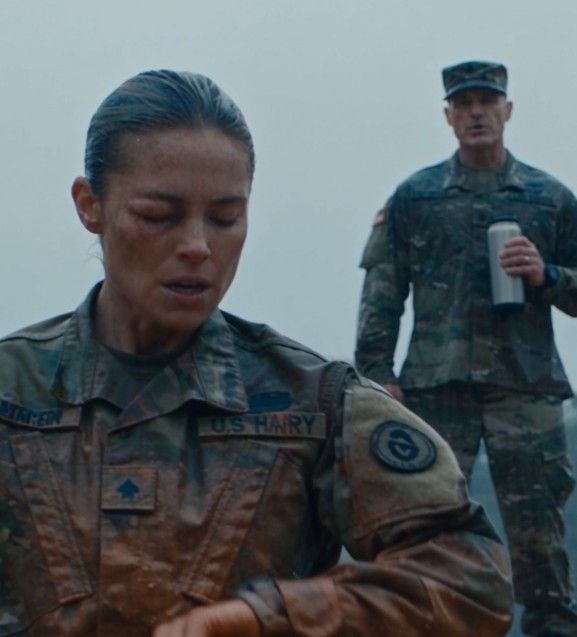
“Go home to mommy,” Senior Instructor Vance shouted.
Three hours later, his life depended on my trigger finger.
By Day 14 of the Federal Tactical Resolution Selection Course, fifty candidates had become six.
We called it The Grinder.
That morning, all six of us were crawling through freezing mud beneath rusted barbed wire while rain hammered our helmets.
The red Georgia clay swallowed everything it touched.
I dragged myself forward on bleeding elbows.
Above me, Vance paced along a wooden catwalk in spotless boots, drinking coffee from a thermos.
“You’re moving like a wounded turtle, candidate!”
I kept crawling.
“You think the cartel waits because you’re tired?”
Another inch.
“Go home to mommy, little girl. You’re occupying a man’s position.”
My left thumb found the battered Hamilton watch strapped inside my wrist.
Tap.
Tap.
Tap.
My father’s watch.
Broken for ten years.
I had never taken it off.
Control the small things.
That was how I survived.
Vance thought my silence meant toughness.
It didn’t.
Two years earlier, inside a Seattle bank, I had watched a hostage-taker through my rifle scope.
The shot had been there.
Clean.
Possible.
And I hesitated.
Half a second.
Long enough for the suspect to move.
Long enough for everything afterward to become something I still woke up screaming about.
Selection was supposed to prove that hesitation was gone.
Instead, every crack of thunder brought Seattle back.
And I was hiding something else.
Three days earlier, an elbow during combat training had smashed into my right cheekbone.
Every blink sent white-hot pain through my face.
My shooting eye blurred at the edges.
I was almost certain the orbital bone was fractured.
If medical found out, my course ended immediately.
So I lied.
Memorized the vision chart.
Hid ibuprofen in my duffel.
Adjusted my shooting position.
Vance knew something was wrong.
He just didn’t know what.
“You’re weak!” he shouted as I reached the final stretch. “You’re going to get somebody killed!”
I tasted blood where my teeth cut my cheek.
Tap.
Tap.
