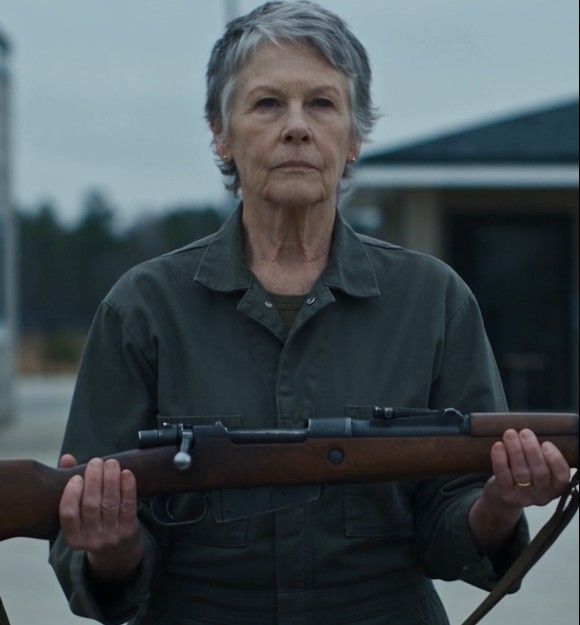
He was removed from lead-instructor duties and assigned to a period of supervised retraining. His performance record reflected the loss of trust. For six months, he was not allowed to run independent live-fire evolutions.
The consequence hit him harder than any public reprimand could have.
He had built his identity around being the person who made the conditions difficult for everyone else.
Now someone else decided whether he was ready.
Evelyn returned home the next morning.
She lived three hours away in a small house with too many books, a garden she neglected, and one wall of photographs she rarely showed visitors. The wooden rifle case went back beneath her workbench.
For a week, she tried not to think about the range.
Then Lena Ortiz sent a letter.
It was handwritten.
Lena thanked her for the demonstration, but the shot received only one sentence. Most of the letter was about the lesson afterward. Lena admitted she had nearly withdrawn from the advanced course because she was tired of being treated as if questions were evidence of weakness. Watching Evelyn refuse humiliation without becoming cruel had changed something for her.
At the bottom she wrote: I thought confidence meant never letting anyone see doubt. You made it look more like knowing what deserves your attention.
Evelyn read the line twice.
Then she placed the letter in the rifle case.
Three months later, Mercer called.
“I have a strange request.”
“Those are usually your only kind.”
“Would you come back for a weekend seminar?”
“No wind machines.”
“I will personally unplug them.”
She returned in October.
Mason was there.
Evelyn almost turned around when she saw him helping set targets near the one-hundred-meter line. His rank had not changed. His posture had.
He noticed her and walked over.
“Mrs. Carter.”
“Captain.”
For a moment, the old tension came back.
Then Mason held out a small range notebook.
“I owe you an apology.”
Evelyn did not take the notebook.
“You owe more than one person an apology.”
“I know.”
That answer made her listen.
He told her supervised retraining had been worse than he expected because no one cared about his reputation. Every decision had to be explained. Every change had to be documented. He had been paired with an instructor ten years younger who asked him to justify procedures he used to issue as commands.
“Turns out I hated being questioned because I had stopped questioning myself.”
Evelyn looked toward the target line.
“That can happen quietly.”
Mason nodded.
“I was wrong about you before you opened the case.”
“Yes.”
“I was wrong after you made the shot too. I wanted the machine to be broken because the alternative was admitting I had built a test to prove something that was never true.”
“Yes.”
He almost smiled. “You do not make apologies easy.”
“They are not supposed to be performance events.”
This time he did smile.
He handed her the notebook.
Inside were written apologies to the range operator and two trainees he had embarrassed during prior sessions. Evelyn closed it.
“Why show me?”
“Because I wanted you to know the consequence did not stop at losing the range.”
She gave it back.
“Good. Keep going.”
