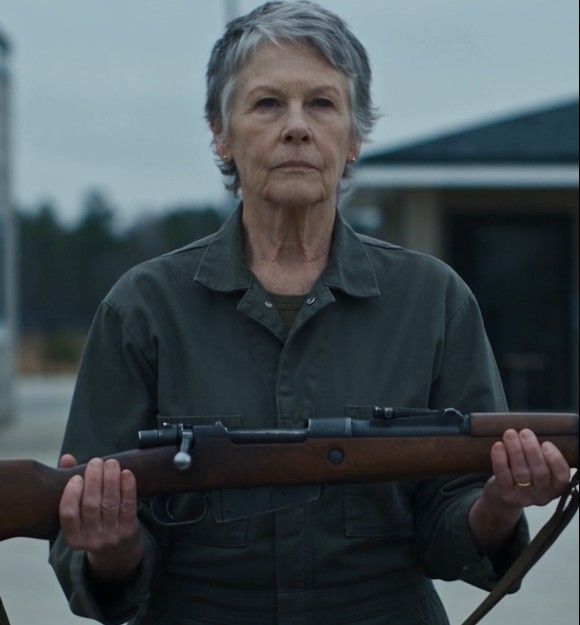
Evelyn lifted her case.
A trainee immediately offered to carry it.
She smiled. “I brought it. I can carry it.”
Then she looked at Mason.
“But you can open the gate.”
For a second, nobody knew whether she was serious.
Mason opened the gate.
The planned demonstration continued after lunch.
This time Evelyn did not shoot.
She stood beside the trainees with a chalkboard and asked them to tell her what they had seen before the shot. Most spoke about the flags. One mentioned the dust. Another noticed the target timing. A quiet trainee named Lena Ortiz described the heat shimmer and the way the far grass moved differently from the nearest flag.
Evelyn nodded.
“That is why the closest answer is not always the correct one.”
She drew a simple line across the board.
“Wind is not one condition. It is a series of conditions between you and the target. People are like that too. You can make a bad decision very quickly if you judge them by the piece nearest you.”
Several trainees glanced toward Mason’s empty position.
Evelyn did not.
She had no interest in turning a lesson about judgment into public revenge.
At the end of the session, Lena asked about the rifle.
“How old is it?”
Evelyn ran her hand along the wooden case.
“Older than some of your instructors.”
“Was it yours when you competed?”
Evelyn paused.
“For part of it.”
That was all she offered.
The fuller story came later.
Commander Mercer invited her to his office after the trainees left. The range director, safety officer, and Mason were already there. The control logs were printed on the table.
Mercer began with procedure.
Mason had exceeded the planned wind setting without documenting the change. He had ordered a moving-target sequence outside the demonstration brief. He had opened Evelyn’s private rifle case without permission and handled the weapon before confirming its status with the invited owner. None of those actions had caused injury. That did not make them good judgment.
Mason defended each decision separately.
The wind increase was within machine limits. The target system was designed for movement. The rifle had been visibly cased. Evelyn had accepted the challenge.
Evelyn listened until he finished.
Then she asked one question.
“Why did you need me to fail?”
Mason looked at her.
“I did not.”
“Then why did you make the test harder after I agreed to it?”
“Because this is an elite facility.”
“That is not an answer.”
Mercer stayed silent.
Mason’s shoulders tightened.
“People walk in here expecting exceptions. Visitors. Civilians. People who want to stand beside operators because they know somebody or used to do something impressive. I protect the standard.”
Evelyn looked at him for a long moment.
“No. You protected your ownership of the standard. Those are different things.”
He started to respond.
She raised one hand.
“A standard is clear before the test begins. You changed the test because you had already decided what I was. When the result contradicted you, you blamed the equipment. That is not rigor. It is vanity wearing a uniform.”
Mason stopped talking.
The review that followed did not end his career, but it ended his control of that range.
Other instructors described a pattern. Mason adjusted training conditions without documenting changes. He used public embarrassment to correct mistakes that should have been handled privately. He treated questions about safety margins as challenges to his authority. None of it had looked catastrophic from one day to the next. Together, it showed a leader whose judgment became less reliable whenever his pride was involved.
