“I believe you are sorry.”
“Can you forgive me?”
“Eventually, maybe. But forgiveness will not change the notice.”
He nodded once.
That was the first consequence he accepted without asking me to soften it.
Melanie accepted nothing.
She hired her own attorney and argued about dates, belongings, and whether money she had spent decorating the house gave her any claim to remain. My attorney handled the communication. I refused to be pulled into late-night fights by text.
The designer sectional never arrived.
The deposit was lost because Melanie would not pay the balance and the store enforced its cancellation terms. For weeks she blamed me for that money as if I had placed the order after being told no.
The irony was almost too perfect.
Eventually, the deadline arrived. Travis and Melanie moved into a smaller apartment twenty-five minutes away. They could not afford the neighborhood or space they had become accustomed to while living under my roof with nearly every major expense covered.
They sold the SUV I had helped finance and kept one car between them for a while. They canceled the landscaper, the subscriptions, the delivery memberships, and the lifestyle they had mistaken for their own income.
I did not enjoy watching it.
But I did not stop it.
The day they moved out, I returned to the house with my attorney’s confirmation that the occupancy had ended and a locksmith scheduled for that afternoon.
The kitchen looked larger than I remembered.
Melanie had taken the cream throw pillows she bought, the expensive coffee machine she considered hers, and the framed prints from the guest-room office. She had left the old dining chairs she once called dated.
Before I unpacked a single bag, I walked through every room with a legal pad. It was an old business habit: when something felt overwhelming, inventory it. The guest room Melanie had used as an office was empty except for dents in the carpet. My bedroom was untouched. In the garage, boxes had been moved but nothing important was missing.
The damage was mostly not physical.
For weeks, I would hear a floorboard creak and expect Melanie to appear with another purchase she had already decided I should fund. I would open the refrigerator and feel guilty for eating something expensive, then remember every shelf belonged to a kitchen I paid for. I had to retrain myself inside my own home.
I also did a complete financial review.
Not because I suspected Travis had stolen from me. The truth was more uncomfortable: I had voluntarily made access too easy. I had added him to accounts for convenience, saved cards in apps he and Melanie used, and let recurring transfers continue long after the original emergencies ended. I had confused openness with trust and trust with the absence of boundaries.
With help from my bank, I replaced cards, updated passwords, turned on transaction alerts, and removed every authorization I no longer needed. I created a separate household card for my own recurring bills and stopped storing payment information in delivery accounts shared with anyone else.
The bank employee who helped me never once asked why I had allowed so much access. She simply asked what I wanted the accounts to look like now.
That question became a kind of refrain in my recovery.
What do you want now?
I wanted my mornings back.
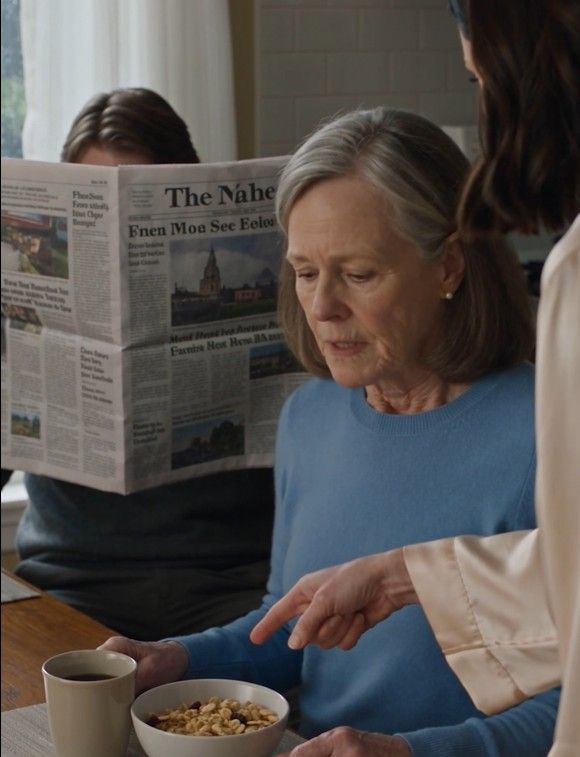
So I moved the newspaper basket away from the chair where Travis had hidden behind the headlines. I donated the silk-cushioned dining chairs Melanie had persuaded me to buy and found a sturdy wooden set at a local shop. I changed the curtains in the guest room, not because hers were ugly, but because choosing them myself felt important.
I even bought granola.
The same brand that had started the final argument.
The first morning I poured it into a bowl, I stood in the kitchen laughing at how absurdly symbolic breakfast had become. I ate by the window while the rain came down and no one told me whose food I was allowed to touch.
There was loneliness too. I will not pretend boundaries made everything immediately peaceful. The house had been noisy for two years, and after Travis and Melanie left, silence arrived in every room at once. Some evenings I missed hearing another person upstairs so much that I nearly called my son and invited him back.
Instead, I called him to talk.
We learned that connection did not require cohabitation and love did not require financial dependence. He came for coffee sometimes and left after an hour. I visited his apartment and did not bring a check. Each ordinary visit taught us both that a relationship could survive without one person subsidizing the other.
On the counter sat one thing I did not expect.
The black notebook.
I had carried it with me, so I stared at it in confusion until I realized this was a different notebook: new, black, almost identical in size.
Inside the cover, Travis had written a note.
Mom, I can’t undo what you spent. I can stop asking you to spend more. I’m starting my own record now.
Below that, he had written the first entry: Moving expenses — paid by us.
I sat down at the kitchen table and cried.
Not because the gesture erased two years. It did not.
Because for the first time, my son seemed to understand that adulthood was not measured by whether someone could rescue you. It was measured by what you learned to carry yourself.
His marriage to Melanie deteriorated quickly after they moved.
Without my house and money absorbing their arguments, the disagreements they had avoided became impossible to disguise. Travis began refusing purchases they could not afford. Melanie accused him of becoming cheap and weak. He accused her of treating every limit as an insult.
I stayed out of it.
When they separated eight months later, I did not offer Travis my spare bedroom.
That was hard.
He rented a studio apartment near his job.
That was necessary.
