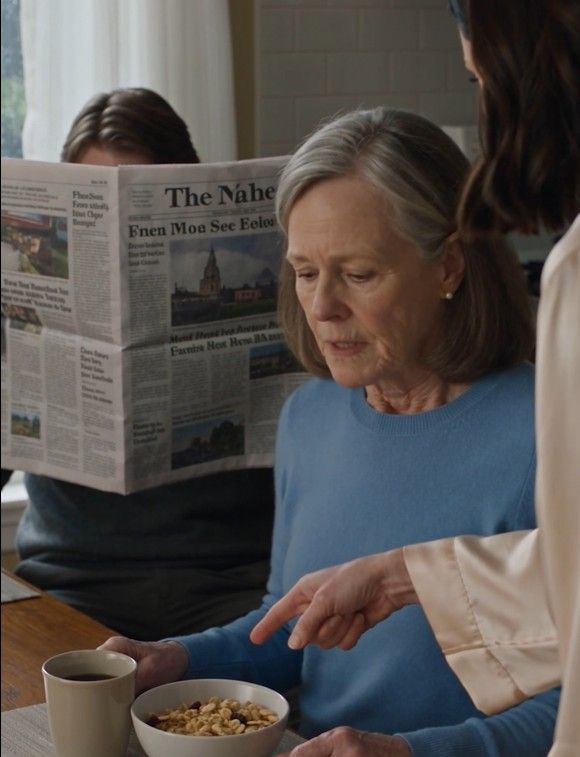
“Get out, Ruth. I’m done supporting someone who behaves like trash.” My daughter-in-law pointed toward the front door of the Seattle house I had owned for more than thirty years as though she were evicting an unwanted tenant. I was sixty-eight, sitting at my own kitchen table with coffee and granola while rain tapped softly against the windows, and the worst part was not Melanie’s voice. It was my son Travis sitting six feet away behind his newspaper, saying nothing. The argument had started over breakfast. Melanie walked into the kitchen in silk pajamas, saw the granola beside my bowl, and snapped, “That was mine.” I reminded her that the groceries had been charged to my credit card, just like almost every grocery order for the previous two years. She laughed. “You think your little Social Security check makes you important?” I looked at Travis. He knew exactly who paid the bills. He kept reading. Melanie folded her arms and said I lived there, ate their food, used their electricity, and contributed almost nothing. Their food. Their electricity. Inside my house. Two years earlier, Travis had called me admitting that he and Melanie were struggling with credit cards, expensive rent, a bad investment, and bills they could no longer manage. He asked to stay for a few months. After my husband Henry died, four bedrooms sat mostly empty, and Travis was my only child. I opened the door without hesitation. Months became two years. Melanie turned a guest room into her office, replaced curtains, rearranged furniture, changed dining chairs, hired a more expensive landscaper, and persuaded me to replace appliances that still worked. I paid property taxes, insurance, electricity, water, heat, internet, groceries, cleaning, landscaping, repairs, subscriptions, and every emergency that somehow became mine. I kept telling myself family mattered more than money. That morning, Melanie wanted something larger: an eleven-thousand-dollar cream designer sectional she had ordered after I explicitly told her I did not want it. She expected me to pay the remaining balance because, according to her, I could afford it. “No,” I said. Her expression hardened. “You always make everything about your money.” “It is my money.” She leaned closer and called me dead weight. Then she suggested that if I could not follow their rules, perhaps they should start looking into retirement facilities, even state-run places for older people who could no longer manage independently. I handled my own finances, drove, traveled alone, volunteered, and managed every part of my life. Travis knew that. “Did you hear what she just said?” I asked him. Finally, he lowered the newspaper. For one second, I thought he would defend me. “Mom, Melanie’s upset.” “She threatened to put me in a facility.” “She didn’t mean it that way.” Melanie immediately said, “I absolutely did.” Travis rubbed his forehead. “Mom, maybe you could help us this one time.” One time. I thought about the tuition, wedding money, honeymoon help, SUV down payment, medical bills, failed business idea, tax emergency, credit cards, and every call that began with, “Mom, I hate asking.” I had documented every amount in a worn black notebook because thirty years of running a business had taught me to record numbers. The total was well over half a million dollars, not including two years of supporting them in my home. “No,” I said again. Melanie pointed toward the door. “Fine. Then get out.” When I stayed seated, she stepped closer and repeated it, calling me trash and saying she was tired of supporting me. I looked at Travis one last time. He lowered his eyes. That was when I understood he was not trapped between us. He had simply decided making me surrender was easier than confronting his wife. I stood, picked up my purse, walked through the house I had paid for, and opened my front door. Cold Seattle rain touched my face. Behind me, Melanie laughed and said maybe fresh air would teach me to appreciate how good I had it. I waited outside for the sound of Travis following me. It never came. Five minutes later, I sat inside my old silver Lexus with rain sliding down the windshield and the black notebook open in my lap. For the first time, it did not look like a record of everything I had given my son. It looked like a record of everything he had learned to expect. Then I opened my banking app. 👇
I stared at the glowing screen while rain drummed on the roof of the Lexus.
For years, opening my banking app had meant checking whether a bill had cleared, whether Travis needed another transfer, whether some charge Melanie had promised to explain was larger than expected. That morning, I opened it for a different reason.
I started with the credit card Melanie used for groceries.
She was an authorized user. I removed her.
Then I moved to the household account I had created to make recurring expenses easier to manage. I changed the password, removed Travis’s access, and turned off the automatic transfer that had been sending money every month into the account he used for personal expenses.
My finger hovered over the confirmation button for several seconds.
Then I pressed it.
I did not empty anyone’s bank account. I did not take money that belonged to them. I simply stopped sending mine.
The difference felt enormous.
The next call I made was to the furniture store.
The eleven-thousand-dollar sectional had been ordered with a deposit Melanie had placed on her own card. The balance was due before delivery. I told the store, calmly, that I would not be providing payment for any portion of the order and that no one had permission to charge my cards.
The woman on the phone thanked me for clarifying.
That was all.
No argument. No accusation. No one called me dead weight.
I sat in the car for another ten minutes before driving to a hotel downtown. I could have marched back into my own house, but I was too angry to trust myself not to say something I would regret. I needed one night where no one could make my coffee, groceries, furniture, or grief into evidence against me.
By noon, my phone started ringing.
Melanie called first.
Then Travis.
Then Melanie again.
I did not answer until my son left a voicemail saying there was a problem with the credit card and he needed me to call immediately.
Needed.
The word had become so familiar that I almost missed how strange it sounded after he had watched his wife order me out of the home I owned.
I waited until three in the afternoon before calling him back.
“What did you do?” he asked.
“Which part?”
“The cards. The account. Melanie’s grocery order was declined.”
“Yes.”
“Why?”
I looked at the black notebook on the hotel desk.
“Because this morning your wife told me she was done supporting me. I decided to relieve both of you of that burden.”
He went quiet.
“Mom, come on.”
“No, Travis. You had your chance to say come on when she told me to get out.”
“She was angry.”
“And you were silent.”
“I didn’t know what to say.”
“That has been your answer for two years.”
He exhaled hard. “So you’re cutting us off?”
There it was.
Not Are you safe? Not Where are you? Not I’m sorry you sat in the rain alone.
“So far,” I said, “I have stopped paying your personal expenses and removed access to my credit. I am also going to speak with an attorney about the correct way to end your living arrangement in my house.”
His voice sharpened. “You’re kicking us out over an argument?”
“No. I’m ending two years of being treated like a wallet in my own home. This morning simply made it impossible to pretend otherwise.”
He tried to interrupt.
I spoke over him for the first time in my life.
“Do not order anything in my name. Do not use my accounts. Do not move, sell, or throw away anything that belongs to me. I will contact you after I get legal advice.”
Then I ended the call.
My hands shook afterward, but not from fear.
They shook from the unfamiliar weight of a boundary I intended to keep.
